Mums
Chrysanthemum x morifolium
Autumn mum / garden mum
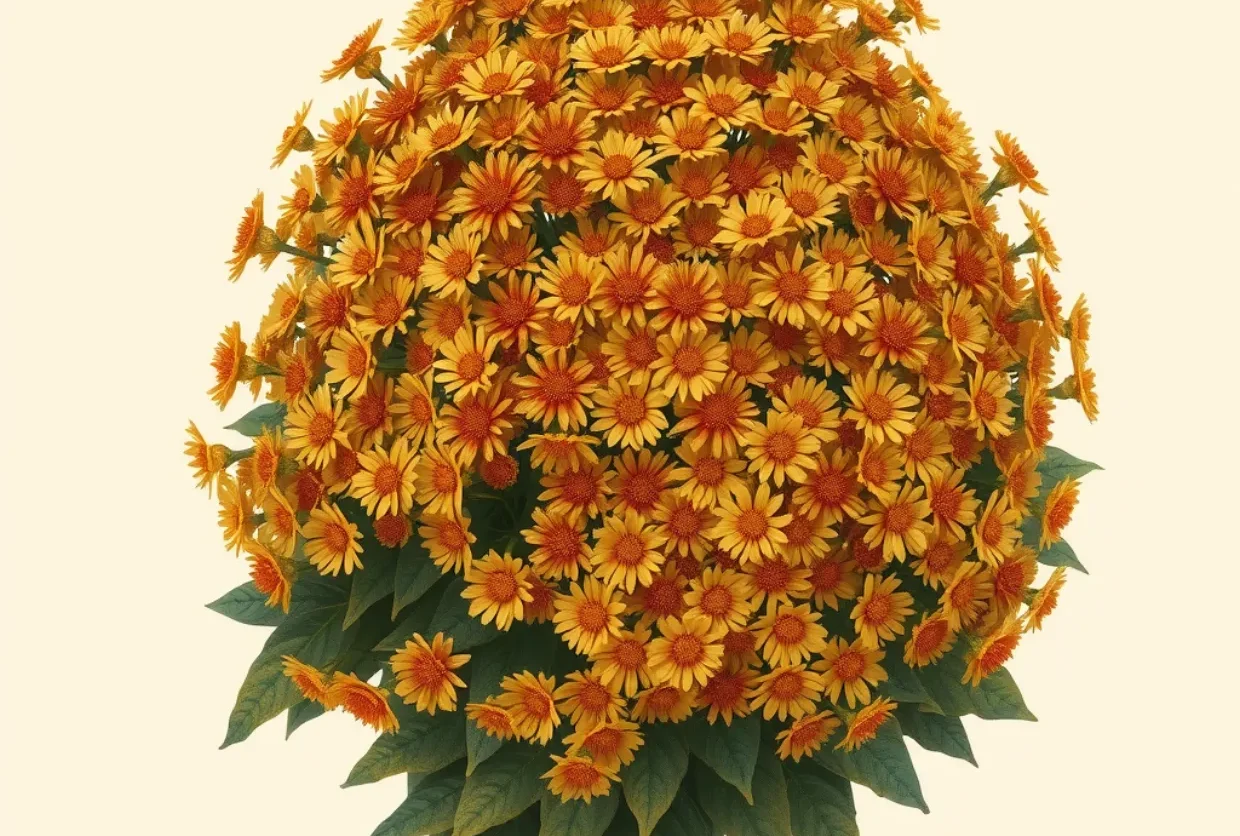
A hardy perennial that almost everyone kills, for one reason: it was planted in autumn in full flower instead of in spring as a small plant.
The record
Every plant in the database answers the same questions in the same order, so two entries can be read line for line. 16 of 17 fields sourced.
- Light
- Full sun
- Light detail
- 6 hours or more; sprawls in partial shade
- Water
- Moderate
- Water detail
- Steady moisture, well drained
- Soil
- High in organic matter, moist, well drained
- Soil pH
- 6.0 to 8.0
- Mature size
- 1 to 3 ft tall, 1 to 2 ft wide
- Toxicity
- NC State rates chrysanthemum low severity poison and a problem for cats, dogs and horses: stomach upset and vomiting if eaten, and contact with foliage can cause mild rashes in sensitive people.
- Lifecycle
- Perennial
- Difficulty
- Easy
- Hardiness zones
- 5 to 9
- Bloom time
- Autumn
- Flower color
- Gold, bronze, orange, purple, red or white
- Pollinators
- Butterflies and late season pollinators
- Deer resistant
- not recorded
- Spacing
- 12 in to 3 ft apart
- Native range
- Asia, a hybrid of five Chinese species
Hardy in zones 5 to 9. Colder than zone 5, grow it in a container and overwinter it under cover.
The last day to pinch. Pinch two or three times through spring and early summer, then stop. After that the buds are set and pinching removes the flowers.
The year
Plant or divide and prune, and when it is actually in flower. Everything else is leaving it alone.
Toxic to pets
NC State rates chrysanthemum low severity poison and a problem for cats, dogs and horses: stomach upset and vomiting if eaten, and contact with foliage can cause mild rashes in sensitive people.
Why your mums die every winter
Mums are sold in September in full flower, planted that weekend, and dead by March. This happens to almost everyone, and it is not bad luck or a bad plant.
Illinois Extension puts it plainly: mums planted in autumn are not as likely to survive the winter, because a plant bought in bud has put its energy into flowers rather than roots and has weeks rather than months to establish before the ground freezes. The pot of gold flowers on the porch step in October is a decorative object with a root system that has nowhere to go.
The same plant put in the ground in spring is a hardy perennial in zones 5a to 9b that comes back for years. It is the same species; the only difference is when it went in.
So there are two honest ways to buy mums, and it helps to decide which one you are doing. Buy them flowering in autumn and treat them as seasonal decoration, like a pumpkin. Or buy small plants in spring, plant them, pinch them through summer and have a perennial. Trying to get the first to behave like the second is the disappointment.
Types of mums, and which classes belong in a garden
The National Chrysanthemum Society sorts blooms into thirteen classes, which is more detail than a garden needs, but the distinction underneath them is worth having: some classes were bred for exhibition benches and some for beds, and buying the wrong one is why a spectacular plant sometimes falls apart in the first autumn storm.
| Class | What the flower looks like | Height | Where it belongs |
|---|---|---|---|
| Decorative | Flat, fully double heads of overlapping petals | 1 to 3 ft | The garden class. Most hardy cushion mums sold for beds are these |
| Pompon | Small, dense, near-perfect spheres | 1 to 2 ft | Beds, edging and containers. The sturdiest in weather |
| Single and semi-double | One to several rows of ray petals around an open daisy center | 1 to 3 ft | Gardens, and the only class that feeds pollinators properly |
| Anemone | A raised cushion of short florets sitting inside a ring of ray petals | 1 to 3 ft | Gardens and cutting, with more character at close range |
| Spoon | Ray petals ending in small flattened spoons | 1 to 3 ft | Cutting, and a good garden plant despite the exhibition look |
| Quill | Straight tubular petals radiating from the center | 2 to 3 ft | Cutting. Tall enough to need support in an exposed bed |
| Spider | Long curling tubular petals, often hooked at the tips | 2.5 to 3.5 ft | Exhibition and cutting. Easily wrecked by wind and rain in an open garden |
For a bed that has to survive weather without staking, stay in the first three rows: decorative, pompon and single. The spiders, quills and spoons are worth growing, but grow them where you can cut them, or where a wall takes the wind off.
Watering, which mums are unusually fussy about
Mums have shallow, fibrous roots and a lot of leaf, which is an awkward combination: they run out of water faster than most perennials and show it within hours. A wilted mum in a nursery pot in September has usually been dry more than once already, and that is worth knowing before you buy one.
- Water when the top inch is dry rather than on a schedule. In heat that can be daily for a plant in a pot and every two or three days for one in the ground.
- Water at the base, not over the top. Wet foliage on a dense mum in autumn is how the leaf spots and the botrytis get started.
- A plant that has wilted hard once flowers less, and one that wilts repeatedly drops its lower leaves and does not recover them that season.
- Mulch the crowns of garden mums. It steadies the moisture at exactly the depth the roots occupy, which does more than watering more often.
- Cut back sharply once the plant is dormant. A dormant mum sitting in wet winter soil is the second most common way they are lost, after simply being planted too late.
Site and soil
Full sun at six hours or more. NC State notes they tolerate partial shade but sprawl in it, which is the failure people describe as the plant falling open in the middle.
Soil wants to be high in organic matter, moist and well drained, at a neutral pH between 6.0 and 8.0. Root rot and stem rot are both on NC State’s problem list, so drainage carries the same weight as it does with any plant that is being asked to survive a wet winter.
The plant itself is compact: 1 to 3 feet tall and 1 to 2 feet wide, spaced 12 inches to 3 feet apart depending on variety.
Pinching, and the date that decides it
A mum left alone grows tall, flops and flowers thinly. Pinching is what produces the dome of flowers people buy the plant for, and it is the single most useful thing you do to it.
- Start when growth reaches about six inches
Pinch out the top inch of each shoot with your fingers. It branches into two, and each of those will branch again.
- Repeat every few weeks
Two or three pinches over spring and early summer. Each one doubles the number of stems and shortens the plant.
- Stop by early July
The rule of thumb is the fourth of July, which is easy to remember and about right. Iowa State gives mid-June to July 1 for early-flowering types and no later than July 15 for late ones.
- Then leave it alone
Buds are set after that. Pinching in August removes the flowers you were growing all summer for.
Getting them through winter
The instinct is to tidy the dead growth in November. Research says not to.
Garden mums survive better with the old growth left standing through winter, with a protective mulch applied over the plants in late autumn. The mulch is not there to keep the plant warm; it is there to keep the frozen soil uniformly frozen, because the freeze-and-thaw cycle heaves shallow-rooted plants out of the ground. That heaving, not the cold, is what actually kills them.
Cut the old stems back in spring once new growth shows at the base. The plant then wants dividing every few years in spring, which keeps it vigorous and gives you more plants than you need.
What goes wrong
NC State lists aphids, thrips, spider mites and lace bugs among the insects, and bacterial blight, powdery mildew, stem rot, rust, root rot, verticillium wilt and leaf spot among the diseases.
Most of this only shows up on plants that are crowded, dry at the root, or watered over the foliage. Spider mites in particular are a hot-and-dry problem, and a mum in a small pot on a sunny step is exactly the situation that produces them.
Verticillium wilt is the one worth taking seriously, because it lives in the soil and there is no cure. A plant that wilts on one side and does not recover with water comes out, and mums do not go back into that spot.
Toxicity, in plain terms
NC State rates chrysanthemum as low severity poison, listing it as a problem for cats, dogs and horses: stomach upset and vomiting if eaten, and contact with the foliage causing mild rashes in some sensitive people.
In practice this is a plant that makes an animal briefly unwell rather than one that puts it in danger, and gloves are enough for the dermatitis. Chrysanthemums are the natural source of pyrethrins, which is why the family has an insecticidal reputation, and the same chemistry is behind the mild reactions in people who handle them a lot.
Frequently asked questions
- What are the different types of mums?
- Thirteen classes officially, but for a garden the ones that matter are decorative, pompon and single, which stand up to weather. Spider, quill and spoon mums are bred for exhibition and cutting and are easily wrecked by wind and rain in an open bed.
- How often should I water mums?
- Whenever the top inch is dry, which in heat means daily for a potted plant and every two or three days in the ground. Mums have shallow roots and heavy foliage, so they run dry faster than most perennials, and a plant that wilts hard once flowers less for the rest of the season.
- Do mums like sun or shade?
- Full sun, six hours or more. In shade they stretch, flower thinly and lean, and the soft growth is more prone to mildew. Some afternoon shade is acceptable in the hottest states, but shade is not what makes them last longer.
- Why do my mums never come back?
- Because they went in during autumn. A mum bought in flower in September has spent its energy on blooms and has too little time to root before the ground freezes. The same plant put in in spring is a reliable perennial in zones 5 to 9.
- Should I cut them back before winter?
- No. Leave the old growth standing and mulch over the plant in late autumn. The mulch keeps frozen soil frozen, which stops the freeze-thaw heaving that pushes shallow roots out of the ground. Cut back in spring instead.
- When do I stop pinching?
- Early July. The fourth of July is the usual reminder; Iowa State gives mid-June to July 1 for early varieties and July 15 at the latest for late ones. Pinch after that and you remove the flower buds.
- Are florist mums and garden mums the same plant?
- They are the same species bred for different jobs. Florist types are grown for large flowers under glass and are not reliably hardy outdoors; garden mums are selected for hardiness and a compact habit. What is sold on a supermarket shelf in autumn is usually somewhere in between.
- Are mums poisonous to pets?
- Mildly. NC State rates them low severity for cats, dogs and horses, causing stomach upset and vomiting if eaten. The foliage can also cause a mild rash on people who react to it. Unpleasant rather than dangerous, but worth a call to a vet if an animal has eaten a lot.
Companion plants
How this entry is compiled
- Care values come from university extension publications and the USDA hardiness map, never from other gardening sites.
- Toxicity follows the ASPCA listing and is quoted rather than summarized.
- A value we cannot source is printed as not recorded, never estimated.
Compiled and checked by the Gardnicks editorial desk · last checked 2026-08-16
Sources for this entry
- NC State Extension Gardener Plant Toolbox, Chrysanthemum x morifolium
- Illinois Extension, Why do my mums always die?
- Iowa State Extension, Growing Chrysanthemums in Iowa
- Clemson HGIC, Chrysanthemums: How to Grow Garden Mums
Where two sources disagree, the entry follows the one closest to the plant’s own growing region and says so in the text.
What kills it
Three failures cover almost everything readers write in about.
More in Flowers
 Petunia
Full sun · zones not recorded
Petunia
Full sun · zones not recorded
 Dahlia
Full sun · zones 7 to 10
Dahlia
Full sun · zones 7 to 10
 Rose
Full sun · zones not recorded
Rose
Full sun · zones not recorded
 Moonflower
Full sun · zones 10 to 12
Moonflower
Full sun · zones 10 to 12
Plates are illustrations, not photographs of a specific plant, and are not evidence of a variety, place or season.