Petunia
Petunia x hybrida
Garden petunia
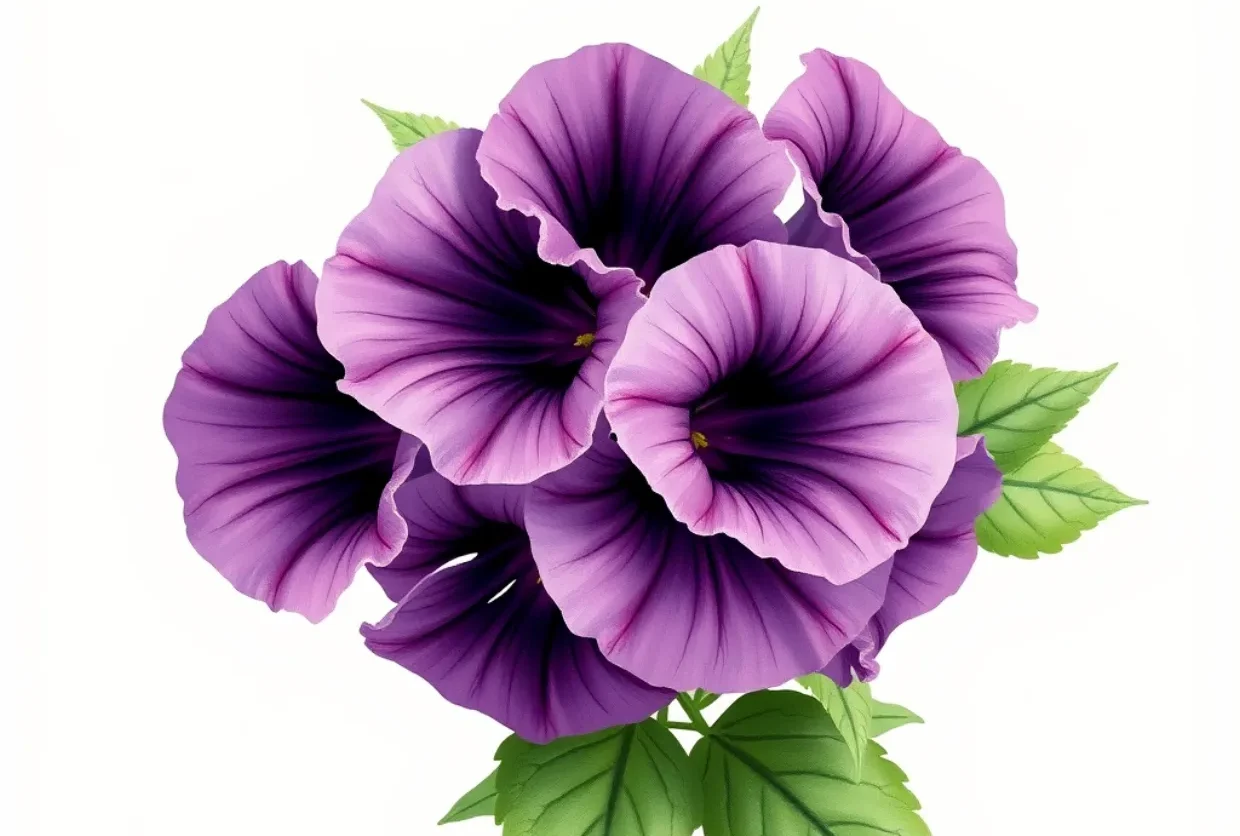
Sold as one plant, behaves as four. The group name on the label predicts whether the display survives the first heavy rain in July.
The record
Every plant in the database answers the same questions in the same order, so two entries can be read line for line. 12 of 17 fields sourced.
- Light
- Full sun
- Light detail
- Spindly with few flowers in shade; the one requirement with no flexibility
- Water
- Moderate
- Water detail
- 1 to 2 in every 7 to 10 days in the ground; baskets may need daily
- Soil
- Light, well drained, medium fertility
- Soil pH
- 6.0 to 7.0
- Mature size
- 6 to 18 in tall, 18 in to 4 ft spread
- Toxicity
- not recorded
- Lifecycle
- Annual
- Difficulty
- Easy
- Hardiness zones
- not recorded
- Bloom time
- Spring until frost
- Flower color
- Purple, pink, red, white, yellow and bicolors
- Pollinators
- not recorded
- Deer resistant
- not recorded
- Spacing
- 12 to 18 in apart
- Native range
- not recorded
How far to cut them back in midsummer. Clemson prunes declining shoots to about half their length. It looks drastic and it is the single most effective thing you can do to a leggy petunia.
The year
Plant or divide and prune, and when it is actually in flower. Everything else is leaving it alone.
The group name on the label predicts how it survives summer
Petunias are sold as one plant and behave as four, and the difference is not cosmetic. It decides whether the display collapses after the first heavy rain in July.
Grandiflora types carry the largest flowers, and Clemson’s assessment is blunt: they generally do not thrive in South Carolina, because humidity damages the big soft blooms. They are the ones that look best in the garden center and worst in August.
Multiflora types have smaller flowers, many more of them, and Clemson describes them as durable and prolific and resistant to petal blight. In a hot humid climate they are the sensible choice.
Floribunda types sit intermediate between the two.
Milliflora types are much smaller than any other petunias on the market, which suits small pots and edging.
Then there are the spreading types sold under series names, which are a different proposition again: Purple Wave stays under 4 inches tall and works as a groundcover, while Tidal Wave spreads 2 to 4 feet but grows 16 to 22 inches tall.
Overall, height runs from 6 to 18 inches and spread from 18 inches to 4 feet. Those ranges are why buying by picture rather than by name produces beds that do not work.
Set out as a table, because the group also decides two jobs that people apply uniformly and should not.
| Group | Flower | Spacing | Deadheading and pinching |
|---|---|---|---|
| Grandiflora | The largest, up to 5 inches across | 12 in apart in full sun, closer in shade | Deadhead weekly. Pinch back at about 6 inches tall to force side shoots |
| Multiflora | Smaller, and many more of them at once | 12 in apart | Standard types need deadheading. Pinch at about 6 inches tall |
| Floribunda | Intermediate between the two above | 12 in apart | As multiflora |
| Milliflora | Miniature, 1 to 1.5 inches across, in quantity | As close as 4 to 6 in | Self-cleaning, so no deadheading. Do not pinch |
| Spreading and Wave types | Varies by series, carried on trailing stems | At least 18 in apart | Self-cleaning, so no deadheading. Do not pinch |
The pinching line is the one that catches people. Taking the top inch off a grandiflora or multiflora while it is four or five inches tall and not yet flowering makes it branch instead of running up on a single stem, and it is the cheapest improvement available on this plant. Doing the same to a milliflora or a Wave undoes the habit those were bred for.
The deadheading line saves the most work. Modern small-flowered and spreading petunias abort their spent flowers before seed sets, so the weekly round of pinching off dead heads that petunias are famous for applies only to the large-flowered groups. Buying a self-cleaning series is a decision about your July, not just about the flower.
Color is the one axis where petunias have no real competition among bedding plants. Named series cover essentially the whole range: solid and veined flowers in the Madness series at three inches across, compact 1.5 to 2 inch blooms across the Carpet series, and oddities such as Black Velvet, which is as close to a genuinely black flower as bedding plants get. Where a specific color is the point of the planting, buy by series name rather than by picture, because the series also tells you the plant size and the rain tolerance that come with it.
Are petunias annuals or perennials?
Botanically they are tender perennials. In practice they are annuals almost everywhere in the country, because frost ends them and they have no dormancy to carry them through it. Only in frost-free areas, roughly zones 10 and 11, will a petunia persist from one year into the next, and even there it goes woody and stops flowering well enough to be worth keeping.
So a petunia is a one-season plant, and the season is the part worth managing. From planting out after the last frost, a well-fed plant that gets its midsummer cutback will flower until the first frost kills it, which in most of the country is five months or more of continuous bloom. That is a longer run than nearly any perennial gives, and it is the actual argument for growing them.
In a container the same holds with one qualification: baskets and pots run out of nutrients long before they run out of season, and a hanging basket that quits in July has almost always been starved rather than aged out. Petunias in pots last exactly as long as you keep feeding them.
Wild petunia is a different plant entirely
Wild petunia is Ruellia humilis, and the name is a straightforward misnomer. It belongs to the acanthus family, while true petunias are in the nightshade family alongside tomatoes and peppers. The two are not related; the flowers simply look alike.
It is worth knowing because it answers a question the bedding petunia cannot. Wild petunia is a hardy North American native perennial, found in dry open woods and prairie from Pennsylvania through Indiana and south to Alabama. It makes a compact plant a foot tall, occasionally two, with oblong leaves finely haired on both sides so the foliage carries a silvery cast, and lavender to purple tubular flowers.
- Each flower lasts a single day, and the plant produces them steadily from late spring through fall, so the display reads as continuous even though no individual bloom is.
- It wants sun and dry, well-drained, rocky ground, which is close to the opposite of what a bedding petunia in a basket is given.
- The ripe seed capsules split explosively and can throw seed more than ten feet, which is either a feature or a nuisance depending on the planting.
If the appeal of petunias is the flower rather than the bedding display, this is the plant that gives it without replanting every May.
Site and soil
Full sun, and this one is not negotiable: Clemson states petunias become spindly with few flowers when grown in shade. Everything else about the plant is forgiving; light is not.
Soil should be well drained, light and of medium fertility, at pH 6.0 to 7.0. Rich, heavy ground gives leaf at the expense of flower.
Space 12 to 18 inches apart for good ground cover, which is wider than most people plant and is what lets a bed fill without turning into a mildewed mat.
Petunias will grow in most soils, and the qualifier is drainage rather than fertility. Light, well-drained ground of medium fertility gives the best growth; heavy or poorly drained ground gives soft plants that rot at the base in a wet spell. Where the site is genuinely wet, Clemson’s answer is structural rather than chemical: build a raised bed. The pH window is 6.0 to 7.0, which most garden soil already sits inside, so this is one of the few plants on this site where a soil test is not the first thing to do.
Bed preparation is worth one pass and no more. A balanced fertilizer such as 10-10-10 worked into the soil at about 2 pounds per 100 square feet before planting covers the early season, and anything richer than that produces the leafy, flowerless plant described further down. In containers, incorporate a timed-release fertilizer into the mix at planting instead, because a pot has no reserve of its own.
Planting, and whether to start from seed
Petunias are warm-season plants with no frost tolerance at all, and the timing follows from that rather than from a calendar date.
- Wait until the soil is at least 60°F and all frost danger has passed. This applies to nursery starts as much as to home-raised seedlings. Plants set out into cold ground sit and sulk while ones planted two weeks later overtake them.
- Buy stocky plants, not tall ones in full flower. A short bushy transplant with few open flowers establishes faster and gives more over the season than a leggy one already blooming in the cell pack, which has usually been in that pack too long.
- Pinch the top inch off grandifloras and multifloras once they are four or five inches tall, before they flower. Skip this on millifloras and spreading types.
- Space by group. Twelve inches for grandifloras and multifloras, four to six for millifloras, at least eighteen for spreading types.
Growing from seed is possible but it is the harder route, and worth taking only for the variety choice. Seed needs starting indoors 10 to 12 weeks before the last frost, which means around the first of March in northern states, and that is a long stretch of indoor growing in which things can go wrong. For a bed or two of plants, transplants are cheaper in effort than they look.
Water and feed
In the ground, established plants need 1 to 2 inches of water every seven to ten days. That is a deep soak rather than a daily sprinkle.
Containers are a separate regime entirely. Hanging baskets may need watering as often as daily depending on size, and the spreading types are the thirstiest of all.
Feeding has a schedule rather than a frequency, and it changes partway through the season. The fertilizer worked into the bed at planting carries the plants through early summer. From early to mid-July, switch to a liquid feed for flowering plants applied every two to three weeks, which is the point at which the initial reserve has run out and growth is at its heaviest.
The spreading and Wave types are the exception and they need weekly feeding. They carry far more foliage and flower for the volume of root than an upright petunia does, and they are almost always in a container besides. This is the single most common reason a Wave basket that looked spectacular in June is thin and pale by August: it was fed on the schedule for a bedding petunia.
Petunias are heavy feeders by the standards of bedding plants, and a basket that has stopped flowering in July has usually run out of nutrients rather than water. Yellowing leaves in a container in midsummer point the same way. Before reaching for a spray, feed it, cut it back and see what happens over the following fortnight.
Petunias in containers and hanging baskets
Most petunias sold are going into a pot rather than a bed, and a container changes the plant’s requirements more than it changes any other bedding annual’s. Everything that makes petunias easy in the ground, the deep infrequent soak and the medium-fertility soil, stops applying the moment the roots are in a basket.
- Water far more often than the ground figures suggest. A hanging basket in summer heat can need water daily, and the spreading types, which carry the most leaf for the volume of root, are the thirstiest of all. Water until it runs from the base rather than wetting the surface.
- Feed constantly, and expect that to be the limiting factor. A basket that stops flowering in July has run out of nutrients almost every time. A slow-release fertilizer mixed in at planting plus a liquid feed through the season is the combination that carries one to frost.
- Put the large-flowered types under cover. Grandifloras are the group most damaged by rain, which is exactly why a basket or a pot on a covered porch suits them better than an open bed does. The place they fail is the middle of a lawn in a wet August.
- Choose the group for the container. Millifloras suit small pots and window boxes at 4 to 6 inch spacing. Spreading and Wave types are what a large hanging basket wants, and they are self-cleaning, so a basket hung out of reach does not need deadheading.
- Cut a basket back too. The midsummer halving described below applies to containers as much as to beds, and it is harder to make yourself do on a basket that cost money. Do it anyway; the alternative is bare stems with flowers only at the tips for the rest of the season.
Keeping them going past midsummer
The characteristic petunia failure is a plant that is bare and stringy in the middle with a few flowers at the ends of long shoots. It happens to almost everyone around July, and it is entirely fixable.
- Deadhead the large-flowered types
Grandiflora and double petunias need it. Removing the spent flower prevents seed forming, which is what tells the plant to stop.
- Take the seed pod, not just the petals
Pinch behind the swelling at the base of the faded flower. Pulling off limp petals alone leaves the pod developing and achieves nothing.
- Cut the whole plant back by half in midsummer
Clemson’s instruction for declining plants is to prune shoots back to about half their length. It looks drastic and it is the single most effective thing you can do.
- Never strip it bare
Cut back to within a few inches of the base if it is really far gone, but leave some leaves on. A plant with no foliage cannot rebuild.
- Feed and water straight after cutting back
You have just asked for a whole new set of shoots. Expect flowers again within two to three weeks.
Many modern spreading and multiflora types are self-cleaning and need no deadheading at all, which is a real advantage in a large planting. They still benefit from the midsummer cut.
What goes wrong
Clemson’s summary is that petunias have few serious insect or disease pests, with aphids the likely one, and petal blight a problem in rainy and very humid weather.
Petal blight is the reason the group matters. Large soft grandiflora flowers hold water, turn to brown mush after a storm and then rot; smaller multiflora flowers shed it. Cultivars differ markedly here, and some are specifically noted for recovering well after rain.
The pest the summary understates is the budworm. Its caterpillars bore into buds and open flowers rather than chewing leaf margins, so the first sign is usually flowers full of ragged holes, or buds that never open, with small black pellets of frass scattered over the foliage and the pot rim underneath. It is easy to miss because the caterpillar itself is often inside the bud and colored to match the flower. Picking them off works on a few plants, and Bacillus thuringiensis, sold as liquid Bt, works on a planting too large to search by hand.
Slugs produce a similar-looking symptom in damp weather, irregular holes in leaves and flowers, but leave a slime trail on the plant or the soil rather than frass, and no petunia is chewed at ground level by a budworm.
Beyond that, the complaints are cultural. Few flowers means too little sun or too much nitrogen. A stringy plant means it needs cutting back. Yellowing leaves in a basket in midsummer is usually hunger.
Toxicity, in plain terms
The ASPCA does not list petunia among plants toxic to cats, dogs or horses, and no extension toxicity listing was found for it. This page records toxicity as not recorded rather than a confident no, because an absent listing is not a positive statement of safety.
Frequently asked questions
- Why have my petunias gone leggy with flowers only at the tips?
- Normal midsummer behavior. Clemson’s fix is to prune the shoots back to about half their length, then feed and water. Flowers return in two to three weeks. Leave some foliage on rather than stripping the plant.
- Do I need to deadhead them?
- The large-flowered and double types, yes. Many modern spreading and multiflora varieties are self-cleaning. When you do deadhead, pinch off the seed pod behind the flower, not just the limp petals.
- Are petunias perennials?
- Tender perennials in theory, annuals in practice. Frost ends them and they have no dormancy to survive it, so only in frost-free zones 10 and 11 do they persist, and even there they go woody. Everywhere else they are replanted each spring and flower from the last frost to the first.
- How often should I water petunias?
- In the ground, 1 to 2 inches every seven to ten days as a deep soak rather than a daily sprinkle. Containers are a separate regime: a hanging basket may need water daily in heat, and the spreading types are the thirstiest of all. Millifloras are the most drought-tolerant group.
- What is wild petunia?
- Ruellia humilis, a hardy North American native perennial in the acanthus family. It is not related to true petunias, which are nightshades, and only the flower shape connects them. It grows about a foot tall in dry sunny ground and flowers from late spring to fall.
- Something is eating holes in my petunia flowers. What is it?
- Usually budworms. The caterpillars bore into buds and flowers rather than chewing leaves, and the tell is small black pellets of frass on the foliage below. Pick them off, or use liquid Bt on a larger planting. Slugs cause similar holes in damp weather but leave slime rather than frass.
- Which petunias handle heat and rain best?
- Multifloras, which Clemson describes as durable, prolific and resistant to petal blight. Grandifloras, with the biggest flowers, are the ones that suffer in humidity. Some spreading cultivars are specifically noted for tolerating heat and rain damage.
- Can they grow in part shade?
- Not well. Clemson states they become spindly with few flowers in shade. Full sun is the one requirement with no flexibility.
- Why did my hanging basket stop flowering in July?
- Usually nutrients rather than water. Petunias are heavy feeders and want a balanced fertilizer monthly, more often in containers, where every watering leaches some out. Cut the plant back at the same time as you feed.
Companion plants
How this entry is compiled
- Care values come from university extension publications and the USDA hardiness map, never from other gardening sites.
- Toxicity follows the ASPCA listing and is quoted rather than summarized.
- A value we cannot source is printed as not recorded, never estimated.
Compiled and checked by the Gardnicks editorial desk · last checked 2026-08-16
Sources for this entry
- Clemson HGIC, Petunia
- University of Minnesota Extension, Growing petunias
- Iowa State Extension, Selecting and Planting Petunias
- Illinois Extension, Deadheading for More Blooms
Where two sources disagree, the entry follows the one closest to the plant’s own growing region and says so in the text.
What kills it
Three failures cover almost everything readers write in about.
More in Flowers
 Hyacinth
Full sun · zones 4 to 8
Hyacinth
Full sun · zones 4 to 8
 Mums
Full sun · zones 5 to 9
Mums
Full sun · zones 5 to 9
 Peony
Full sun · zones 3 to 8
Peony
Full sun · zones 3 to 8
 Yarrow
Full sun · zones 3 to 9
Yarrow
Full sun · zones 3 to 9
Plates are illustrations, not photographs of a specific plant, and are not evidence of a variety, place or season.