Peony
Paeonia lactiflora
Herbaceous peony / garden peony / Chinese peony
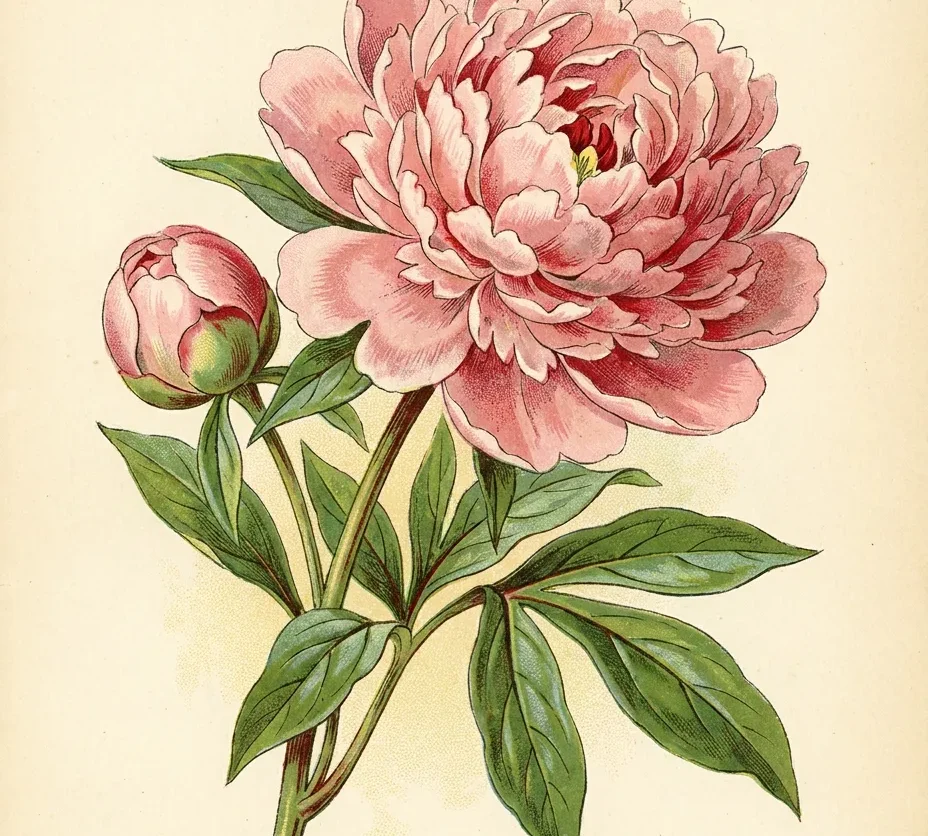
A peony that never flowers is almost always a peony planted too deep. One to two inches over the eyes decides everything else about this plant.
The record
Every plant in the database answers the same questions in the same order, so two entries can be read line for line. 17 of 17 fields sourced.
- Light
- Full sun
- Light detail
- 6 hours or more; tolerates 2 to 6 at a cost in flower
- Water
- Moderate
- Water detail
- Steady through the growing season, never standing wet
- Soil
- Well drained, prepared once and left alone
- Soil pH
- Acidic, below 6.0
- Mature size
- 1 to 3 ft tall and wide
- Toxicity
- NC State lists peony as a problem for cats, dogs and horses.
- Lifecycle
- Perennial
- Difficulty
- Easy
- Hardiness zones
- 3 to 8
- Bloom time
- Late spring to early summer, about two weeks a plant
- Flower color
- White, pink, red, burgundy, purple, orange or yellow
- Pollinators
- Bees, butterflies and pollen-eating beetles
- Deer resistant
- Yes
- Spacing
- 3 ft apart, planted once
- Native range
- Europe, the Mediterranean basin and Asia
Hardy in zones 3 to 8. Colder than zone 3, grow it in a container and overwinter it under cover.
Depth over the eyes at planting. At four inches you get foliage and no flowers, sometimes for years, and the only fix is to dig the plant up and raise it.
The year
Plant or divide, and when it is actually in flower. Everything else is leaving it alone.
Toxic to pets
NC State lists peony as a problem for cats, dogs and horses.
The one measurement that decides everything
A peony that never flowers is almost always a peony planted too deep, and the tolerance is far tighter than anyone expects. Iowa State’s instruction is to set the buds, the eyes, one to two inches below the soil surface, and notes that plants seem to know the difference between two inches and four: at four you get handsome foliage and few flowers, sometimes none at all, for years.
That is the whole of the difficulty with this plant. Everything else about a peony is forgiving. It lives for decades, it wants very little, it is shunned by deer, and it comes back every spring without being asked. But it is planted once, and if it is planted an inch too low it sulks until somebody digs it up and raises it.
Types of peonies: herbaceous, tree and Itoh
Three plants are sold as peonies and they are not interchangeable. The type decides how it is pruned, how deep it is planted, and whether the planting-depth rule above applies to it at all, which is why it belongs before any other decision.
| Type | What the plant is | Winter | What it needs differently |
|---|---|---|---|
| Herbaceous peony | The familiar perennial clump, three feet or so, dying back to the ground each year | Disappears entirely and returns from the crown | The eyes go one to two inches below the surface. This is the type the depth rule is written for |
| Tree peony | A woody shrub that keeps its framework through winter, reaching four to six feet over many years | Bare woody stems remain standing | Grafted, so the graft union goes four to six inches deep. Never cut it to the ground, and it takes light shade better than the others |
| Itoh, or intersectional | A cross between the two: herbaceous habit with tree peony foliage and flower size | Dies back like a herbaceous peony | Plant like a herbaceous peony. It carries the strongest stems of the three and rarely needs support |
The practical differences matter more than the botany. A tree peony cut back in autumn the way a herbaceous one is will not regrow that framework for years. An Itoh gives the huge tree-peony flowers on a plant that vanishes for winter, which is why it has become the answer for gardeners who want the flower without the shrub. And only the herbaceous type is what most people picture when they say peony.
Flower forms, which is the other half of the label
The American Peony Society recognizes six flower forms, and a catalog listing will usually give the form alongside the name. It is worth reading, because form decides whether the flower stands up in rain.
- Single: one or two rows of broad petals around an open center of stamens. The lightest flower, and the one that never flops.
- Japanese: like a single, but the center is filled with narrow petal-like staminodes rather than ordinary stamens.
- Anemone: a further step, with the center fully converted into short narrow petals.
- Semi-double: several rows of broad petals with stamens still visible among them. A good compromise between fullness and weight.
- Bomb: a broad outer ring of petals with a dense rounded mound sitting on top of it.
- Full double: no visible center at all. The heaviest flowers, the ones sold as cut peonies, and the ones that go face-down after rain unless they are supported.
If your peonies lie on the ground every June, the form is usually the reason rather than the feeding. Doubles and bombs hold water in the flower; singles and Japanese forms shed it. Choosing a lighter form is a permanent fix where staking is an annual chore.
Where it grows
NC State lists herbaceous peonies across zones 3a to 8b, which is nearly the whole country, though they perform best in the middle of that range where winters are properly cold. Peonies need a period of winter chill to flower well, which is why the plant that thrives in Minnesota disappoints in the deep south.
If you garden in a warm zone, the adjustments are specific: choose low-chill types, keep the crown no more than an inch deep, and do not mulch over winter, because the mulch acts as a blanket and removes the cold the plant is waiting for.
Light and soil
Full sun, six or more hours, and it will take partial shade at a cost. Too much shade is the second most common reason a peony does not bloom, after depth.
Well-drained soil, on the acidic side of neutral. Peonies are long-lived enough that it is worth preparing the ground properly once rather than improving it around a plant that will be there in twenty years.
Go easy on feeding. Excess nitrogen produces leaves at the expense of flowers, which is the same story as with most flowering perennials and is particularly frustrating here, because the plant looks healthy while doing nothing you wanted.
Planting
- Measure the eyes, do not guess
One to two inches below the surface, and closer to one in warm zones. This is the single number that decides whether you get flowers.
- Choose a spot you will not need back
Peonies resent disturbance and live for decades. Somewhere with six hours of sun and no plans for a path through it.
- Prepare a bed, not a hole
Well-drained ground worked properly once. The plant will be in it far longer than most things you plant this year.
- Remove the first spring’s flower buds
Iowa State recommends taking them off in the first spring so the plant puts its energy into roots and foliage. It costs you one season and buys you the next twenty.
- Support the heavy doubles
Large double flowers hold rain and fall over. A ring put in before the growth is tall disappears; one added afterwards never quite does.
Through the year
Growth pushes from the crown in early spring, flowers arrive late spring into early summer, and NC State notes that each plant blooms for about two weeks. That short window is the honest trade with this plant: two spectacular weeks and a good-looking mound of foliage for the rest of the season.
The ants that appear on the buds are a source of endless worry and are, in NC State’s words, totally harmless. They are drawn to nectar on the outside of the bud and do nothing to the plant either way.
Cut foliage down in autumn once it has died back, and remove it rather than leaving it, because powdery mildew overwinters on old leaves and autumn is when it shows up.
What goes wrong
NC State lists powdery mildew, especially in autumn, spring rose beetles, southern blight, and an unidentified bud-boring insect.
But the complaints people actually write in about are not diseases. They are no flowers, and the causes are cultural in this order: planted too deep, too much shade, too much nitrogen, or a plant that is simply too young or was recently moved. A transplanted peony can take two or three springs to settle before it flowers again, and that is normal rather than a fault.
Toxicity, in plain terms
NC State lists peony as a problem for cats, dogs and horses. It is a plant worth siting away from a run where a dog grazes, and worth knowing about if you cut flowers for the house where a cat can reach them.
If an animal has eaten part of one and is unwell, ring a vet rather than waiting to see how it develops.
Frequently asked questions
- What are the types of peonies?
- Three: herbaceous, the familiar clump that dies back each winter; tree peony, a woody shrub that keeps its framework and is grafted, so it is planted deeper; and Itoh or intersectional, a cross that flowers like a tree peony on a plant that dies back like a herbaceous one.
- What is the difference between a tree peony and a regular peony?
- A tree peony is a woody shrub whose stems stay standing all winter and must never be cut to the ground. A herbaceous peony disappears entirely and regrows from the crown. They are also planted at different depths, because a tree peony is grafted and the union goes four to six inches down.
- When should I divide peonies?
- Early fall, and only if you actually need to, because peonies flower best left alone for decades. Lift the clump, wash the soil off, and cut it into pieces with three to five eyes each. Replant at the same shallow depth, and expect no flowers for the first year or two after the move.
- Can I grow peonies in a pot?
- Yes, with care. Use a container at least sixteen to twenty inches across and as deep, because the root system is substantial, and accept that the pot needs winter protection: peonies require cold to set buds, but roots in a container are far more exposed than roots in the ground.
- Why has my peony never flowered?
- Depth first. The eyes should sit one to two inches below the surface; at four inches the plant makes leaves and no flowers, sometimes for years. After that, check for too much shade, too much nitrogen, and whether the plant is simply young or recently moved.
- Do I need to get rid of the ants?
- No. NC State describes them as totally harmless. They are after nectar on the outside of the bud and have nothing to do with whether the flower opens.
- Can I move an established peony?
- You can, and it will punish you for it with two or three springs of foliage and no flowers while it re-establishes. Peonies resent disturbance, so move one only when you genuinely have to, and replant it at the same careful depth.
- Will peonies grow in the south?
- In the warmer zones, with adjustments: low-chill types, crowns no more than an inch deep, and no winter mulch, because mulch insulates the crown against the cold the plant needs to set flower.
- How long do they live?
- Decades, routinely outliving the person who planted them and often the house. That is why the ten minutes spent getting the planting depth right is the best-value ten minutes in this entry.
Companion plants
How this entry is compiled
- Care values come from university extension publications and the USDA hardiness map, never from other gardening sites.
- Toxicity follows the ASPCA listing and is quoted rather than summarized.
- A value we cannot source is printed as not recorded, never estimated.
Compiled and checked by the Gardnicks editorial desk · last checked 2026-08-16
Sources for this entry
- NC State Extension Gardener Plant Toolbox, Paeonia herbaceous types
- Iowa State University Extension, Growing Peonies in Iowa
- Iowa State University Extension, Reasons Why Peonies Fail to Bloom
Where two sources disagree, the entry follows the one closest to the plant’s own growing region and says so in the text.
What kills it
Three failures cover almost everything readers write in about.
More in Flowers
 Tulip
Full sun · zones 3 to 8
Tulip
Full sun · zones 3 to 8
 Hyacinth
Full sun · zones 4 to 8
Hyacinth
Full sun · zones 4 to 8
 Geranium
Full sun · zones not recorded
Geranium
Full sun · zones not recorded
 Salvia
Full sun · zones 3 to 8
Salvia
Full sun · zones 3 to 8
Plates are illustrations, not photographs of a specific plant, and are not evidence of a variety, place or season.