Moonflower
Ipomoea alba
Moonflower vine / moon vine
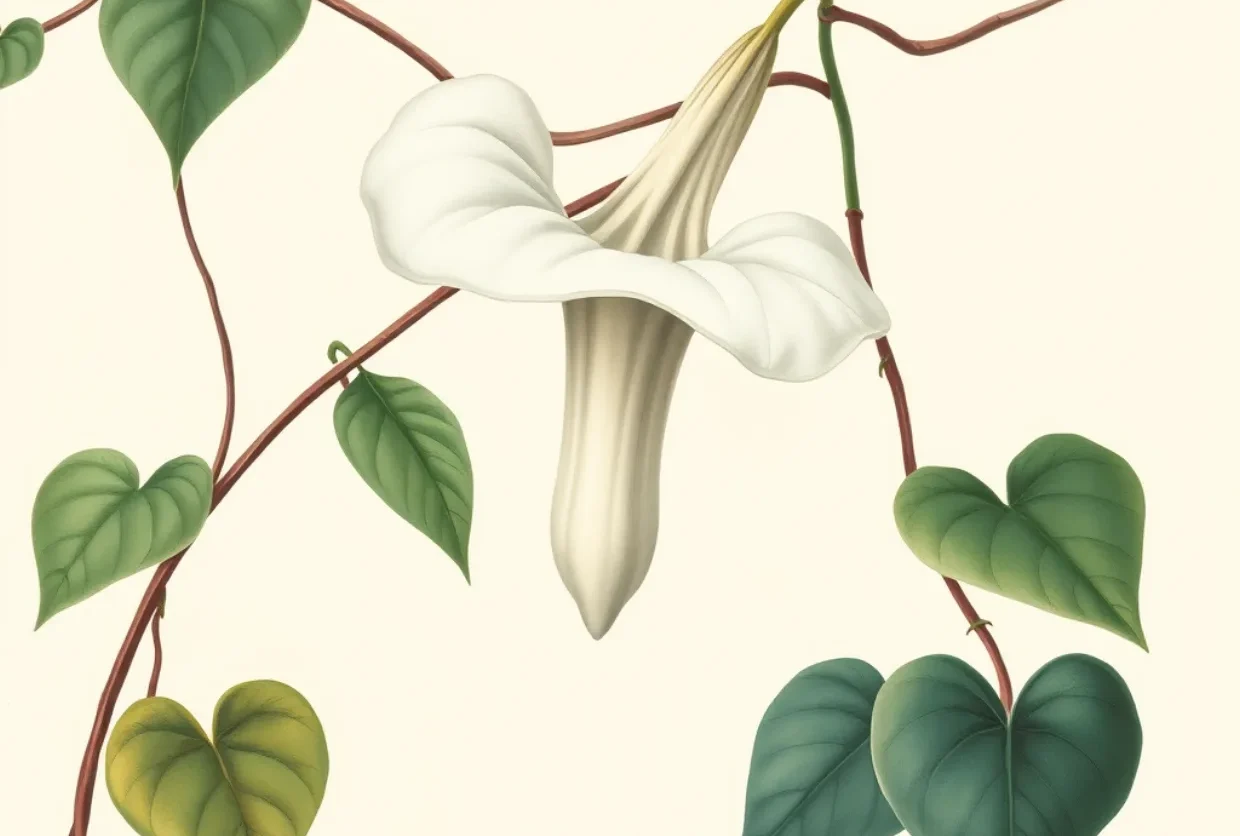
Two very different plants carry this name. The vine opens white trumpets at dusk and is mildly toxic; the Datura that shares the name is extremely toxic in all parts.
The record
Every plant in the database answers the same questions in the same order, so two entries can be read line for line. 16 of 17 fields sourced.
- Light
- Full sun
- Light detail
- 6 hours or more; it needs heat to make the growth that carries the flowers
- Water
- Moderate
- Water detail
- Good drainage is the only real requirement
- Soil
- Clay, loam or sand, well drained
- Soil pH
- Acid, neutral or alkaline
- Mature size
- 10 to 30 ft tall, 3 to 6 ft wide
- Toxicity
- NC State rates Ipomoea alba low severity: vomiting, and large amounts of seeds may cause hallucinations, from indole alkaloids in the seeds. Toxic to dogs, cats and horses. The unrelated Datura that shares the name moonflower is extremely toxic in all parts.
- Lifecycle
- Annual
- Difficulty
- Easy
- Hardiness zones
- 10 to 12
- Bloom time
- Summer through autumn, opening late afternoon and closing at dawn
- Flower color
- White
- Pollinators
- Night-flying moths; host plant for hummingbird and sphinx moths
- Deer resistant
- not recorded
- Spacing
- 6 to 24 ft apart
- Native range
- Florida, Mexico, Central and South America
Hardy in zones 10 to 12. Colder than zone 10, grow it in a container and overwinter it under cover.
When the flowers open. The bud unfurls over a few minutes, fast enough to sit and watch, and closes again at dawn. Very little else in a garden performs on cue.
The year
Plant or divide, and when it is actually in flower. Everything else is leaving it alone.
Toxic to pets
NC State rates Ipomoea alba low severity: vomiting, and large amounts of seeds may cause hallucinations, from indole alkaloids in the seeds. Toxic to dogs, cats and horses. The unrelated Datura that shares the name moonflower is extremely toxic in all parts.
Two very different plants are called moonflower
This page is about Ipomoea alba, the twining vine in the morning glory family, which opens large white trumpets at dusk and closes them at dawn.
The name moonflower is also applied to Datura, an unrelated genus in the nightshade family, also known as devil’s trumpet, thorn-apple and jimsonweed. Wisconsin Horticulture is unambiguous about that plant: all parts are extremely toxic, containing narcotic and hallucinogenic alkaloids, with serious illness or death possible from ingestion, and the seeds the most toxic part.
The two are easy to tell apart once you know. Ipomoea alba is a climbing vine that twines up a support with heart-shaped leaves. Datura is a self-supporting bushy plant that stands on its own with coarse jagged leaves and a spiny seed pod.
If you were sent here looking for the plant with the spiky seed capsule, this is the wrong entry, and that plant is not one to have where children are.
The two plants, side by side
| Moonflower vine, Ipomoea alba | Datura, D. metel and relatives | |
|---|---|---|
| Form | A climbing vine, 10 to 30 ft tall and 3 to 6 ft wide, needing support | A bushy shrub, 3 to 4 ft tall and wide, spreading, needing none |
| Flower | White trumpets, opening at dusk | Trumpets in white, purple, lavender or yellow, including double forms |
| Which way the flower points | Outward from the vine | Upward. The related Brugmansia hangs its flowers down, which is how those two are told apart |
| Toxicity | Low severity. Vomiting, and hallucinations from a large quantity of seeds | High severity, all parts. Hallucinations, dilated pupils, delirium, weak rapid pulse, convulsions and coma |
| Family | Morning glory | Nightshade |
The quickest field test needs no flower at all: if it climbs, it is the vine; if it stands up by itself as a bush, it is Datura. That settles it in a second and it settles the part that matters, because the toxicity ratings are two categories apart.
Purple moonflowers
Worth answering directly, because the search is common and the answer carries a warning. The moonflower vine is white. There is no purple form of Ipomoea alba.
Purple, lavender and near-black flowers sold under the name moonflower are Datura, and cultivars such as Double Purple are among the most widely sold of them. So a purple moonflower is not a color variant of the plant on this page; it is the high-severity plant wearing the same common name, and buying one on the strength of a photograph is precisely how the confusion causes harm.
If purple is what you want at dusk, the honest alternatives are the purple-flowered morning glories, which are close relatives of the vine on this page, open in the morning rather than the evening, and carry the same low toxicity rating. What is not available is a purple Ipomoea alba.
The flower, and why it is worth growing
Moonflower vine blooms summer through autumn in large fragrant white trumpets that open in late afternoon and close at dawn.
The opening is the part people plant it for. The bud unfurls over a few minutes, fast enough to watch, and it happens on a schedule reliable enough to sit down for. There is not much else in a garden that performs on cue.
NC State records the nectar attracting night-flying moths, and it is a host plant for hummingbird and sphinx moths. Planted next to something scented and pale, it is the anchor of a garden designed to be used after dark.
The mechanics are worth setting out, because they are the reason to plant it. Each flower is about six inches across, white, with five fused lobes and a pale green star at the center. It opens in the late afternoon or early evening and closes again at dawn, so the plant is doing its work in exactly the hours most gardens are empty.
The opening is not gradual. A bud that has been a tight furled spiral all day unwinds over the course of a few minutes, fast enough to watch happen. That is the whole appeal, and it is the reason to site the plant beside somewhere you actually sit rather than at the end of the garden.
The scent comes with it and is strongest at the same hours. Flowering runs from midsummer into fall, so this is a plant that starts late and is at its best in the part of the season when a lot of the garden is finishing.
What arrives with the scent is the other half of the plant. Moonflower is pollinated by night-flying moths, and it draws sphinx moths and hummingbird clearwings, which are large enough to be mistaken for hummingbirds in the half light. It also supports two specialized bees associated with the genus, and bats work the same flowers. Very little else in a garden is doing anything for nocturnal wildlife.
Moonflower bud stages, and what to watch for
The opening is the reason people grow this plant, and it is quick enough that it is missed by anyone who does not know what a bud about to open looks like.
- A young bud is a slim green spike, tightly furled and lying close against the stem. Days from opening.
- Elongating. The bud lengthens and pales toward cream, and the spiral twist of the furled petals becomes visible along its length. This is the stage to start watching in the evening.
- Swollen and pale, held out from the stem. Opening tonight. On a warm still evening this stage is reached within an hour or two of sunset.
- The unfurling takes minutes rather than hours. The spiral releases and the trumpet spreads flat, and on a good evening it is fast enough to watch happen.
- Open, and scented. The fragrance arrives with the opening rather than before it. The flower holds through the night.
- Spent by mid morning, collapsing into a soft twist. Each flower lasts one night only, and a healthy vine opens several a night through the season.
Two things follow from that sequence. Warmth accelerates the whole thing, so a hot still evening gives an earlier and faster opening than a cool breezy one, and a cold spell can hold buds at the swollen stage for days. And since each flower is a single night, the display depends on how many buds the vine is carrying rather than on how long any one lasts, which is the argument for the full sun and heat this entry calls for: they are what produce the growth that carries the buds.
Growing it
Hardy only in zones 10a to 12b, so almost everywhere it is grown as an annual, which suits it because it is fast. It climbs 10 to 30 feet in a season and spreads 3 to 6 feet, spaced 6 to 24 feet apart.
Full sun at six hours or more. Soil can be clay, loam or sand at acid, neutral or alkaline pH, needing only good drainage. This is not a demanding plant.
- Nick or soak the seed first
The coat is hard. Soak overnight or nick it with a file; untreated seed germinates slowly and unevenly.
- Start 4 to 6 weeks before the last frost
Or sow direct once the soil is warm. It needs heat to get going and sulks in cold ground.
- Give it a real support from day one
It twines, so it needs something to wrap around: a trellis, an arbor, wires or a fence. It cannot climb a flat wall.
- Do not feed it much
Like most morning glory relatives, rich soil and nitrogen give you a large quantity of leaf and very few flowers.
- Plant it where you sit in the evening
The scent and the opening are both wasted at the bottom of the garden. Beside a door or a terrace is the point of the plant.
What goes wrong
NC State’s assessment is short: no significant problems.
That is worth taking at face value rather than as an omission. Moonflower is genuinely close to problem-free, and almost everything that goes wrong with it is a decision made before it was planted.
- All leaves and no flowers is the common complaint, and it is nearly always too much nitrogen or too little sun. Cutting back on feed is the fix, not more of it.
- Seed that never came up is a hard seed coat rather than dead seed. Untreated moonflower seed germinates slowly and unevenly, and nicking or soaking it is not optional advice.
- A plant that sat still all summer was almost certainly sown or set out into cold ground. This is a tropical vine that needs warmth to start, and one sown two weeks later into warm soil overtakes it easily.
- A support that failed is the failure nobody anticipates. A vine that climbs 10 to 30 feet in a single season and carries dense foliage puts real load on whatever it is tied to, and a light trellis or a few strings will come down in a summer storm with the whole plant on it.
- Aphids and spider mites turn up occasionally, more often in warm dry conditions and on plants under stress. A jet of water handles both on a vine this vigorous.
One thing that is not a problem but surprises people: moonflower self-seeds, so seedlings appear the following spring around where it grew. In most gardens that is free plants. Where it is not wanted, they pull out easily while small.
The other is a plant that never really got going, which in a cool summer is simply the climate. This is a tropical vine, and it needs heat to produce the growth that carries the flowers.
Toxicity, in plain terms
NC State rates Ipomoea alba low severity: vomiting, and large amounts of seeds may cause hallucinations, from indole alkaloids in the seeds. It is listed as toxic to dogs, cats and horses.
That is a modest listing, and the practical risk is limited to seed eaten in quantity rather than to a plant being brushed past.
The contrast with the other moonflower is the point of this section. Datura is in a different league entirely: all parts extremely toxic, tropane alkaloids including atropine and scopolamine, and neither drying nor boiling destroys them. Two plants, one common name, and radically different answers to the same question.
Frequently asked questions
- Is moonflower poisonous?
- It depends which one. Ipomoea alba, the vine, is rated low severity: vomiting, and hallucinations from large amounts of seed. Datura, also called moonflower, is extremely toxic in all parts and can kill. The vine twines up a support; Datura stands on its own with a spiny seed pod.
- What time do the flowers open?
- Late afternoon, and they close at dawn. The bud unfurls over a few minutes, fast enough to sit and watch, which is most of the reason to grow it.
- Why is mine all leaves and no flowers?
- Too much nitrogen or too little sun. Moonflower vine wants full sun and unimproved soil; feeding it produces foliage at the expense of flower.
- Do the seeds need soaking?
- Yes. The seed coat is hard, so soak overnight or nick it with a file before sowing, four to six weeks before the last frost or direct once the soil is warm.
- Will it come back next year?
- Only in zones 10 to 12. Everywhere colder it is grown as an annual, which works well because it climbs 10 to 30 feet in a single season.
Companion plants
How this entry is compiled
- Care values come from university extension publications and the USDA hardiness map, never from other gardening sites.
- Toxicity follows the ASPCA listing and is quoted rather than summarized.
- A value we cannot source is printed as not recorded, never estimated.
Compiled and checked by the Gardnicks editorial desk · last checked 2026-08-16
Sources for this entry
- NC State Extension Gardener Plant Toolbox, Ipomoea alba
- Wisconsin Horticulture, Datura
- Illinois Extension, Moonflower
- Clemson HGIC, Make a Nocturnal or Moon Garden
Where two sources disagree, the entry follows the one closest to the plant’s own growing region and says so in the text.
What kills it
Three failures cover almost everything readers write in about.
More in Flowers
 Hyacinth
Full sun · zones 4 to 8
Hyacinth
Full sun · zones 4 to 8
 Hydrangea
Part shade · zones 6 to 11
Hydrangea
Part shade · zones 6 to 11
 Sunflower
Full sun · zones not recorded
Sunflower
Full sun · zones not recorded
 Lavender
Full sun · zones 5 to 9
Lavender
Full sun · zones 5 to 9
Plates are illustrations, not photographs of a specific plant, and are not evidence of a variety, place or season.