Hydrangea
Hydrangea macrophylla
Bigleaf hydrangea / French hydrangea / mophead / lacecap
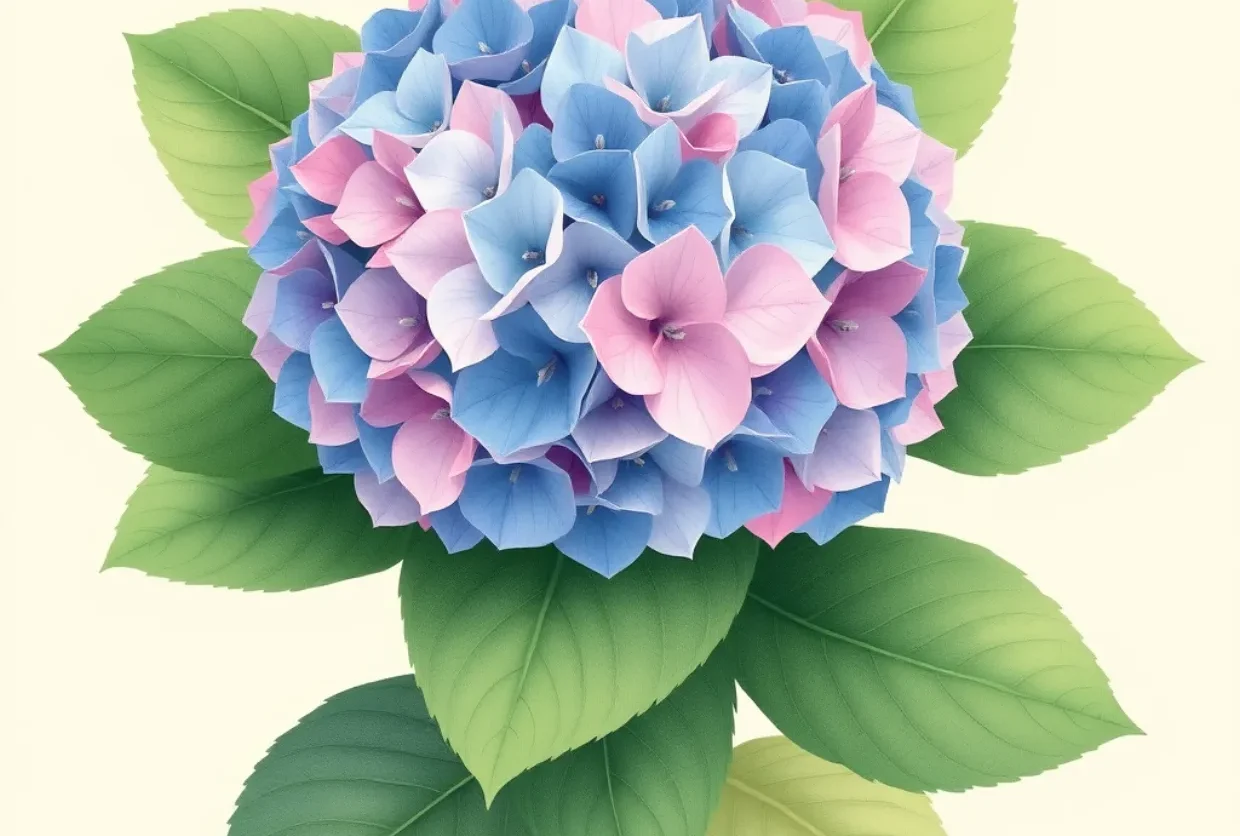
Bigleaf hydrangea sets next year's flower buds in late summer. Almost every problem with it, above all the years without bloom, comes back to that.
The record
Every plant in the database answers the same questions in the same order, so two entries can be read line for line. 16 of 17 fields sourced.
- Light
- Part shade
- Light detail
- Morning sun, afternoon shade; avoid hot exposed sites
- Water
- Moderate
- Water detail
- Water whenever it wilts in the absence of rain
- Soil
- Rich in organic matter, well drained, tolerates occasional wet
- Soil pH
- 5.0 to 5.5 for blue, 7.0 and above for pink
- Mature size
- 3 to 6 ft tall and wide
- Toxicity
- NC State lists low severity poison characteristics in bark, flowers and leaves. Large quantities cause nausea, stomach pain, vomiting and sweating.
- Lifecycle
- Shrub
- Difficulty
- Moderate
- Hardiness zones
- 6 to 11
- Bloom time
- Summer, on the previous year's growth
- Flower color
- Blue, pink, purple or white, by soil pH
- Pollinators
- not recorded
- Deer resistant
- No
- Spacing
- 3 to 6 ft apart
- Native range
- Japan, China, Korea and Southeast Asia
Hardy in zones 6 to 11. Colder than zone 6, grow it in a container and overwinter it under cover.
The year
Plant or divide and prune, and when it is actually in flower. Everything else is leaving it alone.
Toxic to pets
NC State lists low severity poison characteristics in bark, flowers and leaves. Large quantities cause nausea, stomach pain, vomiting and sweating.
The one thing that decides everything
Bigleaf hydrangea sets its flower buds in late summer for the following year. Every common problem with this shrub follows from that single fact, and once you have it, most of the advice on this page stops being a list of rules and starts being obvious.
It explains why a healthy plant covered in leaves can produce no flowers at all: the buds were on the plant last autumn, and something removed them. Penn State names the usual suspects as winter injury to the flower buds, too much shade, excess nitrogen, and pruning at the wrong time of year. Three of those four are things a gardener does.
It also explains why the pruning window is so narrow and so early. Buds begin forming in late summer, so cutting after roughly the first of August takes next year’s flowers off with the stems.
Where it will and will not grow
NC State lists Hydrangea macrophylla for zones 6a through 11b. That range describes where the plant survives, which is not the same as where it flowers reliably. In the colder half of that range the wood comes through winter and the flower buds do not, and Penn State is direct about it: even a moderately severe winter can kill or damage the buds.
This is the gap that produces the most disappointed hydrangea owners in the country. If you garden at the cold edge, either accept that flowering is a good-winter event, site the plant somewhere sheltered from wind and out of early morning sun after a freeze, or grow one of the reblooming cultivars that also flowers on new growth.
Light
Morning sun with afternoon shade is the target, and UGA’s version of the instruction is worth quoting because it names the failure: avoid hot, dry, exposed sites. Bigleaf hydrangea has large, thin leaves and no drought strategy, and full afternoon sun in the south produces a plant that wilts every day by two o’clock whatever you do with the hose.
Too much shade goes wrong in the other direction. NC State’s range runs from dappled light through to deep shade, but deep shade is survival rather than performance: the plant stays green and flowers thinly, and it is one of the four causes of failure to bloom on Penn State’s list.
Soil and planting
This is a shrub that genuinely wants organic matter, which sets it apart from most of the drought-tolerant plants people group it with. UGA’s preparation is 50 pounds of composted organic matter per 10 square feet, incorporated into the top 8 to 12 inches of soil, which is a real bed rather than an improved hole.
Drainage should be good, though NC State notes it tolerates soil that is occasionally wet, which is more forgiveness than most shrubs offer.
Mulch generously: 3 to 5 inches of an organic mulch such as pine straw, pine bark or fall leaves. On a plant whose leaves are the first thing to wilt, keeping the root zone cool and evenly moist does more than any watering routine.
Watering
UGA’s rule is refreshingly practical: water whenever the plant begins to wilt in the absence of rainfall. Bigleaf hydrangea is an honest plant about this. It tells you, visibly, before it is in trouble.
The one thing to distinguish is afternoon wilt in heat from genuine drought. A plant that flags at four o’clock and is upright again by morning is managing its own water loss. A plant still flat at breakfast needs a deep soak, and needs it at the root zone rather than over the foliage.
Feeding
A general-purpose fertilizer such as 8-8-8 or 10-10-10 at 1 pound, about two cups, per 100 square feet, applied in March, May and July.
Do not exceed that thinking you will get more flowers. Excess nitrogen is on Penn State’s list of reasons a hydrangea does not bloom, because the plant spends the season making leaves instead of buds. Heavily fed hydrangeas are large, green and disappointing.
Blue or pink, and how much control you actually have
Flower color on bigleaf hydrangea is a soil chemistry effect rather than a fixed trait, with one important exception: white cultivars stay white and cannot be shifted.
Blue requires acid soil. UGA puts the threshold at pH 5.5 or lower, achieved with half a cup of wettable sulfur per 10 square feet, or a drench of one tablespoon of aluminum sulfate in a gallon of water, applied between March and May. Penn State’s figure for reliable blue is the 5.0 to 5.5 range.
Pink requires the opposite: pH 7.0 or higher, using one cup of dolomitic lime per 10 square feet, or a drench of one tablespoon of hydrated lime in a gallon of water, over the same months.
Two practical notes. The change is gradual and it drifts back, because your soil and your water keep pulling the pH toward whatever they are; this is maintenance rather than a one-time fix. And a plant in a container is far easier to hold at a chosen pH than a plant in open ground next to a limestone foundation.
Types of hydrangeas, and why the type decides the pruning
Every pruning instruction for hydrangeas depends on one fact: whether the plant sets its flower buds on last year’s wood or on growth it has not made yet. Cut an old-wood type in late winter and you remove the whole of next summer, which is the single most common reason a healthy hydrangea produces leaves and no flowers.
| Type | How to recognize it | Buds on | When to prune |
|---|---|---|---|
| Bigleaf, H. macrophylla | Thick glossy leaves, rounded mophead or flat lacecap heads. The blue and pink ones | Old wood | Straight after flowering, and lightly. Never in late winter |
| Mountain, H. serrata | Like a smaller, finer bigleaf with lacecap heads | Old wood | After flowering. Its buds are hardier than bigleaf, so it flowers more reliably in cold gardens |
| Panicle, H. paniculata | Cone-shaped heads that age from white to pink. Limelight is one | New wood | Late winter or early spring, and it can be cut hard. The most sun-tolerant and cold-hardy type |
| Smooth, H. arborescens | Big rounded white heads on a soft-stemmed shrub. Annabelle and Incrediball | New wood | Late winter. Cutting it back hard gives stronger stems that hold the heads up |
| Oakleaf, H. quercifolia | Lobed leaves like an oak, cone-shaped flowers, fall color and peeling bark | Old wood | After flowering, and it needs very little. A native with the longest season of interest |
| Climbing, H. anomala petiolaris | A woody climber that clings to walls, flat white lacecap heads | Old wood | After flowering, only to keep it in bounds. Slow to start, then vigorous for decades |
If you do not know which one you have, wait and watch. A hydrangea that flowers on stems which were bare and woody through winter is an old-wood type. One that flowers on stems it grew from the base that same spring is a new-wood type. A single season of not pruning costs nothing and settles the question permanently.
Reblooming bigleaf cultivars, sold as flowering on both old and new wood, blur this. They are more forgiving of a mistimed cut, but they still flower best on the old wood, so the safe timing is the old-wood one.
Pruning
Prune when the flowers begin to fade, and stop by the first of August. That is the whole instruction for a standard bigleaf hydrangea, and following it is what separates a shrub that flowers every year from one that does not.
Remove spent flower heads and any dead or weak stems. Do not shear the whole plant to a shape, and do not tidy it up in autumn or late winter, however untidy it looks by then, because that is exactly when the buds are sitting on the stems waiting for spring.
Reblooming cultivars are the exception. They flower on both old and new wood, so they can be cut after the blooms fade, and if a hard freeze takes the old-wood buds they can still be pruned in late winter and will flower on the new growth.
What goes wrong
NC State lists leaf spot, bacterial wilt and powdery mildew, and notes the plant is susceptible to deer damage. Most of the leaf problems are worse where air does not move and where the foliage is watered from above, which makes spacing and watering at the base the two cheapest preventive measures available.
If a plant looks healthy and simply will not flower, work through Penn State’s four causes in order before assuming anything is diseased: winter bud injury, too much shade, too much nitrogen, and pruning at the wrong time. Nearly every case is one of those.
Frequently asked questions
- What are the different types of hydrangeas?
- Six: bigleaf and mountain, which carry the mophead and lacecap heads; panicle and smooth, which have cone-shaped and rounded white heads; oakleaf, with lobed leaves and fall color; and climbing. The split that matters is that bigleaf, mountain, oakleaf and climbing flower on old wood, while panicle and smooth flower on new wood.
- Why does my hydrangea have leaves but no flowers?
- Usually pruning at the wrong time. An old-wood type cut in late winter has had next summer removed. The other common causes are a late frost after the buds broke, too much shade, and too much nitrogen, which produces leaf at the expense of flower.
- When should I prune a hydrangea?
- Depends entirely on the type. Bigleaf, mountain, oakleaf and climbing go straight after flowering. Panicle and smooth go in late winter or early spring and can be cut hard. If you do not know which you have, prune nothing for a season and watch where the flowers appear.
- Do hydrangeas need full sun?
- Most want morning sun with afternoon shade. Panicle hydrangeas are the exception and take full sun well. Bigleaf hydrangeas in full afternoon sun wilt daily in summer whatever the soil moisture, which is a heat response rather than a watering problem.
- How do I turn my hydrangea blue?
- Only bigleaf and mountain hydrangeas change color, and it is soil chemistry rather than a dye: acid soil makes aluminum available and the flowers come blue, alkaline soil locks it away and they come pink. White hydrangeas, including panicle and smooth types, do not change at all.
- Why is my hydrangea wilting even though the soil is wet?
- Large leaves lose water faster than the roots can replace it in afternoon heat, so a midday wilt that recovers by evening is normal and needs no water. A plant still wilted in the morning is a genuine watering or root problem.
Toxicity, in plain terms
NC State describes hydrangea as having low severity poison characteristics, with bark, flowers and leaves listed, and notes that eating large quantities causes nausea, stomach pain, vomiting and sweating.
The practical reading is that this is not a plant a curious animal or child is likely to be seriously harmed by in passing, and it is also not a plant anything should be eating. If an animal has chewed a quantity of it and is unwell, ring a vet rather than waiting to see.
How this entry is compiled
- Care values come from university extension publications and the USDA hardiness map, never from other gardening sites.
- Toxicity follows the ASPCA listing and is quoted rather than summarized.
- A value we cannot source is printed as not recorded, never estimated.
Compiled and checked by the Gardnicks editorial desk · last checked 2026-08-16
Sources for this entry
- NC State Extension Gardener Plant Toolbox, Hydrangea macrophylla
- University of Georgia Extension, Growing Bigleaf Hydrangea (C973)
- Penn State Extension, Why Doesn't My Hydrangea Bloom?
- Penn State Extension, When to Prune Which Hydrangea Species
Where two sources disagree, the entry follows the one closest to the plant’s own growing region and says so in the text.
What kills it
Three failures cover almost everything readers write in about.
More in Flowers
 Petunia
Full sun · zones not recorded
Petunia
Full sun · zones not recorded
 Lantana
Full sun · zones 7 to 11
Lantana
Full sun · zones 7 to 11
 Vinca
Part shade · zones 4 to 9
Vinca
Part shade · zones 4 to 9
 Mums
Full sun · zones 5 to 9
Mums
Full sun · zones 5 to 9
Plates are illustrations, not photographs of a specific plant, and are not evidence of a variety, place or season.