Witch hazel
Hamamelis virginiana
Common witchhazel
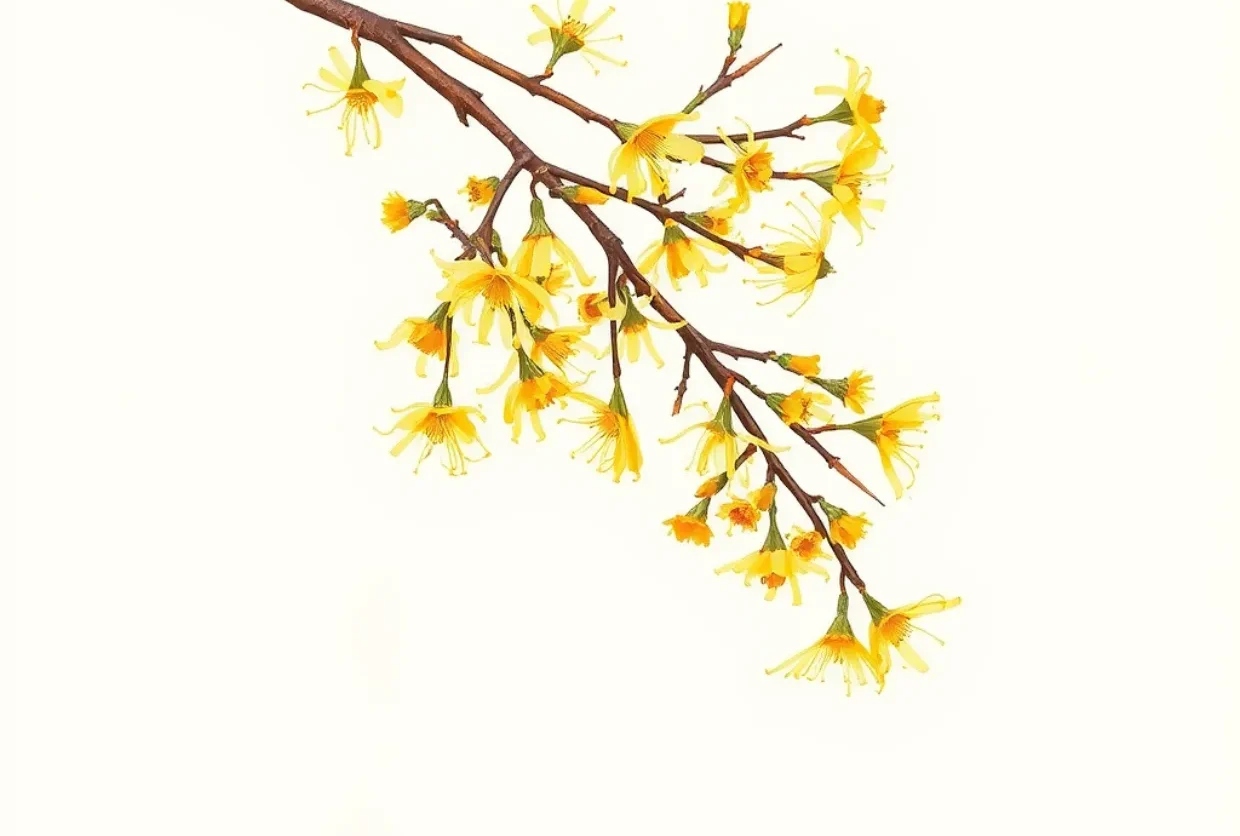
The shrub that flowers when nothing else does. Three different plants are sold under the name and they bloom in different months, so the label matters.
The record
Every plant in the database answers the same questions in the same order, so two entries can be read line for line. 16 of 17 fields sourced.
- Light
- Full sun to partial shade
- Light detail
- Flowers best in full sun; reliable on woodland edges
- Water
- Moderate
- Water detail
- Moist ground; tolerates occasional flooding
- Soil
- Clay or high organic matter, well drained
- Soil pH
- Below 6.0, acidic
- Mature size
- 15 to 30 ft tall, 15 to 20 ft wide
- Toxicity
- not recorded
- Lifecycle
- Shrub
- Difficulty
- Easy
- Hardiness zones
- 3 to 9
- Bloom time
- October to December; February to March in vernal and hybrid types
- Flower color
- Yellow, or orange to red in hybrid cultivars
- Pollinators
- Noctuid moths; seeds feed turkeys and small mammals
- Deer resistant
- Browsed
- Spacing
- 12 to 24 ft apart
- Native range
- Eastern North America
Hardy in zones 3 to 9. Colder than zone 3, grow it in a container and overwinter it under cover.
How long the seed capsules take to ripen. They mature a full year after flowering, then split explosively and fire the seed several feet from the plant.
The year
Plant or divide and prune, and when it is actually in flower. Everything else is leaving it alone.
Which witch hazel you buy decides which month it flowers
Witch hazel is the shrub that flowers when nothing else does, in spidery ribbon-petaled clusters on bare branches. But there are three different plants sold under the name, and they do not flower at the same time of year.
Common witch hazel, Hamamelis virginiana, is the North American native, and NC State gives its bloom as October to December, yellow and fragrant, on branches that are usually still carrying gold autumn leaves.
Vernal witch hazel, H. vernalis, flowers February to March in yellow and orange-red, spicily scented, on bare wood, and holds for three or four weeks.
The hybrids, H. x intermedia, cross the Japanese and Chinese species and also flower February to March, in a range from yellow through orange and red to purple depending on cultivar. These are the ones with the big, showy, colored flowers in nursery photographs.
If the point is a native shrub that closes the autumn, buy the first. If the point is flowers in February, buy either of the other two, and know that the hybrid comes with a complication described further down.
Where it grows
NC State gives common witch hazel as hardy in zones 3a to 9b, which covers almost the whole country, growing 15 to 30 feet tall and 15 to 20 feet wide, spaced 12 to 24 feet apart.
Those are the real numbers and they surprise people who bought it as a shrub. This is a small multi-stemmed tree given thirty years, and it wants that room.
In the wild it grows along woodland margins and stream banks, which describes the conditions it wants: moist, well-drained, acidic soil below pH 6.0, high in organic matter, tolerating clay and occasional flooding. Full sun to partial shade, with the best flowering in full sun.
The woodland-edge origin is the useful part. This is one of the few genuinely good shrubs for the half-shaded strip along a boundary or under high tree canopy, where it will still flower.
The tolerances are worth reading in both directions, because the list of what it accepts is longer than most shrubs and the list of what it refuses is short and absolute. It takes clay, it takes occasional flooding, and it takes anything from full sun to partial shade. What it will not take is ground that is dry through summer, soil that is alkaline, or an exposed position with wind across it. A witch hazel that is failing in an ordinary garden is nearly always in one of those three situations rather than suffering from anything.
Acidity is the tolerance most often missed at the buying stage. NC State puts the requirement below pH 6.0, which means chalky and limey gardens are the wrong home for it, and the symptom is a plant that never quite thrives rather than one that visibly dies. A soil test before planting a slow, expensive shrub is worth the delay.
Named varieties, and which ones stay small
The section above settles which species to buy. This is the level below it, the named plant on the label, and the difference between one cultivar and the next is as much about mature size as about flower color. A Hamamelis chosen for a small winter garden and a Hamamelis chosen for the back of a boundary are not the same purchase.
| Variety | Species | Flower | Mature size |
|---|---|---|---|
| Arnold Promise | H. x intermedia | Fragrant lemon-yellow petals with a red calyx, opening later than most hybrids | 12 to 15 ft, vase-shaped |
| Jelena, also sold as Copper Beauty | H. x intermedia | Coppery-orange twisted petals about an inch long, with orange, red and yellow fall color | 12 to 15 ft, wide spreading |
| Diane | H. x intermedia | Copper-red and only slightly fragrant, with yellow to red fall foliage | 8 to 12 ft tall by 10 to 15 ft wide |
| Ruby Glow | H. x intermedia | Copper-red petals, kinked and twisted, red and orange in fall | 15 ft tall and wide, vase-shaped |
| Goldcrest | H. mollis | Rich golden yellow with wider petals than the species, strongly scented in February | 8 to 10 ft, wide spreading |
| Red Imp | H. vernalis | Petals from copper-red to maroon on the smallest of the garden species | 6 to 10 ft |
| Tim’s Purple | H. vernalis | Purple-red petals, unusual in the genus | 6 to 10 ft |
Sizes here come from the Morton Arboretum for the hybrids and Clemson for the species. Two things fall out of the table. The hybrids are broader than they are tall in several cases, so width is the constraint that catches people, not height. And the fall color is a second season of interest that most buyers do not know they are getting, with some cultivars holding their leaves well into the winter months.
Scent, which varies more by variety than buyers expect
Fragrance on a January afternoon is the reason most people plant a Hamamelis, and it is not distributed evenly across the genus. Chinese witch hazel, H. mollis, carries the strongest scent of the group, and Goldcrest is the selection made for exactly that. Arnold Promise is reliably fragrant. Diane, by the Morton Arboretum’s description, is only slightly so. Jelena, which is among the most widely grown witch hazels in the world, has very little scent at all, and buying it expecting perfume is a common disappointment.
Placement decides whether you get any of it. These are shrubs to plant close to a path or a door, where the flowers are met on a winter day rather than admired from a window. A Hamamelis at the bottom of the garden in February is a plant you look at, not one you smell, and the scented cultivars are wasted there.
Is there a dwarf witch hazel?
Not in any strict sense. The smallest route into the genus is vernal witch hazel, H. vernalis, which Clemson gives as maturing at 6 to 10 feet, against 8 to 15 feet for the hybrids and up to 25 feet for the common witch hazel in the wild. Anything advertised as a dwarf witch hazel is making a relative claim inside that range rather than offering a genuinely small shrub, and nothing sold under the name settles below roughly six feet.
Where the space genuinely is not there, two options work. Growing one in a large pot with a soil-based compost restricts the size severely, standing the pot on feet so it drains through winter. Or prune for size deliberately: the RHS method is to cut the previous season’s growth back to two leaf buds from the main stem straight after flowering, taking care to tell the long narrow leaf buds from the rounder flower buds so the next display survives the operation.
Shrub or tree?
Both descriptions are honest. Clemson calls witch hazels large shrubs, or in some instances small trees, and the Morton Arboretum classifies the hybrids as a compact tree of 10 to 15 feet. The plant is naturally multi-stemmed and grows into an open, loosely branched, slightly zigzagging vase, and that habit is most of why it is worth having in a winter garden.
Anything sold as a witch hazel tree is the same plant with the lower stems removed. It can be limbed up into something closer to a single-trunk small tree, and the upright form leaves room to plant bulbs or small perennials underneath. What does not work is treating it as a rounded shrub: grown in shade it makes long gangly shoots, and sheared into a ball it stops flowering altogether.
Planting and pruning
- Plant between October and April
The dormant window is the one to use, and bare-root or field-grown plants go in then. Avoid planting when the ground is frozen or waterlogged. Container-grown witch hazels can technically go in at any time, but one planted in spring or summer needs careful, regular watering through its first season to make up for it.
- Do not bury the graft union
On a grafted hybrid, and most of them are grafted, the swollen joint near the base of the stem stays above the soil. Planting deep buries it, and a buried union is what turns the sucker problem described below from an occasional chore into a permanent one. Set the plant so only the uppermost roots are covered.
- Give it the space it will need
Twelve to twenty-four feet apart. A witch hazel planted three feet off a path is a pruning problem for the rest of its life.
- Keep it moist while it establishes
It comes from stream banks and woodland edges. The first two summers are when a dry spell does lasting damage.
- Prune straight after flowering
That is the window. Next year’s buds form through the summer, so pruning later removes them.
- Cut back to a branch, not to a stub
Take branches out at their point of origin. The plant’s natural form is open and vase-shaped, and shearing destroys it.
- Remove suckers at the base
Dig them out in very early spring as soon as the soil can be worked, before growth starts. On a grafted plant this is not optional; see below.
The grafting problem, on hybrids only
Hybrid witch hazels are almost always grafted onto common witch hazel roots, and that rootstock sends up suckers from below the graft union.
Left alone, those suckers are vigorous, they are common witch hazel rather than the cultivar you paid for, and they gradually take over. The classic outcome is a shrub that flowered orange in February for a few years and now flowers yellow in November, and the owner concludes it changed. It did not; the rootstock won.
Suckers are easy to identify once you know the tell: the RHS notes they hold on to their leaves longer in autumn than the rest of the plant, so a shoot still green when the canopy has turned is almost always rootstock. The fix is trivial if it is done: pull or dig suckers from the base every spring, cutting them off as close to the main stem as possible, because any stump left behind simply shoots again. Look for the graft union near ground level, and treat everything emerging below it as a weed.
What it does for wildlife
NC State records something unusual here. The flowers are pollinated by noctuid moths, which are active in cold weather when almost nothing else is flying, and that is exactly why this plant blooms when it does.
The seeds are eaten by wild turkeys and small mammals, birds take the fruit, deer browse the leaves, and it is a host plant for witch hazel dagger moth larvae.
The seed capsules do one more thing worth watching for: they ripen a full year after flowering and then split explosively, firing the seed several feet from the plant. That is the faint cracking sound from a witch hazel on a warm autumn day.
What goes wrong
NC State’s summary is short and unusual: no serious pests. Occasional caterpillars, Japanese beetles, leaf gall aphids, powdery mildew and leaf spots.
Leaf gall aphids produce cone-shaped bumps on the upper leaf surface that look alarming and do no meaningful harm. Powdery mildew and leaf spot arrive late in the season on a plant that is about to drop its leaves anyway.
Two root diseases are worth knowing about even though neither is common, because both are fatal and neither announces itself until the plant is already going. Phytophthora root rot follows wet, badly drained ground, which is the one soil condition this shrub does not tolerate, and honey fungus can take an established plant from below with no warning above ground. The symptom in both cases is the same and unhelpful: gradual decline, thin growth, and eventual collapse. Prevention is drainage, and there is no treatment.
Animals matter more than insects here. Rabbits and deer both browse witch hazel and are a genuine problem in rural gardens, particularly on a young plant whose whole framework is within reach. A guard around the base for the first few years costs almost nothing against the price of the shrub. In containers, vine weevil larvae are the pest to watch: the adults notch the leaf margins visibly, and the grubs eat the roots invisibly until the plant is beyond saving.
Everything else on the failure list is cultural and is covered above: drying out while establishing, shearing instead of thinning, a buried graft, and a rootstock allowed to take over.
The genuine failures are cultural rather than biological: a plant that dries out badly while establishing, one sheared into a ball so it stops flowering, and a grafted hybrid quietly replaced by its own rootstock.
Toxicity, in plain terms
NC State’s entry for common witch hazel carries no toxicity listing, and the record on this page reads not recorded rather than a confident no, because an absent listing is not a positive statement of safety.
What can be said is that witch hazel extract is a long-standing skincare preparation made from the bark and twigs, and NC State notes the various medicinal uses, especially for skin. This is not a plant gardeners treat as a hazard.
Frequently asked questions
- When does witch hazel flower?
- It depends which one you have. The native Hamamelis virginiana flowers October to December; vernal witch hazel and the x intermedia hybrids flower February to March. Buying the wrong one is the usual reason the flowering time is not what was expected.
- Why is mine suddenly a different color?
- It is a grafted hybrid being taken over by its rootstock. Hybrids are grafted onto common witch hazel, which suckers from below the graft; those suckers flower yellow in autumn. Remove everything growing from below the union each spring.
- What is the best witch hazel variety?
- Arnold Promise for scent and a late yellow display, Jelena for coppery-orange flowers and the best fall color, Diane for red, and Goldcrest if a strong February fragrance matters most. All are 8 to 15 feet at maturity, so the choice is as much about the space you have as the flower.
- Is there a dwarf witch hazel?
- Not really. Vernal witch hazel is the smallest garden species at 6 to 10 feet, and anything sold as dwarf is relative to a genus where 15 feet is normal. For a tight spot, grow one in a large pot or prune the previous season’s growth back to two leaf buds right after flowering.
- Is witch hazel a shrub or a tree?
- A large multi-stemmed shrub that behaves like a small tree with age. Clemson describes the genus as large shrubs or small trees, and the Morton Arboretum classifies the hybrids as a compact tree of 10 to 15 feet. The natural shape is an open vase, not a ball.
- How big does it get?
- NC State gives 15 to 30 feet tall and 15 to 20 feet wide for the native species, spaced 12 to 24 feet apart. It is sold as a shrub and matures into a small multi-stemmed tree, so it needs the room from the start.
- Will it flower in shade?
- Yes, and it is one of the better shrubs for part shade since it grows naturally on woodland edges. Flowering is best in full sun, so shade costs you flowers rather than health.
- When should I prune it?
- Immediately after it flowers. Next year’s buds form over summer, so a later cut removes the display. Take whole branches back to their point of origin rather than shearing, because the open vase shape is most of the plant’s character.
Companion plants
How this entry is compiled
- Care values come from university extension publications and the USDA hardiness map, never from other gardening sites.
- Toxicity follows the ASPCA listing and is quoted rather than summarized.
- A value we cannot source is printed as not recorded, never estimated.
Compiled and checked by the Gardnicks editorial desk · last checked 2026-08-16
Sources for this entry
- NC State Extension Gardener Plant Toolbox, Hamamelis virginiana
- Iowa State Extension, All About Witch Hazels
- The Morton Arboretum, Hybrid witch-hazels
- Clemson HGIC, Witch Hazel
Where two sources disagree, the entry follows the one closest to the plant’s own growing region and says so in the text.
What kills it
Three failures cover almost everything readers write in about.
More in Flowers
 Begonia
Part shade · zones 10 to 11
Begonia
Part shade · zones 10 to 11
 Lily
Full sun · zones 3 to 8
Lily
Full sun · zones 3 to 8
 Rose
Full sun · zones not recorded
Rose
Full sun · zones not recorded
 Yarrow
Full sun · zones 3 to 9
Yarrow
Full sun · zones 3 to 9
Plates are illustrations, not photographs of a specific plant, and are not evidence of a variety, place or season.