Lily
Lilium spp.
True lily / tiger lily
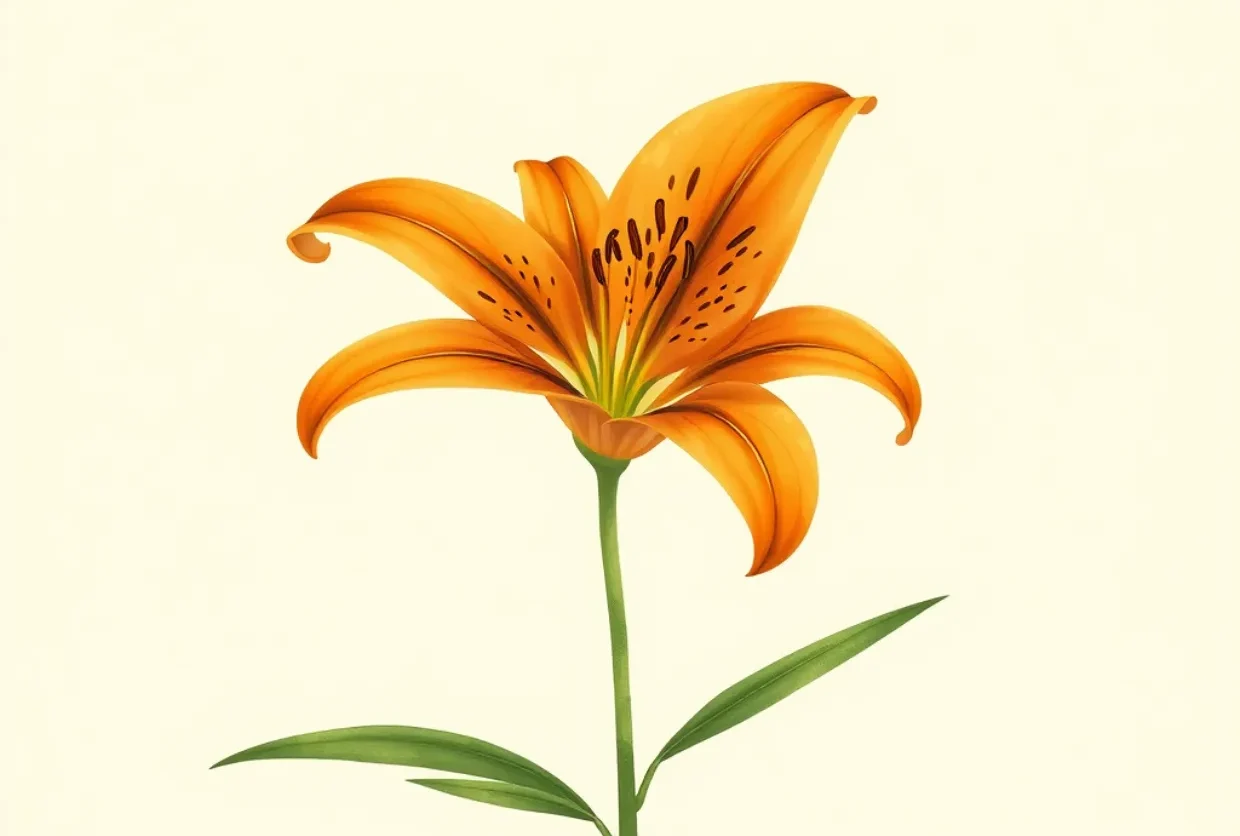
Hardy, long lived and easy, with one hard condition attached: in a house with a cat, true lilies do not belong indoors or in the garden at all.
The record
Every plant in the database answers the same questions in the same order, so two entries can be read line for line. 16 of 17 fields sourced.
- Light
- Full sun
- Light detail
- 6 hours or more; flowering diminishes in shade
- Water
- Moderate
- Water detail
- Even moisture, never waterlogged
- Soil
- Fertile, well drained, high in organic matter
- Soil pH
- Below 6.0, acidic
- Mature size
- 1 to 6 ft tall, 8 in to 2 ft wide
- Toxicity
- Serious risk to cats. Cornell reports that one or two leaves, or pollen ingested during grooming, can cause severe kidney failure; all parts including vase water are toxic. NC State lists lilies as non-toxic to dogs and horses.
- Lifecycle
- Perennial
- Difficulty
- Easy
- Hardiness zones
- 3 to 8
- Bloom time
- June to August
- Flower color
- Orange, white, pink, yellow or red, often spotted
- Pollinators
- Swallowtail butterflies and hummingbirds
- Deer resistant
- not recorded
- Spacing
- 12 in to 3 ft apart
- Native range
- Temperate North America, Europe and Asia
Hardy in zones 3 to 8. Colder than zone 3, grow it in a container and overwinter it under cover.
Planting depth, in autumn. Far deeper than most bulbs, and it is what anchors a stem that can reach six feet without falling over.
The year
Plant or divide and prune, and when it is actually in flower. Everything else is leaving it alone.
Toxic to pets
Serious risk to cats. Cornell reports that one or two leaves, or pollen ingested during grooming, can cause severe kidney failure; all parts including vase water are toxic. NC State lists lilies as non-toxic to dogs and horses.
If you have a cat, read this part first
NC State lists Lilium as non-toxic to dogs and horses and a problem for cats. That flat wording understates it, and this is the one plant page where the safety note belongs at the top rather than near the bottom.
Cornell’s Feline Health Center is direct: a cat that eats one or two leaves, or that ingests a small amount of pollen while grooming, can suffer severe kidney failure. Every part of the plant counts, including the petals, the pollen and the water in the vase. Signs appear within roughly six to twelve hours as vomiting, loss of appetite, lethargy and dehydration.
The practical consequence is simple and worth stating plainly: in a house with a cat, true lilies do not belong indoors as cut flowers or pot plants, and a lily bed is a real risk to a cat that goes outside. If a cat has been near one and is unwell, a vet visit is urgent rather than something to watch overnight.
Daylilies, Hemerocallis, carry the same danger to cats despite being a different genus entirely. Peace lily, calla lily and lily of the valley are also not true lilies; they have their own separate toxicity, so the name alone tells you nothing.
What a true lily actually is
NC State describes lilies as herbaceous perennials in the family Liliaceae, native across the temperate parts of North America, Europe and Asia, growing from bulbs made of fleshy scales.
Those scales matter more than they sound. A lily bulb has no papery skin holding moisture in, which is why it dries out on a shop shelf in a way a tulip bulb does not, and why lilies are the bulb worth buying early and planting straight away.
The genus runs 1 to 6 feet tall and 8 inches to 2 feet wide, hardy in zones 3a to 8b, which is a wider cold range than most summer flowers manage.
Types of lilies: the divisions, and what each one is like to grow
Almost every lily sold today is a hybrid, so the trade sorts them into divisions based on parentage and flower shape rather than on species. The division on the label tells you when it flowers, how tall it gets, whether it is scented and what soil it wants, which is more practical information than the cultivar name.
| Division | Flower and habit | When it flowers | What to know |
|---|---|---|---|
| Asiatic hybrids | Upward-facing, wide range of colors, unscented | Earliest, early summer | The easiest to grow and the most tolerant of ordinary soil. Start here |
| Martagon hybrids, the Turk’s cap lilies | Tall stems hung with many small down-facing flowers, petals curled fully back, leaves in whorls | Early summer | The one group that takes part shade. Slow to settle, then very long-lived |
| Trumpet and Aurelian hybrids | Thick waxy petals forming a deep trumpet, strongly scented | Midsummer, a few weeks after the Asiatics | Tall and heavy-headed, so they usually need staking |
| Oriental hybrids | Enormous open flowers, intensely fragrant, often white or pink with spots | Late summer, last of the season | Wants neutral to slightly acid soil, and resents lime |
| Orienpet and LA hybrids | Crosses between the divisions, combining Oriental size with Asiatic vigor | Mid to late summer | The strongest garden performers of the lot, and usually the tallest |
| Species lilies | The wild forms, including the tiger lily | Varies by species | Tougher and more variable than the hybrids, and often the ones that naturalize |
A practical way to use that table: plant one division from each flowering window and the lily season runs from early summer to the end of August on the same patch of ground, because the divisions are staggered rather than simultaneous.
The plants called lily that are not lilies
This matters more than it sounds, because the toxicity warning at the top of this entry applies to true lilies and not to most of the plants below. Getting the identification wrong in either direction leads to the wrong decision about a cat.
- Daylily, Hemerocallis, is not a Lilium and is not even in the same family. It is, however, in the same danger category for cats, which makes it the one exception on this list.
- Peace lily, Spathiphyllum, is an aroid houseplant. It causes mouth and throat irritation rather than kidney failure.
- Calla lily, Zantedeschia, is another aroid, with the same irritant effect rather than the true-lily one.
- Pineapple lily, Eucomis, is a South African bulb grown for its pineapple-shaped flower spike.
- Flamingo lily, Anthurium, is an aroid houseplant grown for its glossy red spathe.
- Lily of the valley, Convallaria, is a shade groundcover and is seriously toxic in its own right, to people as well as pets, but by a different mechanism.
The rule that covers all of it: if the botanical name begins with Lilium, it is a true lily and the cat warning applies in full. If it does not, look the plant up under its own name rather than assuming the word lily tells you anything.
Site and soil
Full sun at six hours or more, or partial shade at two to six. NC State notes flowering diminishes in shadier conditions, so shade is tolerated rather than wanted.
Soil should be fertile, well drained and high in organic matter, at an acidic pH below 6.0. Drainage is the one non-negotiable: NC State names bulb rot from overly wet soil among the common problems, and a rotted bulb does not recover.
The old advice about keeping the roots cool and the head in the sun holds up here, and mulch is the practical way to do it.
Planting
- Plant in autumn, eight inches deep
NC State’s figure. That depth is much deeper than most bulbs and it is what anchors a stem that may end up five feet tall.
- Buy early and plant promptly
Scaly bulbs dry out in storage. A firm, plump bulb is worth paying for; a shriveled one rarely catches up.
- Space 12 inches or more apart
Close enough to read as a group, far enough that air moves between the stems, which is what keeps botrytis off the foliage.
- Stake the tall ones before they need it
NC State notes taller varieties may require staking. A stem carrying six open trumpets is top-heavy in the first summer storm.
- Mulch and leave them
The bulbs stay in the ground over winter with the scales intact. Lilies resent being lifted and moved, and improve where they are left alone.
Through and after flowering
Bloom runs June through August depending on the type, and the sequence is worth knowing when buying: Asiatic types open first, trumpets and Orientals follow, so a mixed planting flowers across the whole summer instead of for a fortnight.
NC State’s after-care instruction is two-part and people usually do only the first half. Deadhead the spent flowers to stop the plant spending energy on seed, then cut the stems back after bloom once the foliage yellows.
The timing on that second half is the whole point. Green leaves are refilling the bulb for next year, and cutting the stem down while it is still green is the most common reason a lily flowers well the first summer and poorly the second.
Tiger lily, and why it needs its own paragraph
The orange spotted tiger lily, Lilium lancifolium, is the one most people picture, and it behaves differently from the rest.
It grows 2 to 6 feet in zones 5a to 8b, flowers bright orange with dark spots in summer, and attracts swallowtail butterflies and hummingbirds. It also produces small bulbils in the leaf axils that drop to the ground and grow, which makes it the easiest lily to propagate and the reason NC State warns that it spreads asexually and can become weedy. It is naturalized across eastern North America off the back of exactly that habit.
If you want it contained, pick the bulbils off before they drop. If you want a colony, do nothing at all.
What goes wrong
NC State’s list: aphids, bulb mites, slugs, snails, narcissus bulb fly, botrytis and bulb rot in wet soil.
Aphids carry more weight here than on most plants because they transmit lily mosaic virus, which is not curable. Streaked, mottled foliage with distorted growth means removing the plant rather than treating it.
Botrytis shows as brown blotches on leaves in damp weather and is largely a spacing and airflow problem. Slugs work on the new shoots in spring, before there is anything visible to admire, which is when nobody is checking.
The pest not on the list, and now the most destructive one in much of the country, is the scarlet lily beetle: a bright red half-inch beetle whose larvae strip the foliage. It is conspicuous and hand-picking is genuinely effective if it is done early.
Frequently asked questions
- What are the main types of lilies?
- By division: Asiatic hybrids flower first and are the easiest, martagons are the Turku2019s cap type and the only group that takes part shade, trumpets are scented and midsummer, Orientals are the huge fragrant late ones, and the Orienpet and LA crosses are the strongest garden performers. Species lilies, including the tiger lily, are the wild forms.
- What is a Turku2019s cap lily?
- A martagon, division two. Tall stems carrying many small down-facing flowers whose petals curl all the way back, with leaves arranged in whorls up the stem. It is slow to settle after planting and then extremely long-lived, and it is the lily to use where the site is part shade.
- Is a pineapple lily or a flamingo lily a real lily?
- Neither. Pineapple lily is Eucomis, a South African bulb, and flamingo lily is Anthurium, an aroid houseplant. Only plants whose botanical name begins with Lilium are true lilies, and only those carry the severe cat risk described above, along with the daylily.
- How do I get lilies to flower for the whole summer?
- Plant one division from each flowering window rather than several cultivars of one. Asiatics open in early summer, trumpets follow a few weeks later, and Orientals and Orienpets carry it into late summer, so the same bed flowers from June into August.
- Are lilies really that dangerous to cats?
- Yes. Cornell’s Feline Health Center reports that one or two leaves, or pollen ingested during grooming, can cause severe kidney failure, and that every part including the vase water is toxic. Signs come on within six to twelve hours. In a house with a cat, keep true lilies and daylilies out entirely, and treat any exposure as an emergency.
- Are peace lilies and daylilies the same risk?
- Daylilies, Hemerocallis, carry the same kidney risk to cats even though they are a different genus. Peace lily, calla lily and lily of the valley are not lilies at all and have separate toxicity of their own. The common name is not a guide to any of it.
- Can I cut the leaves down after flowering?
- Not while they are green. Deadhead the flowers straight away, but leave the stem and foliage until they yellow, because that is the bulb refilling itself for next year. Cutting early is the usual reason a second season disappoints.
- How deep do lily bulbs go?
- Eight inches, planted in autumn. That is deeper than most bulbs and it is doing real work: it anchors a stem that can reach six feet and keeps the bulb at a stable temperature.
- Why did mine not come back?
- Most often bulb rot from ground that stays wet, since lilies need genuine drainage. The other common causes are foliage cut down while still green, and virus spread by aphids, which shows as streaked distorted leaves and cannot be treated.
Companion plants
How this entry is compiled
- Care values come from university extension publications and the USDA hardiness map, never from other gardening sites.
- Toxicity follows the ASPCA listing and is quoted rather than summarized.
- A value we cannot source is printed as not recorded, never estimated.
Compiled and checked by the Gardnicks editorial desk · last checked 2026-08-16
Sources for this entry
- NC State Extension Gardener Plant Toolbox, Lilium
- NC State Extension Gardener Plant Toolbox, Lilium lancifolium
- Cornell Feline Health Center, Common Cat Hazards
- Cornell Feline Health Center, Poisons
Where two sources disagree, the entry follows the one closest to the plant’s own growing region and says so in the text.
What kills it
Three failures cover almost everything readers write in about.
More in Flowers
 Lantana
Full sun · zones 7 to 11
Lantana
Full sun · zones 7 to 11
 Rose
Full sun · zones not recorded
Rose
Full sun · zones not recorded
 Salvia
Full sun · zones 3 to 8
Salvia
Full sun · zones 3 to 8
 Hyacinth
Full sun · zones 4 to 8
Hyacinth
Full sun · zones 4 to 8
Plates are illustrations, not photographs of a specific plant, and are not evidence of a variety, place or season.