Japanese maple
Acer palmatum
Japanese maple
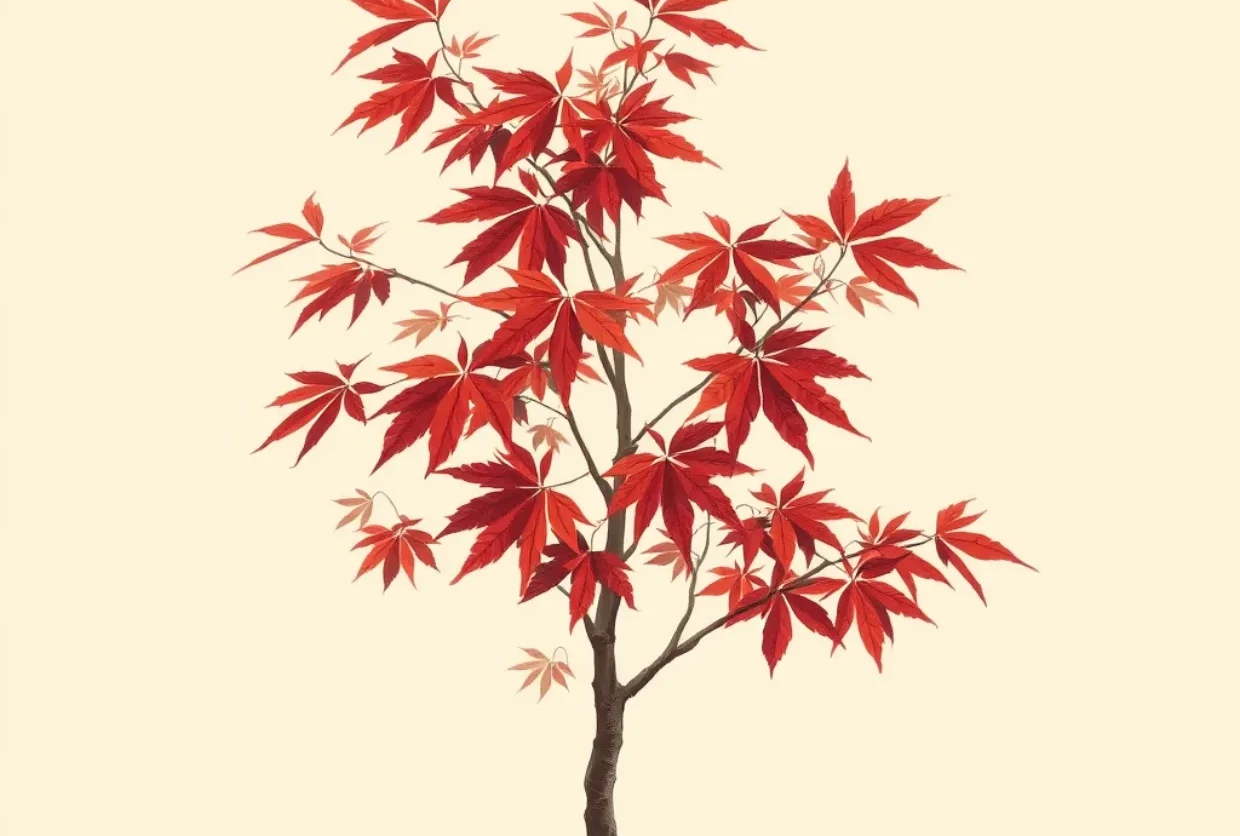
An understory tree that asks almost nothing once it is in the right place, and never recovers from the wrong one. Scorched leaves are a siting fault.
The record
Every plant in the database answers the same questions in the same order, so two entries can be read line for line. 13 of 16 fields sourced.
- Light
- Part shade
- Light detail
- Dappled sun through an upper canopy; morning sun with afternoon shade
- Water
- Moderate
- Water detail
- Consistent moisture; dry soil is what causes scorch
- Soil
- High in organic matter, moist, well drained
- Soil pH
- not recorded
- Mature size
- 15 to 25 ft tall, 10 to 25 ft wide
- Toxicity
- not recorded
- Lifecycle
- Tree
- Difficulty
- Moderate
- Hardiness zones
- 5 to 8
- Growth rate
- Slow
- Root spread
- not recorded
- Pruning window
- Late autumn or winter, never spring
- Bloom time
- Spring, small red to purple flowers
- Deer resistant
- Partially
Hardy in zones 5 to 8. Colder than zone 5, grow it in a container and overwinter it under cover.
Cures for verticillium wilt. Maples are quite susceptible, it lives in the soil, and it kills one side at a time. Water to reduce stress and do not replant a maple in that spot.
The year
Plant or divide and prune, and when it is actually in flower. Everything else is leaving it alone.
The tree is easy. The position is the whole job
Japanese maples need almost nothing once they are in the right place, and they never recover from the wrong one. Nearly every complaint about them, brown crisp leaf edges by July, comes down to where they were planted rather than what was done to them afterwards.
NC State gives the light requirement as dappled sunlight, shade through an upper canopy all day, and names leaf scorch among the standard problems, brought on by excess sun, wind or drought.
That is a description of a woodland understory tree, and it is the opposite of the position they are usually given: alone in the middle of a lawn, in full afternoon sun, in the wind. The Morton Arboretum’s summary is the same one from another direction, that they do best in a partly shaded site with a consistent supply of water.
Morning sun with afternoon shade is the practical version. The east side of a house, the north-east corner, or under the light canopy of a taller tree.
What goes underneath follows from the same conditions. The root area wants to stay cool and evenly moist, so the underplanting should be shade-tolerant and shallow: ferns, hostas and heucheras all work, and all three contrast in leaf texture with a maple rather than competing with it. Keep them out of the first foot or so around the trunk and let mulch do that part. In a small garden an evergreen behind the tree earns its place twice over, giving the fine leaves something to read against in summer and holding the picture together once the maple is bare.
Size, which is usually underestimated
NC State gives 15 to 25 feet tall and 10 to 25 feet wide, at a slow to moderate growth rate.
Slow growth is why the size gets ignored. The tree in the pot is three feet tall and stays small enough for years that the mature figures feel theoretical, and then it is twenty feet across and four feet from the house.
The dissectum group, the weeping cut-leaf forms, stay far smaller and mound rather than climb, which is why they suit small gardens and large pots. The upright forms are proper small trees. Both are sold as Japanese maples and the label is the only way to tell which you are buying.
Forms and cultivars, and what the label is telling you
There are well over a thousand named Japanese maple cultivars, which sounds unmanageable and is not, because only two things on the label decide what you are buying: the form of the tree and the cut of the leaf. Everything else is color. The cultivars below are ones the Morton Arboretum records as reliable in zone 5 when properly sited.
| Cultivar | Form and leaf | Mature size | Fall color |
|---|---|---|---|
| Bloodgood | Upright and rounded. Whole leaf, purple-red through summer | 18 ft tall and wide | Red |
| Emperor I, sold as Acer palmatum Wolff | Upright and rounded. Whole leaf, purple-red | 18 ft tall by 16 ft wide | Scarlet. Late to leaf out, so it escapes late frosts better than most |
| Coral Bark, Sango-kaku | Upright. Whole leaf, green | Up to 25 ft tall by 20 ft wide | The young branches turn coral red and deepen through winter, which is the point of it |
| Lion’s Head, Shishigashira | Vase-shaped and compact. Whole leaf, crinkled and deep green | 15 ft tall by 10 ft wide | Golden to orange-red |
| Crimson Queen | Weeping and mounded. Dissected leaf, purple-red | 6 ft tall by 8 ft wide | Scarlet |
| Tamukeyama | Weeping and mounded. Dissected leaf, emerging crimson and deepening to purple-red | 10 ft tall by 12 ft wide | Not recorded |
| Orangeola | Weeping. Highly dissected leaf, orange in spring and green through summer | 8 ft tall and wide | Bright orange |
| Viridis | Weeping. Dissected leaf, green | 8 to 10 ft tall by 8 ft wide | Gold to orange-red |
Read the size column before the color one. The range in that table runs from six feet to twenty-five, which is a wider spread than the species figures on this page suggest, and it means the cultivar name rather than the words Japanese maple is what tells you the tree you are taking home.
The form is permanent, too. A weeping dissectum mounds outward and downward and will never become an upright tree, however long it is left, and an upright cultivar cannot be trained into the low cascading shape people usually have in mind. Choosing the wrong one is not correctable by pruning.
Soil and water
High organic matter, moist, well drained. The combination matters more than either half: they want steady moisture and they will not sit in water.
Consistent water is the direct defense against scorch. Deep, occasional watering in dry spells is worth more than a daily sprinkle, and mulch over the root area does more than either, because it holds moisture and keeps the shallow roots cool.
Acidic ground high in organic matter is what the tree is actually asking for. It will grow in poor soil, but New Hampshire Extension is blunt about the cost: growth is much slower and the tree is far more likely to be stressed, which on a plant this slow and this expensive is a long time to spend regretting the position.
The scorch symptom is worth recognizing precisely, because it is the most common complaint about this tree and it is regularly mistaken for disease. Scorched leaves develop brown, dry margins while the middle of the leaf stays green, and they often drop from the tree by mid to late summer. Nothing is infecting it. The roots cannot supply water as fast as hot sun and wind are taking it out of the leaf, and the fix is shade, mulch and water rather than a spray.
Full sun is possible, but only on one condition: the soil has to be kept evenly moist through the whole season, which in practice means irrigation. Without that, sun plus dry soil is the combination that produces scorch every year. The rule of thumb worth carrying is that the darker the foliage, the more sun the cultivar will take, which is the other half of the color trade described further down.
Planting
- Dig wide and shallow, not deep
The hole should be two to three times the width of the root ball and no deeper than it. A saucer, not a coffee can. Almost all the roots this tree will ever have are going to run outward in the top foot of soil, and that is the volume worth loosening.
- Set it slightly high
The root flare, where the trunk widens into the roots, sits at or just above the surrounding soil level. A tree planted deep is the single most common slow failure in the genus, and it declines over years rather than showing a problem in the first season.
- Deal with circling roots before backfilling
Container-grown maples are often root-bound. Tease the outer roots free, and cut through any that circle the ball. A root left circling eventually girdles the trunk it is wrapped around, which is fatal and entirely preventable at this moment.
- Choose a sheltered position
New Hampshire Extension recommends protection from harsh winter wind and advises against low-lying spots, where cold air settles. Some dieback after a hard winter is normal in zones 5 and 6, and shelter is what limits it.
- Expect late frost damage and do not act on it
Japanese maples leaf out early and are specifically sensitive to late spring frosts. Blackened new growth looks alarming and the tree usually pushes a second flush. Cutting into it immediately removes wood that was going to recover.
- Mulch out to the branch tips, and keep it off the trunk
The mulch ring is doing three jobs at once: holding moisture, keeping the shallow roots cool, and keeping mowers away from the bark.
Pruning
- Not in spring
Maples are bleeders. Cut in spring and the tree loses a great deal of sap through the wound. Late autumn or winter, when it is dormant, is the window.
- Take less than you think
The shape is the plant’s own. Most Japanese maples need thinning, not shortening, and a tree cut back hard rarely looks right again.
- Open the interior
Removing crossing and inward branches lets light and air through the canopy, which suits both the look of the tree and its health.
- Disinfect between cuts
Standard practice on a genus this susceptible to verticillium wilt, which spreads on tools as well as through soil.
- Leave the leader alone on upright forms
Cutting the top out of an upright variety produces a permanent flat-topped shape.
The leaves: fall color, and whether the tree loses them
The leaf is the whole reason for the tree, and it is worth being able to describe. Foliage on Acer palmatum is 2 to 5 inches across, carried in opposite pairs, and simple rather than compound: one blade cut into five, seven or nine sharply pointed lobes, most of them cut deeply toward the center. The effect is a spread hand, which is where the species name comes from, palmatum meaning palm-shaped. On the dissectum cultivars that cutting goes much further, until each lobe is itself shredded into fine threads, and that is the difference the word laceleaf is pointing at.
Japanese maples are deciduous and they drop every leaf each autumn. The question comes up as often as it does because so many cultivars carry red or purple foliage right through summer, which makes them read as evergreen at a glance, and because the fall display arrives late and holds for a long time compared with most trees.
Fall color runs by cultivar rather than by the species, which is why the table above lists it as its own column. Red-leaved uprights such as Bloodgood and Emperor I finish red to scarlet; the green cultivars, including Viridis and Lion’s Head, turn gold and orange-red, which is often the more striking change because the contrast is greater; and Orangeola runs orange in spring, green in summer and orange again in fall, giving three distinct seasons from one tree. Coral Bark adds a fourth, since its display continues after the leaves have gone: the young branches turn coral and deepen through the coldest months, which is unusual value in a small garden where nothing else is doing anything in January.
There is a trade-off buried in the siting advice on this page, and it is worth stating plainly. The dappled shade that prevents leaf scorch also costs some color intensity: the red cultivars need a fair amount of light to color properly, while the yellows and greens are the ones that prefer more shade. So on a hot, exposed site the answer is a green-leaved cultivar in shade rather than a red one being asked to take sun it cannot handle.
Two other leaf events are normal rather than faults. New growth caught by a late frost blackens and looks alarming, and the tree usually pushes a second flush. And on many cultivars the spring leaves emerge one color and settle into another within a few weeks, which is not the plant reverting or being mislabeled.
Fertilizer, and why the answer is usually none
This is the most-asked question about the tree and the shortest to answer. Japanese maples need very little added fertilizer, particularly in soil that is already high in organic matter, which is the soil this page recommends anyway.
- Do not feed a newly planted tree at all. New Hampshire Extension is direct about it: the roots are unlikely to be able to take the nutrients up, so the feed does nothing except sit in the ground.
- On an established tree, feed only if it is genuinely growing too slowly. If it goes on at all, it goes on in spring before the leaves emerge, as a slow-release blend for trees and shrubs, or one formulated for acid-loving plants.
- Never in fall. A late feed pushes soft new growth that will not harden off before winter, and that growth is what dies back in the first hard freeze.
- Compost and mulch over the root area do the job better. They feed slowly, hold moisture and keep the shallow roots cool, which is the thing this tree actually suffers for the lack of.
Overfeeding is worse here than on most trees. A plant grown for its form, its fine branching and its leaf color responds to a heavy feed by producing fast, soft, coarse growth, which is the opposite of everything it was bought for.
Growing one in a pot
A Japanese maple can be grown in a container, and the dwarf and dissectum cultivars are the ones that suit it, being naturally small and slow. The genus has been used for bonsai for centuries, which is the extreme version of the same idea.
Two things need attention. At planting, take the tree out of its nursery pot and cut away any circling or girdling roots; if the rootball is solid, score it with a knife to push new roots outward, because a root-bound maple planted as it comes will strangle itself over years. And in zone 5 or colder, a containerized tree needs protecting through winter somewhere the pot will not freeze solid, since the roots in a pot have none of the insulation that open ground gives them.
What goes wrong
NC State lists Japanese maple scale, aphids, leafhoppers and maple worms among insects, and anthracnose, leaf scorch and frost damage among diseases and disorders.
Leaf scorch is the common one: brown, dry margins on otherwise green leaves, worst on the sunny and windy side. It is a water-supply problem, not a fungus, and no spray touches it. Mulch, deep watering and, if the position is genuinely wrong, moving the tree while it is still small.
Verticillium wilt is the serious one. Maples are quite susceptible, it lives in the soil, and it typically shows as one branch or one side wilting and dying while the rest looks fine. There is no cure. Iowa State and Wisconsin both give the same management: reduce stress with regular watering and prune dead wood out with disinfected tools between cuts. A tree that is lost to it should not be replaced with another maple in the same spot.
Late frost catches the young leaves, which NC State flags specifically. It looks alarming and the tree usually pushes a second flush.
Scale and aphids are the insects most often actually found. Japanese maple scale appears as small hard bumps along the bark rather than as anything moving, and heavy infestations thin the canopy over a couple of seasons. Aphids are more obvious by their by-product than themselves: sticky honeydew on the leaves and on whatever is parked underneath, followed by black sooty mold growing on the honeydew. The mold is harmless in itself and disappears once the aphids are dealt with, which on a small tree is usually a matter of a strong jet of water and leaving the predators alone.
Girdling roots belong on this list even though they are not a pest. A tree planted from a root-bound container, or planted too deep, can be strangled by its own root over ten or fifteen years. The signs are a trunk that goes straight into the ground with no visible flare, thinning growth on one side, and early fall color on that same side. It is diagnosed by excavating the top few inches of soil around the trunk, and it is the reason the planting section above spends a step on it.
One practical note on verticillium: the symptoms overlap with drought stress, root damage and girdling roots, and the difference matters because the responses are opposite. If a whole side of an established maple is dying while the rest looks well, it is worth having an arborist confirm the diagnosis rather than assuming the worst, since a tree lost to verticillium means no maple can be replanted in that spot.
Two things worth knowing before buying
NC State records that Acer palmatum self-seeds readily and is listed as invasive in Virginia and the District of Columbia. Away from those areas it is still worth knowing that seedlings appear around a mature tree and are easy to pull while small.
It is also described as mildly resistant to damage by deer, which is a real but modest advantage, and not the same as deer-proof.
Toxicity, in plain terms
NC State’s entry carries no toxicity listing for Acer palmatum, and this page records that as not recorded rather than a confident no, because an absent listing is not a positive statement of safety.
The maple worth flagging is a different one: red maple, Acer rubrum, whose wilted leaves are seriously toxic to horses. That warning belongs to that species and does not transfer to this one.
Frequently asked questions
- Why are the leaf edges brown and crispy?
- Leaf scorch, from too much sun, wind or dry soil. NC State lists all three as causes. It is not a disease and nothing sprayed will fix it. Mulch, water deeply in dry spells, and if the position is wrong, move the tree while it is small enough to move.
- How much sun can it take?
- NC State’s requirement is dappled sunlight, shade through an upper canopy all day. In practice, morning sun with afternoon shade works well and full afternoon exposure does not.
- When should I prune it?
- Late autumn or winter, while dormant. Maples bleed heavily from spring cuts. Thin rather than shorten, and disinfect tools between cuts because the genus is susceptible to verticillium wilt.
- One side of my tree died. What happened?
- That pattern is characteristic of verticillium wilt, which maples are quite susceptible to. It comes from the soil and cannot be cured. Water regularly to reduce stress, prune dead wood with disinfected tools, and do not plant another maple in the same spot.
- Do Japanese maples lose their leaves?
- Yes, they are deciduous and drop every leaf in autumn. The question comes up because so many cultivars are red or purple all summer, which makes them look evergreen, and because the fall display arrives late and lasts.
- What fertilizer does a Japanese maple need?
- Usually none. Do not feed a newly planted tree, since the roots cannot take it up. On an established tree, feed only if growth is genuinely too slow, in spring before the leaves emerge, with a slow-release blend. Never feed in fall, because the soft growth will not harden off before winter.
- What is the difference between an upright and a weeping Japanese maple?
- The form is fixed by the cultivar. Uprights such as Bloodgood become rounded small trees of 18 feet or so with whole leaves. Weeping dissectum types such as Crimson Queen, Orangeola and Viridis have finely cut leaves and mound outward at 6 to 10 feet. Neither can be pruned into the other.
- Can a Japanese maple grow in a pot?
- Yes, and the dwarf and dissectum cultivars are the ones for it. Cut away circling roots at planting and score a solid rootball. In zone 5 and colder the pot needs winter protection somewhere it will not freeze solid.
- How big will it get?
- NC State gives 15 to 25 feet tall and 10 to 25 feet wide, growing slowly. The weeping dissectum forms stay much smaller and suit pots and small gardens; the upright forms become small trees. Both are sold under the same common name.
Companion plants
How this entry is compiled
- Care values come from university extension publications and the USDA hardiness map, never from other gardening sites.
- Toxicity follows the ASPCA listing and is quoted rather than summarized.
- A value we cannot source is printed as not recorded, never estimated.
Compiled and checked by the Gardnicks editorial desk · last checked 2026-08-16
Sources for this entry
- NC State Extension Gardener Plant Toolbox, Acer palmatum
- The Morton Arboretum, Japanese maple
- Iowa State Extension, Verticillium Wilt
- Wisconsin Horticulture, Verticillium Wilt of Trees and Shrubs
Where two sources disagree, the entry follows the one closest to the plant’s own growing region and says so in the text.
What kills it
Three failures cover almost everything readers write in about.
More in Trees & Shrubs
 Azalea
Part shade · zones 4 to 8
Azalea
Part shade · zones 4 to 8
 Hydrangea tree
Full sun · zones 3 to 8
Hydrangea tree
Full sun · zones 3 to 8
 Peach tree
Full sun · zones 5 to 9
Peach tree
Full sun · zones 5 to 9
 Sago palm
Part shade · zones 9 to 12
Sago palm
Part shade · zones 9 to 12
Plates are illustrations, not photographs of a specific plant, and are not evidence of a variety, place or season.