Peach tree
Prunus persica
Peach
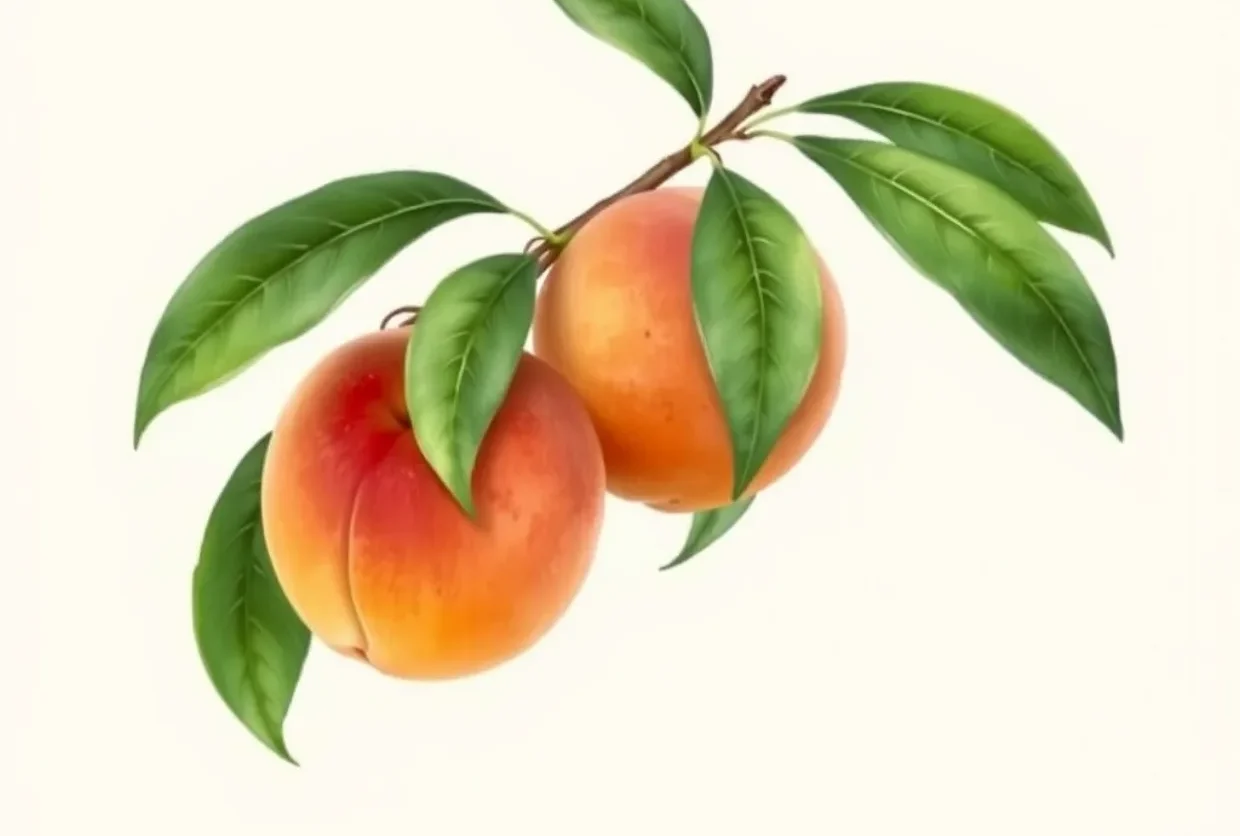
Chill hours decide whether it works where you live, and getting them wrong fails in a way no care corrects. That decision comes before flavor or size.
The record
Every plant in the database answers the same questions in the same order, so two entries can be read line for line. 15 of 16 fields sourced.
- Light
- Full sun
- Light detail
- 6 hours or more; interior light is what ripens the fruit
- Water
- Moderate
- Water detail
- Moist and fertile, but sharply drained; peaches are shallow rooted and short lived in wet ground
- Soil
- Clay, loam or sand, well drained and fertile
- Soil pH
- Acidic to neutral, below 8.0
- Mature size
- 15 to 25 ft tall and wide
- Toxicity
- NC State states the pits contain cyanide compounds and are poisonous if crushed or chewed.
- Lifecycle
- Tree
- Difficulty
- Challenging
- Hardiness zones
- 5 to 9
- Growth rate
- Fast
- Root spread
- Shallow
- Pruning window
- Every year, to an open center
- Bloom time
- Spring, pink and fragrant
- Deer resistant
- not recorded
Hardy in zones 5 to 9. Colder than zone 5, grow it in a container and overwinter it under cover.
Of the flowers needed for a full crop. Everything beyond that is competition. Thinning in May to about 8 inches apart is what turns a heavy crop of small peaches into a moderate crop of good ones.
The year
Plant or divide and prune, and when it is actually in flower. Everything else is leaving it alone.
Toxic to pets
NC State states the pits contain cyanide compounds and are poisonous if crushed or chewed.
Chill hours decide whether it works where you live
Peach trees need a specific number of cold days below 45 degrees before they will break dormancy properly, and cultivars differ widely in how many.
Get that wrong in either direction and the tree fails in a way no care corrects. A high-chill variety planted in the warm South never accumulates enough cold, so it leafs out raggedly and flowers poorly. A low-chill variety planted in the North satisfies its requirement during a mild spell in February, blooms early, and loses the whole crop to the next frost.
The chill requirement is printed on the tag or in the catalog description, and matching it to your region is the first decision, ahead of flavor, size or color.
The numbers, and why sources disagree
Chill hours are counted as hours below about 45°F through the dormant season, and the effective range runs roughly 32 to 50°F with 45°F closest to optimal. The complication is that the words low, medium and high mean different things depending on who is writing, which is the commonest way people misread a tag.
| UGA scale, temperate South | UF scale, subtropical Florida | |
|---|---|---|
| Low chill | Under 600 hours | Under 250 hours |
| Medium | 600 to 750 hours | 300 to 525 hours |
| High chill | 750 to 900 hours | Over 525 hours |
A variety described as low chill on a Florida list can be a medium or even a high-chill tree on a Georgia one. Buy on the number, not on the word, and if a tag gives only the word, treat that as a tag that has not told you anything.
Matching it to where you are
The direction of the error decides which failure you get, and the regional guidance is correspondingly opposite at the two ends of the range.
- North Carolina and similar inland climates: NC State recommends only varieties needing 750 hours or more, and the reason is not the chilling itself but frost. A low-chill tree in a climate with real winter satisfies its requirement in January, breaks dormancy in the first warm spell, and loses the crop to the freeze that follows.
- Coastal and warm South: Clemson recommends low-chill varieties for coastal areas, naming Flordaking, Springcrest, Armking, Junegold and Harvester. A high-chill tree there never accumulates enough cold, so it leafs out raggedly and flowers poorly year after year.
- Florida: a separate case with its own bred cultivars, low chilling and early maturing, developed to work from the panhandle south.
Ripening date is the second variable and it moves with the same geography. Clemson’s harvest windows run from Flordaking in early May through Springcrest in mid May, Redhaven in late June, Redglobe in early July, and Georgia Belle and Jefferson into early August. Inland and at altitude the same variety ripens seven to ten days later than on the coast.
The practical order is therefore: find your local chill-hour figure from a county extension office, choose a variety whose stated requirement matches it, and only then think about flavor and ripening date. Reversing that order is the mistake this whole section exists to prevent.
What it needs
Hardy in zones 5a to 9b, growing rapidly to 15 to 25 feet tall and wide, with an open, rounded, spreading habit that tends toward multiple trunks but can be trained to a single one.
Full sun, six hours or more. Soil should be well drained, moist and fertile, tolerating clay, loam or sand, at acidic to neutral pH below 8.0.
Drainage matters more here than for most fruit trees. Peaches are shallow-rooted and short-lived, and wet ground shortens both further.
Flowering is in spring, pink and pleasantly fragrant, with fruit ripening in summer as yellow to orange drupes 1 to 3 inches across.
The work
NC State rates maintenance as high, and states plainly that pruning is required to maintain a strong structure. A peach is not a tree you plant and leave.
- Prune to an open center
Three or four main scaffold branches spreading outward from a short trunk, with the middle kept open. Sunlight reaching the interior is what ripens fruit and dries foliage.
- Prune every year, hard
Peaches fruit on wood grown the previous season, so an unpruned tree fruits further and further out on the branch tips, on wood too weak to hold it.
- Thin the fruit in late spring
Missouri Extension thins in May, once the frost risk has passed, to about 8 inches apart. This is the difference between a heavy crop of small poor peaches and a moderate crop of good ones.
- Watch the base of the trunk
Peach tree borers attack at ground level. Keep mulch and weeds off the trunk so the base is visible and can be checked.
- Expect a short life
Peaches grow rapidly, crop young and are not long-lived compared with apples. Planting a replacement before the old tree fails keeps the supply going.
What goes wrong
NC State lists peach tree borers, plum curculio, oriental fruit moth, mites, aphids and scale, with brown rot, leaf curl and other fungal problems.
Peach leaf curl is the most visible: leaves in spring emerge thickened, puckered and reddened. It has to be prevented rather than treated: a fungicide applied in the dormant period, either in autumn after leaf drop or in early spring before bud swell. Once the fungus is inside the leaf the disease cannot be controlled that season.
Brown rot turns ripening fruit into a brown fuzzy mummy on the branch. Those mummies carry the disease into next year, so removing and destroying every one, on the tree and on the ground, is the single most useful thing an amateur can do about it.
Peach tree borer is the killer. Look for gummy sawdust-flecked ooze at the base of the trunk. It is why the trunk base has to stay clear and visible.
Plum curculio leaves a crescent-shaped scar on young fruit and causes it to drop.
Honest summary: peaches in a humid climate are one of the more demanding fruit crops for an amateur, and deciding your tolerance for blemished fruit in advance is better than discovering it in July.
Toxicity, in plain terms
NC State states the pits contain cyanide compounds and are poisonous if crushed or chewed.
A swallowed pit passes through; a crushed and chewed one is the concern, which is a real risk with a dog that picks up windfall fruit. The leaves and twigs of stone fruit carry the same compounds, which matters for grazing animals with access to prunings.
Frequently asked questions
- Why does my peach flower and then lose everything?
- Usually a late frost on early blossom, which points at a variety whose chill requirement is too low for your region. Peaches need a set number of days below 45 degrees, and a low-chill variety in a cold area blooms during the first mild spell and loses the crop.
- What are the puckered red leaves in spring?
- Peach leaf curl, and it can only be prevented rather than cured. A fungicide goes on in the dormant period, in autumn after leaf drop or in early spring before bud swell. Once the fungus is inside the leaf, nothing controls it that season.
- Do I need two peach trees?
- No. Missouri Extension states peach cultivars are self-pollinating and more than one cultivar is not required for fruit production, which is the main way peaches are easier than apples.
- Why are the peaches so small?
- Not thinned. Only about 10 percent of the flowers are needed for a full crop, so thin in May once frost risk has passed, to roughly 8 inches apart. It also stops branches breaking under the load.
- What is the sticky ooze at the base of the trunk?
- Peach tree borer, and it is the pest most likely to kill the tree. Gum flecked with sawdust at ground level is the sign, which is why mulch and weeds should be kept back so the trunk base stays visible.
Companion plants
How this entry is compiled
- Care values come from university extension publications and the USDA hardiness map, never from other gardening sites.
- Toxicity follows the ASPCA listing and is quoted rather than summarized.
- A value we cannot source is printed as not recorded, never estimated.
Compiled and checked by the Gardnicks editorial desk · last checked 2026-08-16
Sources for this entry
- NC State Extension Gardener Plant Toolbox, Prunus persica
- Missouri Extension, Home Fruit Production: Peach and Nectarine Culture
- Missouri Extension, Prevent peach leaf curl
- Clemson HGIC, Pruning Peaches and Nectarines
- Penn State Extension, Peach Disease: Peach Leaf Curl
Where two sources disagree, the entry follows the one closest to the plant’s own growing region and says so in the text.
What kills it
Three failures cover almost everything readers write in about.
More in Trees & Shrubs
 Arborvitae
Full sun · zones 3 to 7
Arborvitae
Full sun · zones 3 to 7
 Limelight hydrangea
Full sun · zones 3 to 8
Honeysuckle
Full sun · zones 4 to 9
Limelight hydrangea
Full sun · zones 3 to 8
Honeysuckle
Full sun · zones 4 to 9
 Japanese maple
Part shade · zones 5 to 8
Japanese maple
Part shade · zones 5 to 8
Plates are illustrations, not photographs of a specific plant, and are not evidence of a variety, place or season.