Limelight hydrangea
Hydrangea paniculata
Panicle hydrangea
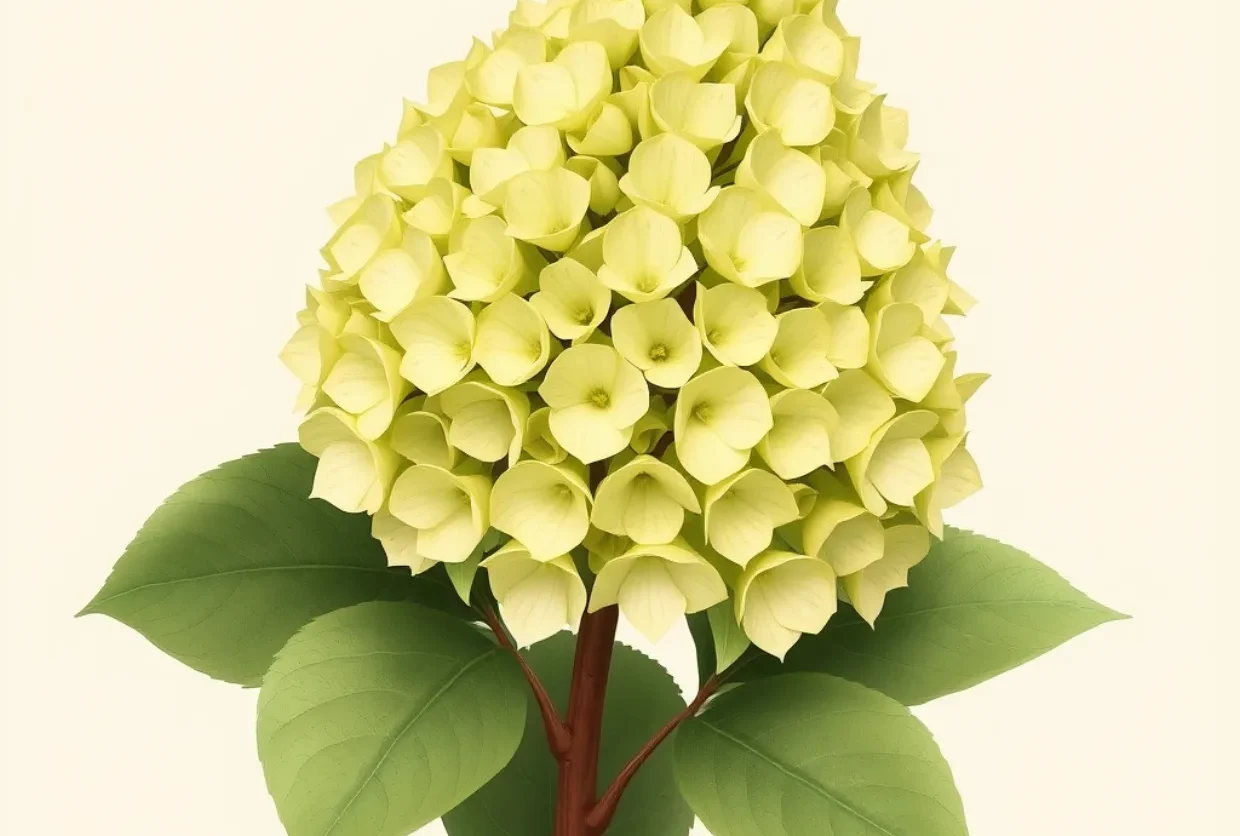
The hydrangea you can prune without losing the flowers. It blooms on new growth, so a hard cut in late winter increases the display instead of removing it.
The record
Every plant in the database answers the same questions in the same order, so two entries can be read line for line. 15 of 16 fields sourced.
- Light
- Full sun
- Light detail
- More sun tolerant than other hydrangeas; afternoon shade still helps in the south
- Water
- Moderate
- Water detail
- Moist and well drained; tolerates occasional wet
- Soil
- Clay, loam, sand or high organic matter
- Soil pH
- Acidic to neutral
- Mature size
- 8 to 15 ft tall and 6 to 25 ft wide in the species; cultivars far smaller
- Toxicity
- NC State lists hydrangea as poisonous to humans, cats, dogs and horses.
- Lifecycle
- Shrub
- Difficulty
- Easy
- Hardiness zones
- 3 to 8
- Growth rate
- Fast
- Root spread
- not recorded
- Pruning window
- Late winter or early spring; it blooms on new wood and tolerates hard cutting
- Bloom time
- Summer into autumn
- Deer resistant
- No
Hardy in zones 3 to 8. Colder than zone 3, grow it in a container and overwinter it under cover.
Where the flower buds form. That is the whole difference from a mophead hydrangea: buds form on this spring's growth, so a hard late-winter cut increases the display instead of removing it.
The year
Plant or divide and prune, and when it is actually in flower. Everything else is leaving it alone.
Toxic to pets
NC State lists hydrangea as poisonous to humans, cats, dogs and horses.
This is the hydrangea you can prune without losing the flowers
Panicle hydrangea is the one that solves the problem every other hydrangea creates. It blooms on new growth, so NC State’s guidance is that it can be severely pruned in late winter or spring.
That single fact separates it from the mophead hydrangeas people struggle with. Bigleaf hydrangea sets its buds the previous summer, so a tidy cut in autumn or a hard frost in April removes the whole display. Panicle hydrangea makes its flower buds on the growth it produces that same spring, so you can cut it back hard every year and it flowers regardless.
It is also the toughest hydrangea for cold: zones 3a to 8b, which reaches further north than any of the others. And NC State notes it is more tolerant of full sun than other hydrangea species, which is the second constraint that usually decides where a hydrangea can go.
Size, which is the thing to check on the label
The species grows 8 to 15 feet tall and 6 to 25 feet wide, and can reach 25 feet, at a rapid growth rate. Spacing is 6 to 12 feet.
Limelight itself is described as more compact than the species, with green to creamy white flowers, and there is now a whole family of panicle cultivars at very different sizes: dwarf forms staying around three feet, mid-size types around six, and the full-size ones that become small trees.
Rapid growth plus a 25-foot potential is what turns an impulse buy into a problem against a house wall. The cultivar name is the only thing that tells you which one you have.
Limelight, Little Lime and the rest of the panicle family
Limelight is a cultivar of Hydrangea paniculata, and the size problem people run into is that the species and its cultivars cover an enormous range.
| Plant | Mature size | Where it fits |
|---|---|---|
| PeeGee, the old panicle hydrangea | 10 to 15 ft as a shrub, or up to 25 ft trained as a small tree | A large garden, or as a specimen tree. Far bigger than most people expect from the name hydrangea |
| Limelight | 6 to 8 ft tall and equally wide | Hedging, screening, the back of a border, a standalone specimen |
| Little Lime | About half the height of Limelight | Small gardens, foundation planting, and the one that will actually live in a large container |
Little Lime carries the same flower and the same habits as Limelight at half the size, so the choice between them is purely about the space rather than about the plant.
What all of them share is the property this page opens with: they flower on the current season’s growth. That means they can be cut back every spring without losing the display, and it also means late frosts cannot take the flowers, because the buds have not formed yet when the frost arrives. Bigleaf hydrangeas fail on both counts, and that difference, rather than the flower color, is why the panicle group has taken over so many gardens.
Hardiness is the other reason. Limelight is rated across zones 3 through 9, which is a wider range than almost any other flowering shrub of this size, and it covers gardens where a bigleaf hydrangea will grow leaves and never flower.
Landscaping with Limelight hydrangea, and what to plant in front of it
At 6 to 8 feet in both directions, Limelight is large enough to do structural work rather than just decorate, and the uses follow from that scale.
- As a flowering hedge or screen, planted in a row. This is the use the size suits best, and it is how to hide an air conditioning unit, a boundary or a neighbor’s view without a fence.
- As a specimen, standing alone where the full 8 foot spread is visible and the flower heads carry from a distance.
- In a mixed border, at the back, where the late-summer flowering fills the gap after the perennials have finished.
- In a large container, though this is the case for Little Lime rather than Limelight, since a pot cannot support the full-size plant for long.
The problem every one of those uses creates is the same: a mature Limelight is bare and woody for the bottom two feet, because the spring pruning takes the growth back to a framework and the new stems carry their leaves higher. Something has to go in front of it.
What works is anything that reaches about knee height, takes the same full sun, and does not mind competing with a shrub root system.
- Ornamental grasses such as switchgrass or fountain grass. The fine texture is the opposite of a ten-inch flower head, and they carry through winter after the hydrangea is cut back.
- Catmint, salvia and hardy geranium for a long season of blue and purple against the lime and white, all three tolerant of dry ground once established.
- Sedum such as Autumn Joy, which flowers at the same time as the hydrangea and holds its shape into winter.
- Boxwood or a low evergreen where the planting is formal, which gives the bed a defined edge in the months the hydrangea is bare sticks.
What does not work is anything that wants shade or steady moisture, because the position that suits a panicle hydrangea is open and sunny, and anything shade-loving planted in front of it will be in full sun.
Deadheading Limelight hydrangeas, and whether to bother
Deadheading is optional on this plant and mostly a matter of taste, which is worth saying because it is the opposite of the situation on many summer flowers.
The heads age from lime through white to pink and rose and then to a papery tan, and they hold on the plant right through winter. Left alone they are one of the better winter silhouettes in a garden, and they catch frost and snow. Removing them through the season does not produce a second flush, because the flowers form on new growth made that spring and that growth is already committed.
So the choice is between a tidy shrub and a plant that still does something in January. If you do deadhead, cut just below the spent head rather than taking the stem down, and leave the hard cut for the spring pruning described above. The one case for removing heads promptly is heavy snow country, where a plant carrying dozens of wet snow-loaded heads bends and splays.
The flowers cut well and dry well, which is worth planning for: cut them for drying when the heads have taken on their pink or rose tint in late summer rather than while they are still green, because that is the color they will keep.
The color change is the plant, not the soil
Panicle hydrangea flowers open creamy white in panicles 6 to 8 inches long from summer into autumn, then fade to pink and finally to brown as autumn approaches.
That progression is worth understanding because it is completely different from the famous blue-to-pink hydrangea question. Bigleaf hydrangea changes color with soil pH and aluminum availability. Panicle hydrangea does not: the pink is age, not chemistry, and no soil amendment affects it.
The late brown stage is why these are the hydrangeas people leave standing over winter. Dried panicles hold their shape through snow, and they look deliberate rather than neglected.
Growing it
- Full sun in the north, some afternoon shade in the south
More sun-tolerant than other hydrangeas, but sun tolerance is relative and hot southern afternoons still scorch.
- Almost any soil, as long as it drains
Clay, loam, sand or high organic matter, acidic to neutral, tolerating occasional wet. This is the least fussy hydrangea on soil.
- Prune hard in late winter or early spring
Cut back by a third to a half, or harder. It flowers on new wood, so this increases the display rather than costing it.
- Leave some framework
Cutting to the ground each year produces a mass of thin whippy stems that fall over under wet flower heads. Pruning to a low permanent framework gives stems strong enough to hold them.
- Water deeply once a week, and twice in real heat
Hydrangea leaves are large and lose moisture fast, and inconsistent water is what produces scorched leaf margins and poor flower quality rather than any disease. A long soak once a week is the baseline; in southern summers, and in sandy soil anywhere, twice weekly is closer to right. Frequent shallow watering is the one pattern that does not work.
- Plant in spring or fall, not in summer heat
A hydrangea set out into hot weather struggles to establish, because it is losing water through those leaves faster than a new root system can supply it. The cool ends of the season are when the roots can get ahead.
- Feed once, at pruning time, or not at all
A granular fertilizer for woody plants, the kind sold for roses, applied in spring when you make the cut. That is the whole program. Anything more produces the soft growth that causes the flopping described below, on a plant that is already carrying heavy flower heads.
- Shelter it from wind
NC State lists wind damage among its problems. Long panicles on fast, soft growth are exactly what a storm breaks.
What goes wrong
NC State lists aphids, scales and mites, all rarely problematic, and powdery mildew, leaf spot, rust, bud blight and bacterial wilt among diseases, plus wind damage and deer browsing.
In practice this is a robust plant and most complaints are structural. Stems bending to the ground after rain means either too hard a prune the previous spring or too rich a feeding regime, both of which produce soft growth that cannot carry the weight. Browning flower edges in midsummer is usually heat and dryness at the root, which mulch fixes.
A plant that has stopped flowering well is unusual here, and when it happens it is normally shade rather than pruning, which is the reverse of the diagnosis for a bigleaf hydrangea.
Flopping, in detail, because it is the main complaint
A panicle hydrangea carries flower heads that can be ten inches or more across, and after rain those heads hold water and weigh several times what they do dry. Whether the stem holds depends on how thick it is, and stem thickness is decided the previous spring.
- Cutting back too hard forces a burst of long, fast, soft growth from the base, which produces the tallest stems and the weakest ones. Taking off a third of the height leaves a woody framework that the new growth rises from, and that framework is what carries the weight.
- Feeding does the same thing chemically. A fed hydrangea makes more growth and softer growth.
- Shade makes it worse again, because a plant reaching for light stretches.
The fix on an established plant that flops every year is to prune less, not more, and to stop feeding it. On a plant that is already going over, a grow-through support ring put in place in spring, before the growth comes up through it, is invisible by July and works; staking individual stems after they have fallen does not.
The leaf problems, by symptom
- Cercospora leaf spot is the common one on hydrangeas and is recognizable rather than generic: circular spots with purple margins and tan centers, starting on the lower leaves and working up. It disfigures rather than kills, and it spreads on wet foliage, so watering the soil instead of the plant is most of the control.
- Powdery mildew shows as a white dusting on the upper leaf surface, and it is a still-air problem. Spacing and airflow matter more than any treatment.
- Browning, crisped leaf margins are not a disease at all. That is scorch, from heat plus dry roots, and mulch plus the watering above is the answer.
- Aphids gather on the tender new shoots in spring. They rarely amount to anything on a shrub this vigorous and are removed with a jet of water.
Deer browse hydrangeas, and this one has no defense against it beyond fencing. That is worth knowing before planting a row of them along an open boundary in deer country.
Toxicity, in plain terms
NC State lists hydrangea as poisonous to humans, cats, dogs and horses.
The compounds involved release cyanide when the plant material is broken down, and the leaves and buds are the parts of concern. The realistic risk is a dog or a grazing animal eating a quantity of foliage rather than a person brushing past it, but this is a plant worth knowing about in a household with an animal that chews.
Frequently asked questions
- When do I prune a limelight hydrangea?
- Late winter or early spring, and it can be cut hard. It blooms on new growth, which is why NC State says it tolerates severe pruning. This is the opposite of bigleaf hydrangea, where a late cut removes the flowers.
- Why did the white flowers turn pink?
- Age. Panicle hydrangea flowers open creamy white and fade through pink to brown as autumn approaches. Unlike bigleaf hydrangea, the color has nothing to do with soil pH and cannot be changed by amending the soil.
- Why do the stems flop after rain?
- Soft, fast growth carrying wet flower heads, usually from cutting the plant to the ground each spring or feeding it heavily. Prune to a low permanent framework instead so the stems are woody enough to hold the panicles.
- What is the difference between Limelight and Little Lime?
- The same flower and the same behavior at half the size. Limelight reaches 6 to 8 feet tall and wide; Little Lime is about half that, which makes it the one for a small garden or a large container. Both flower on the current season’s growth, so both are pruned in spring and neither loses its display to a late frost.
- How do I stop the stems flopping?
- Prune less, not more, and stop feeding it. Cutting back hard forces long soft stems that cannot carry a wet flower head; taking off about a third of the height leaves a woody framework that can. On a plant that already flops, put a grow-through support ring in place in spring before the new growth comes up through it.
- Can I grow Limelight hydrangea as a hedge?
- Yes, and it is one of the better uses for it. At 6 to 8 feet tall and wide it screens properly, it flowers from late summer into autumn when little else does, and the spring pruning that keeps it dense is the same cut it wants anyway.
- How much sun can it take?
- More than any other hydrangea. Full sun works well in the north; in hot southern gardens afternoon shade still helps, since sun tolerance here is relative rather than absolute.
- How big does it get?
- The species reaches 8 to 15 feet and can go to 25, growing rapidly, so the cultivar decides everything. Limelight is described as more compact, and the panicle family now runs from three-foot dwarfs to small trees.
Companion plants
How this entry is compiled
- Care values come from university extension publications and the USDA hardiness map, never from other gardening sites.
- Toxicity follows the ASPCA listing and is quoted rather than summarized.
- A value we cannot source is printed as not recorded, never estimated.
Compiled and checked by the Gardnicks editorial desk · last checked 2026-08-16
Sources for this entry
Where two sources disagree, the entry follows the one closest to the plant’s own growing region and says so in the text.
What kills it
Three failures cover almost everything readers write in about.
More in Trees & Shrubs
 Azalea
Part shade · zones 4 to 8
Azalea
Part shade · zones 4 to 8
 Apple tree
Full sun · zones 4 to 9
Apple tree
Full sun · zones 4 to 9
 Dogwood tree
Part shade · zones 5 to 9
Dogwood tree
Part shade · zones 5 to 9
Plates are illustrations, not photographs of a specific plant, and are not evidence of a variety, place or season.