Maple tree
Acer rubrum
Red maple / swamp maple
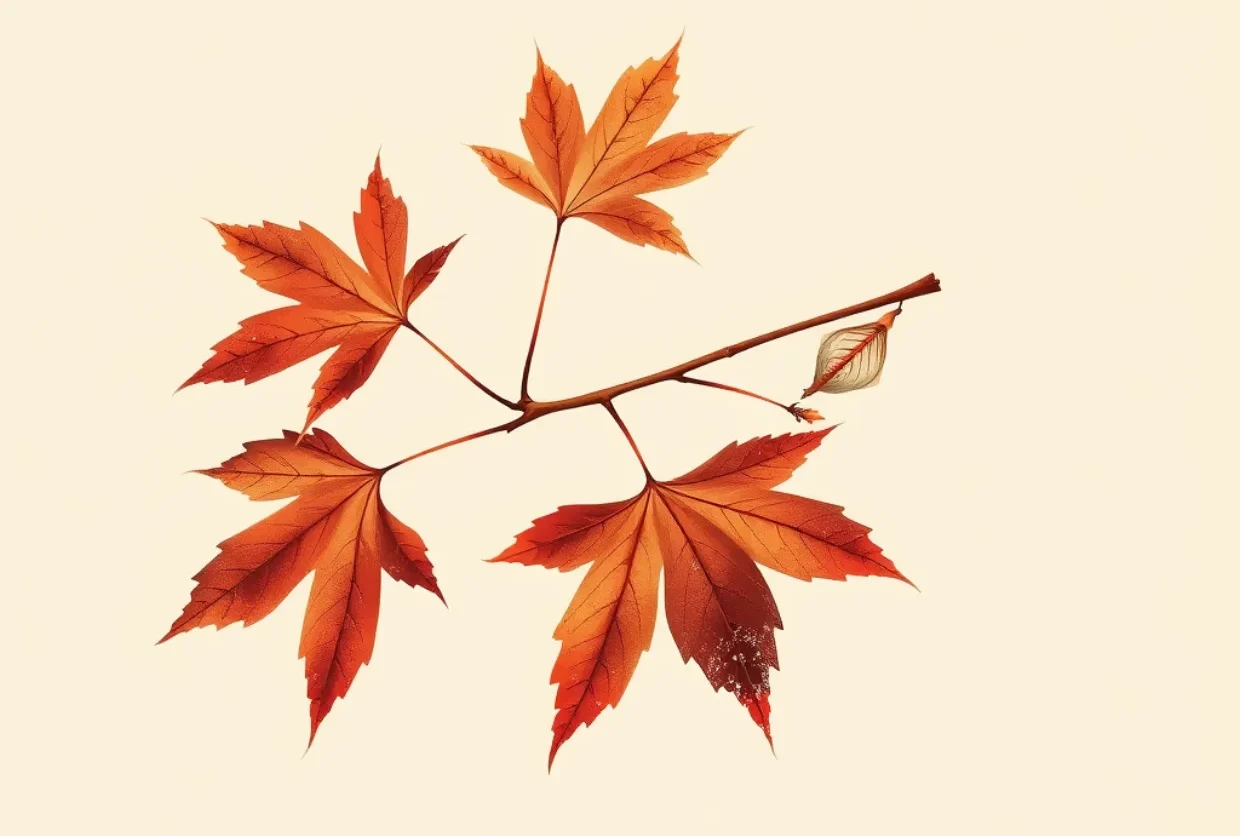
Fast, hardy, cheap and routinely planted far too close to the house. NC State recommends a minimum of sixty feet of space, and the surface roots are why.
The record
Every plant in the database answers the same questions in the same order, so two entries can be read line for line. 15 of 16 fields sourced.
- Light
- Full sun
- Light detail
- Full sun or partial shade at 2 to 6 hours
- Water
- Moderate
- Water detail
- Moist and well drained; tolerates occasional flooding
- Soil
- Clay, loam, sand or high organic matter
- Soil pH
- Acid to neutral
- Mature size
- 40 to 120 ft tall, 30 to 50 ft wide
- Toxicity
- NC State lists red maple as a problem for horses. Fresh leaves are not considered toxic, but wilted leaves destroy red blood cells and cause severe anemia; Minnesota Extension puts the dangerous quantity at 1.5 to 3 pounds per 1,000 pounds of bodyweight. Fallen autumn leaves stay toxic for about thirty days.
- Lifecycle
- Tree
- Difficulty
- Easy
- Hardiness zones
- 2 to 9
- Growth rate
- Fast
- Root spread
- Dense mat of surface roots that can buckle sidewalks and driveways
- Pruning window
- Late autumn or winter, never spring
- Bloom time
- Late winter, small red clusters
- Deer resistant
- not recorded
Hardy in zones 2 to 9. Colder than zone 2, grow it in a container and overwinter it under cover.
Minimum space NC State recommends. That figure alone rules the tree out of most suburban front gardens, and it is routinely ignored because a young red maple is cheap and grows fast.
The year
Plant or divide and prune, and when it is actually in flower. Everything else is leaving it alone.
Toxic to pets
NC State lists red maple as a problem for horses. Fresh leaves are not considered toxic, but wilted leaves destroy red blood cells and cause severe anemia; Minnesota Extension puts the dangerous quantity at 1.5 to 3 pounds per 1,000 pounds of bodyweight. Fallen autumn leaves stay toxic for about thirty days.
Fast, cheap, and planted far too close to houses
Red maple is the most widely planted native shade tree in the eastern United States, and it earns that with a genuinely useful set of traits: hardy from zone 2a to 9b, growing rapidly, tolerating clay, loam, sand, acid or neutral soil and occasional flooding, and turning red early in autumn.
The catch is size. NC State gives 40 to 120 feet tall and 30 to 50 feet wide, with a minimum of 60 feet of available space recommended.
Sixty feet. That figure alone rules the tree out of most suburban front gardens, and it is routinely ignored because a young red maple is cheap, grows fast and looks tidy for the first decade.
The roots are the specific problem
NC State describes a dense mat of surface roots that can buckle sidewalks and driveways if the tree is planted too close.
Surface rooting is what makes red maple a poor choice near hard landscaping, and it is also why grass struggles under a mature one: the roots occupy the top few inches of soil and take the water first.
This is not a fault in the tree. It is a tree adapted to wet bottomland soils where deep rooting is impossible, and the habit comes with the tolerance for flooding. It just means the planting position has to be chosen for a tree that will own the top layer of soil for fifty feet in every direction.
What it offers
Flowering happens earlier than people expect: small red flowers in clusters maturing in late winter, January to March in the South, which makes it one of the first nectar sources of the year.
NC State records it attracting bees, butterflies, moths and songbirds, with seeds eaten by birds and the fruit and buds a primary food for gray squirrels.
Autumn color comes early and varies by cultivar, from red through gold, orange and burgundy. Because seedling trees are variable, named cultivars are the way to get a specific autumn color reliably.
Which maple, because the name covers several very different trees
This entry is written about red maple, Acer rubrum, which is what a nursery usually means by a maple tree in the eastern United States. But several species share the name and they are not interchangeable, least of all in how long they last and how much trouble they cause.
| Maple | Size | Character | Worth knowing |
|---|---|---|---|
| Red maple, A. rubrum | 40 to 120 ft tall, 30 to 50 ft wide | Fast, adaptable, early red flowers, variable fall color | The subject of this page. Tolerates wet ground and black walnut; does not tolerate heavy pollution |
| Sugar maple, A. saccharum | 60 to 75 ft tall, 40 to 50 ft wide | Slower, longer-lived, brilliant yellow to burnt-orange fall color | The better tree where conditions allow. Intolerant of salt, drought and pollution, so it fails as a street tree |
| Silver maple, A. saccharinum | Large and fast | Very fast growth, weak wood | The one behind most maple complaints: brittle limbs, aggressive surface roots, short life for its size |
| Autumn Blaze, A. x freemanii | 40 to 55 ft, growing 3 to 5 ft a year | A red and silver maple hybrid bred for fast growth and reliable red fall color | Inherits the silver maple’s structural weakness. See below |
| Japanese maple, A. palmatum | 6 to 25 ft | A small ornamental, not a shade tree | Entirely different in scale and in care, and covered in its own entry |
Autumn Blaze, and why it needs pruning others do not
Autumn Blaze is the most-planted maple cultivar in America and the one most often regretted, for a reason that is structural rather than horticultural. It is a cross between silver maple and red maple, and it took the silver maple’s growth rate, 3 to 5 feet a year, along with what comes with it.
Fast growth produces less dense wood. The tree also tends to form co-dominant stems and tight branch unions with bark included between limb and trunk instead of solid wood, and an included-bark union is a seam rather than a joint. The result is a tree that looks magnificent for a decade and then loses large limbs in ordinary storms.
None of that makes it a bad choice, but it makes it a conditional one. An Autumn Blaze needs structural pruning while it is young, to remove competing leaders and open up the tight unions before they are load-bearing, and it needs that attention again periodically. A tree that has gone ten years without any structural pruning is the one that fails, and by then the correction is an arborist’s job rather than a homeowner’s.
Planting
- Measure the distance to hard surfaces first
Sixty feet of available space is the recommendation. Away from driveways, paths, foundations and drains.
- Choose a named cultivar for autumn color
Seedlings vary considerably; a named selection gives a predictable result.
- Plant at the right depth
The root flare stays visible at the surface. A maple planted deep declines slowly over years and no later care fixes it.
- Do not prune in spring
Maples bleed heavily from spring cuts. Late autumn or winter, while dormant.
- Give up on the lawn underneath
Surface roots and shade will win. A mulched bed under the canopy is easier and better for the tree than grass competing with it.
What goes wrong
NC State lists aphids, leafhoppers, borers, scale and caterpillars among insects, and verticillium wilt, which it flags as potentially fatal, along with canker, fungal leaf spot and root rots.
Verticillium wilt is the one that matters. It is soil-borne, maples are susceptible, and the pattern is one branch or one side wilting and dying while the rest looks healthy. There is no cure. Watering to reduce stress and removing dead wood with disinfected tools is the management, and a maple lost to it should not be replaced with another maple in the same ground.
The other genuine problem is mechanical. Fast growth produces weak wood and narrow branch unions, so red maples shed limbs in storms more readily than slower trees. Formative pruning in the first ten years, encouraging wide branch angles and a single leader, pays for itself later.
Chlorosis, which is a soil problem wearing a nutrient costume
Pale green leaves with dark green veins still showing through is chlorosis, and on maples it is one of the most common complaints in the second half of the country. The Morton Arboretum ties it to two conditions: high soil pH and drought. In alkaline ground the tree cannot take up manganese and iron even though both are present, so feeding it a general fertilizer changes nothing and feeding it nitrogen makes the canopy larger and the problem worse.
The distinction that matters diagnostically: chlorosis is uniform across the whole tree and worst on the newest leaves, while verticillium takes one branch or one side and leaves the rest normal. If a maple is pale all over, look at the soil pH and the water. If half of it is dying, look at the vascular system.
Bark and structural damage
Maples have thin bark, and that has consequences no spray addresses.
- Mower and trimmer wounds at the base are the entry point for borers and canker, on a tree whose bark offers almost no protection. A mulch ring is not decoration here; it is the only barrier.
- Frost cracks and sunscald appear as vertical splits on the south and southwest side of a young trunk, where winter sun warms the bark on a cold day and the tissue splits when the temperature drops again at dusk. Wrapping a young trunk through its first winters prevents it.
- Wind and ice break branches, and this is worse on fast-growing maples than on slow ones for the reason given in the section on cultivars below.
Two more worth naming by symptom. Tar spot produces large black raised spots on the leaves in late summer that look serious and are almost entirely cosmetic; raking and removing fallen leaves reduces it the following year. Cottony maple scale shows as white cottony masses along the undersides of twigs, and heavy infestations produce sticky honeydew and the sooty mold that grows on it.
On salt: sugar maple in particular does not tolerate road salt, drought or air pollution, which is why it fails as a street tree in exactly the places it is most often planted as one.
Toxicity: this one matters if you keep horses
NC State lists red maple as a problem for horses, and the detail behind that flat phrase is worth having.
Fresh leaves are not considered toxic. Wilted leaves are, and severely so: they cause oxidative destruction of red blood cells, producing severe anemia that can kill. Minnesota Extension puts the quantity at 1.5 to 3 pounds of wilted leaves per 1,000 pounds of bodyweight, which is not a large pile.
The signs are dark red or brown urine, depression and refusal to eat. Leaves collected after mid-September are more toxic, but wilted leaves from a summer storm cause illness too, and fallen autumn leaves stay toxic for around thirty days.
So the practical rule for a horse property is that red maples do not belong in or beside a pasture, and a limb that comes down in a storm has to be cleared before the leaves wilt. Illness from maple leaves has only been reported in horses.
Frequently asked questions
- How far from the house should a red maple go?
- NC State recommends a minimum of 60 feet of available space, for a tree reaching 40 to 120 feet tall and 30 to 50 feet wide. The dense mat of surface roots is the reason to keep it away from driveways, paths and foundations specifically.
- Why will grass not grow under mine?
- Surface roots. Red maple roots occupy the top few inches of soil and take the water before grass gets it, and the shade compounds it. A mulched bed under the canopy is the practical answer.
- One side of my maple died. What is that?
- Characteristic of verticillium wilt, which NC State flags as potentially fatal in this species. It comes from the soil and cannot be cured. Reduce stress with watering, remove dead wood with disinfected tools, and do not plant another maple in that spot.
- Are maple leaves dangerous to horses?
- Wilted red maple leaves are, seriously. Fresh leaves are not considered toxic, but wilted ones destroy red blood cells and 1.5 to 3 pounds per 1,000 pounds of bodyweight can be fatal. Watch for dark urine, depression and refusal to eat, and clear storm-fallen branches from pastures before the leaves wilt.
- What is an Autumn Blaze maple?
- A hybrid of silver and red maple, Acer x freemanii, bred for fast growth and reliable red fall color. It reaches 40 to 55 feet, growing 3 to 5 feet a year. The trade is structural: it inherits the silver maple’s weak branch unions and needs structural pruning while young to avoid losing limbs in storms later.
- Why are my maple leaves pale with green veins?
- Chlorosis, from high soil pH or drought rather than a shortage of nutrients in the ground. In alkaline soil the tree cannot take up the manganese and iron that are already there, so ordinary fertilizer does not help and nitrogen makes it worse. Fix the water first, then test the pH.
- Which maple should I plant?
- Sugar maple where the site allows, because it is longer-lived with better fall color, but it will not take salt, drought or pollution. Red maple where conditions are harder or wetter. Avoid silver maple, and treat Autumn Blaze as a tree that comes with a pruning commitment.
- When should I prune it?
- Late autumn or winter while dormant. Maples bleed heavily from spring cuts. Formative pruning in the first decade, for wide branch angles and a single leader, reduces storm damage later on fast-grown weak wood.
Companion plants
How this entry is compiled
- Care values come from university extension publications and the USDA hardiness map, never from other gardening sites.
- Toxicity follows the ASPCA listing and is quoted rather than summarized.
- A value we cannot source is printed as not recorded, never estimated.
Compiled and checked by the Gardnicks editorial desk · last checked 2026-08-16
Sources for this entry
- NC State Extension Gardener Plant Toolbox, Acer rubrum
- University of Minnesota Extension, Are maple leaves toxic to horses?
- Cornell University College of Veterinary Medicine, Red Maple Toxicosis
- Penn State Extension, Trees in Horse Pastures
Where two sources disagree, the entry follows the one closest to the plant’s own growing region and says so in the text.
What kills it
Three failures cover almost everything readers write in about.
More in Trees & Shrubs
 Arborvitae
Full sun · zones 3 to 7
Arborvitae
Full sun · zones 3 to 7
 Sago palm
Part shade · zones 9 to 12
Sago palm
Part shade · zones 9 to 12
 Limelight hydrangea
Full sun · zones 3 to 8
Limelight hydrangea
Full sun · zones 3 to 8
 Redbud
Full sun · zones 4 to 9
Redbud
Full sun · zones 4 to 9
Plates are illustrations, not photographs of a specific plant, and are not evidence of a variety, place or season.