Redbud
Cercis canadensis
Eastern redbud
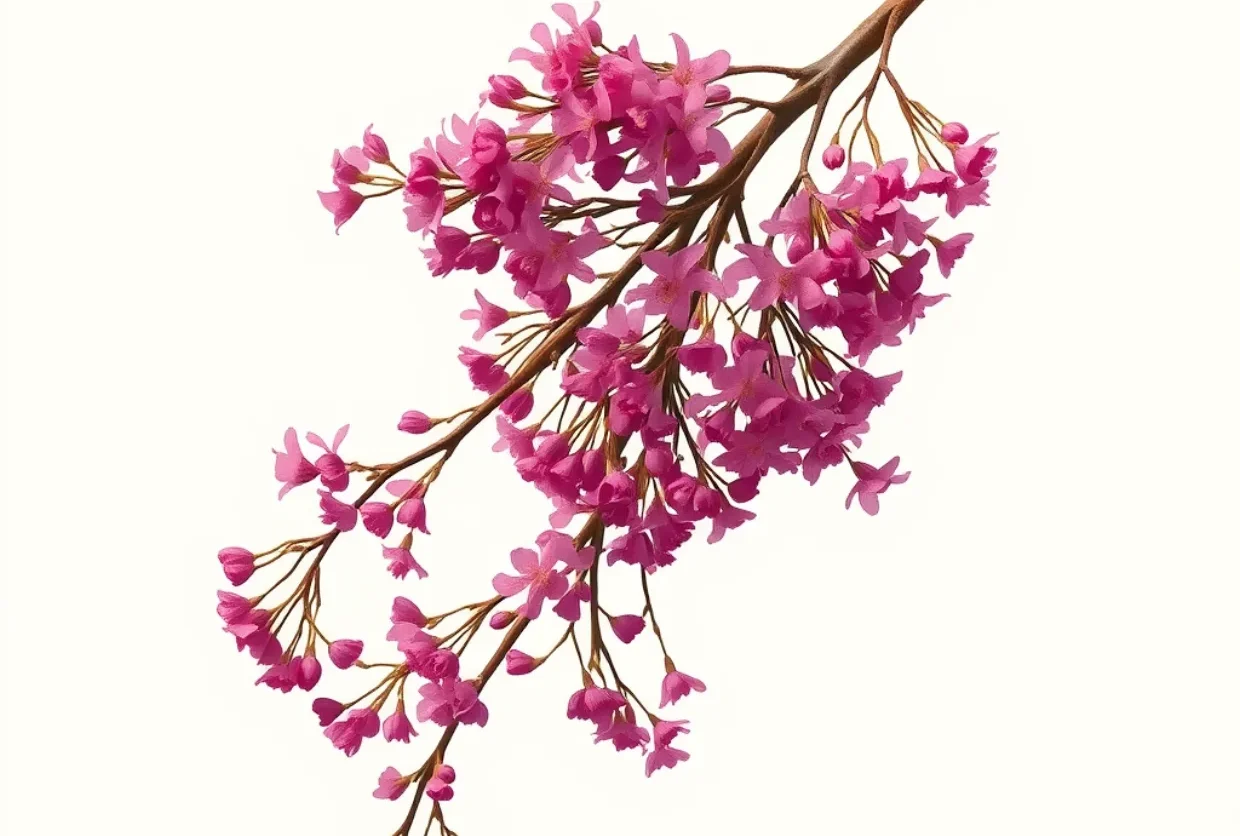
The flowers come straight out of the bark, before the leaves. Cauliflory is a largely tropical trait and almost no other hardy tree does it.
The record
Every plant in the database answers the same questions in the same order, so two entries can be read line for line. 14 of 16 fields sourced.
- Light
- Full sun
- Light detail
- Full sun or partial shade at 2 to 6 hours
- Water
- Moderate
- Water detail
- Well drained; water through the first summers while it establishes
- Soil
- Clay, loam, sand or high organic matter
- Soil pH
- Acid, neutral or alkaline
- Mature size
- 20 to 30 ft tall, 25 to 35 ft wide
- Toxicity
- not recorded
- Lifecycle
- Tree
- Difficulty
- Easy
- Hardiness zones
- 4 to 9
- Growth rate
- Moderate
- Root spread
- Sensitive to disturbance; plant in its permanent position
- Pruning window
- Lightly, after flowering; every cut is a canker entry point
- Bloom time
- March to May, before the leaves
- Deer resistant
- not recorded
Hardy in zones 4 to 9. Colder than zone 4, grow it in a container and overwinter it under cover.
Species of Lepidoptera that breed on it. Host plant value supports breeding insects rather than only feeding adults, which is the metric that separates a native tree from an ornamental one.
The year
Plant or divide and prune, and when it is actually in flower. Everything else is leaving it alone.
The flowers come out of the bark
Redbud does something almost no other hardy tree does. The flowers appear before the leaves, in March to May, and NC State notes they grow right on new stems as well as older branches.
That habit is called cauliflory, flowering directly from woody trunk and limb rather than from new shoots, and it is largely a tropical trait. On a redbud it means a bare tree in early spring is covered in pink from the twig tips right back along the main branches, sometimes on the trunk itself.
It is the reason redbud reads so differently from a cherry or a crabapple at the same season, and the reason it is worth a position where you see it from the house in April.
Size and site
Hardy in zones 4a to 9b, growing at a medium rate to 20 to 30 feet tall and 25 to 35 feet wide. Wider than tall, like dogwood, and that spread is the number people miss.
Full sun or partial shade at two to six hours. Soil can be clay, loam, sand or high organic matter, at acid, neutral or alkaline pH, wanting good drainage and tolerating moist or occasionally dry conditions.
That pH tolerance is unusually broad and makes redbud one of the easier native small trees to place. It also tolerates black walnut, which rules out a great many other species.
Plant it once
NC State is specific that redbud is sensitive to root disturbance and should be placed in its permanent position as soon as possible.
- Choose the final position before buying
A redbud moved after a few years usually does not recover. This is not a tree to relocate.
- Buy small
Smaller container stock establishes far better than a large specimen on a plant this sensitive to disturbance.
- Allow for the spread
25 to 35 feet wide. Against a boundary or a path, that is the dimension that causes trouble.
- Water through the first summers
Establishment is when it is vulnerable. A stressed redbud is what canker and borers find.
- Prune lightly, after flowering
Take out dead and crossing wood. Every cut on this genus is a potential canker entry point, so restraint is the rule.
Redbud tree varieties, and what each one changes
The straight species, Cercis canadensis, reaches 20 to 30 feet tall and 25 to 35 feet wide, with rosy-pink flowers and plain green heart-shaped leaves. Almost every named cultivar changes one of three things: the leaf color, the flower color, or the shape of the tree. Very few change more than one.
| Cultivar | What it changes | Detail |
|---|---|---|
| Forest Pansy | Leaf color | Deep purple foliage, and by a wide margin the most planted redbud cultivar. Susceptible to verticillium wilt, which is the trade and is worth knowing before buying |
| Ruby Falls | Leaf color and form | Red to burgundy heart-shaped leaves on a weeping tree, so it does two jobs at once |
| Merlot | Leaf color | Notably dark foliage, bred to hold the color better through summer heat than Forest Pansy does |
| Hearts of Gold | Leaf color | Golden yellow leaves. Flowers on one-year-old wood, which is unusual in the genus |
| The Rising Sun | Leaf color | New growth apricot, aging through yellow and gold to green, so several colors are on the tree at once. A small tree at about 12 ft |
| Golden Falls | Leaf color and form | Golden yellow foliage on a weeping form |
| Floating Clouds | Leaf color | Leaves heavily variegated with white |
| Carolina Sweetheart | Leaf color | New leaves emerge purple, then take on white, green and hot pink before settling to green in summer |
| Alba and Vanilla Twist | Flower color | White flowers instead of pink. Vanilla Twist is also weeping |
| Appalachian Red and Tennessee Pink | Flower color | The strongest colors in the genus: Appalachian Red is the most intense, Tennessee Pink a true pink rather than the usual mauve-pink |
| Pink Pom Poms and White Pom Poms | Flower form | Double flowers, and sterile, so they set no seed pods |
| Lavender Twist, also sold as Covey | Form | A weeping tree with the standard species flower |
| Ace of Hearts | Size | A dwarf at 10 to 12 feet, for gardens that cannot take the full 30 ft spread |
Forest Pansy, and the caveat that comes with it
Forest Pansy is what most people picture when they picture a purple-leaved redbud, and it is worth being straight about two things.
The first is that the purple fades. New leaves emerge a deep wine purple and hold it through spring, then shift toward bronze and green through the heat of summer, more so the further south the tree is grown. That is normal rather than a failure, and Merlot was bred specifically to hold the color longer.
The second is the one that matters. NC State records Forest Pansy as susceptible to verticillium wilt, a soil-borne disease with no cure that kills branch by branch. Redbuds in general are vulnerable to it; this cultivar particularly so. On a site where a maple or a redbud has already been lost, a different cultivar is the safer choice, and a tree lost to verticillium should not be replaced with another redbud in the same ground.
The redbud leaf
The leaf is the second reason to plant one, after the flowers. It is alternate, simple, and heart-shaped with a pointed tip, 3 to 5 inches across, on a slender stalk that lets it flutter in light wind. It emerges after the flowers have finished, turns clear yellow in autumn, and the whole tree drops it early.
The two southern subspecies differ visibly. C. canadensis subsp. texensis, the Texas redbud, has thick glossy leaves 4 to 8 inches long, heart to kidney shaped and without the pointed tip of the eastern species. Subsp. mexicana has smaller leathery leaves, 2 to 6 inches, with wavy undulating margins. Both are more drought tolerant than the eastern type, which is the practical reason to seek them out in a hot dry garden.
What it feeds
The wildlife record is strong. NC State records 12 species of Lepidoptera using redbud as a larval host plant, including Henry’s elfin butterfly, and it supports the specialized bee Habropoda laboriosa.
Twelve species of caterpillar is the number worth noticing. Host plant value is what supports breeding insects rather than just feeding adults, and it is the metric that separates a native tree from an ornamental one that only offers nectar.
The early bloom matters too, because redbud flowers when very little else is open and the first bees of the year need something.
What goes wrong
NC State lists leafhoppers, caterpillars, borers, Japanese beetles, treehoppers, scale and webworms among insects, and canker, dieback, leaf spots, verticillium wilt, blights and mildew among diseases.
Canker is the characteristic redbud problem. It shows as a sunken dead patch on a branch with the growth beyond it dying back, and the affected limb has to be cut out well below the damage with tools disinfected between cuts.
Verticillium wilt appears here as it does on maples: one branch or one side wilting while the rest looks healthy. It is soil-borne and incurable.
Both are opportunistic on stressed trees, which is why watering through establishment and pruning sparingly does more than any treatment.
The other thing worth knowing before planting: NC State gives the lifespan as typically less than 75 years. Redbud is a short-lived tree by the standards of shade trees, so it is a twenty-to-forty-year feature rather than a legacy planting.
Toxicity, in plain terms
NC State’s entry carries no toxicity listing for Cercis canadensis, and this page records that as not recorded rather than a confident no, because an absent listing is not a positive statement of safety.
Redbud flowers are widely eaten in salads, and the tree is not one gardeners treat as a hazard.
Frequently asked questions
- Why are the flowers on the trunk?
- Cauliflory. Redbud flowers grow directly from older wood as well as from new stems, which is why a bare tree in early spring is pink along the branches and sometimes on the trunk itself. Most hardy trees cannot do this.
- Can I move an established redbud?
- Better not to. NC State notes it is sensitive to root disturbance and should go into its permanent position as soon as possible. Buy small and plant it where it is to stay.
- How big does it get?
- 20 to 30 feet tall and 25 to 35 feet wide, so broader than tall. The spread is the dimension that causes problems near paths and boundaries.
- A branch died back. What is it?
- Most likely canker, which shows as a sunken dead patch with everything beyond it dying. Cut well below the damage with disinfected tools. If a whole side wilts instead, suspect verticillium wilt, which is soil-borne and has no cure.
- Is redbud good for wildlife?
- Genuinely, yes. NC State records 12 species of Lepidoptera using it as a larval host plant, plus a specialized bee. Host plant value supports breeding insects rather than only feeding adults, and it flowers when little else is open.
Companion plants
How this entry is compiled
- Care values come from university extension publications and the USDA hardiness map, never from other gardening sites.
- Toxicity follows the ASPCA listing and is quoted rather than summarized.
- A value we cannot source is printed as not recorded, never estimated.
Compiled and checked by the Gardnicks editorial desk · last checked 2026-08-16
Sources for this entry
Where two sources disagree, the entry follows the one closest to the plant’s own growing region and says so in the text.
What kills it
Three failures cover almost everything readers write in about.
More in Trees & Shrubs
 Peach tree
Full sun · zones 5 to 9
Peach tree
Full sun · zones 5 to 9
 Hydrangea tree
Full sun · zones 3 to 8
Hydrangea tree
Full sun · zones 3 to 8
 Maple tree
Full sun · zones 2 to 9
Maple tree
Full sun · zones 2 to 9
Plates are illustrations, not photographs of a specific plant, and are not evidence of a variety, place or season.