Hydrangea tree
Hydrangea paniculata
Standard hydrangea / tree hydrangea
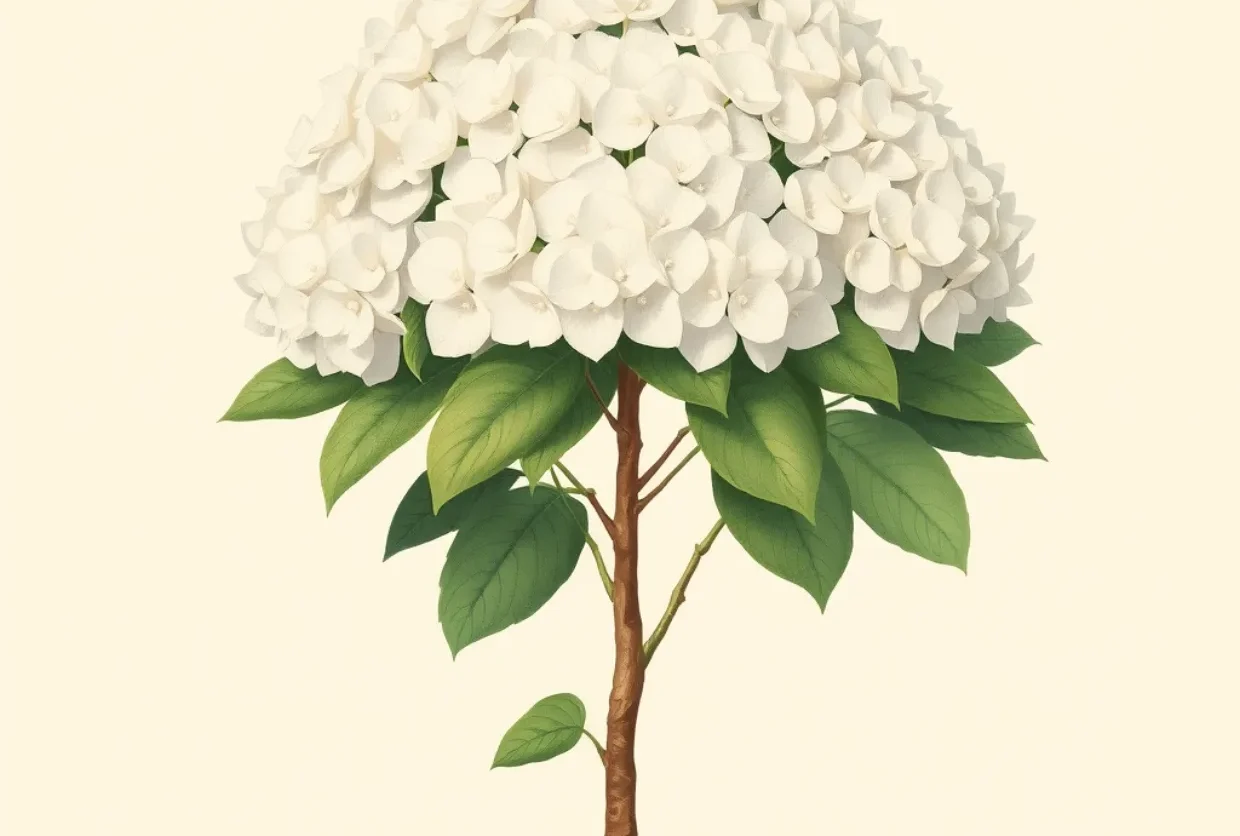
There is no hydrangea tree in the botanical sense. It is a panicle hydrangea trained to a single trunk, and the care specific to it is all about holding that shape.
The record
Every plant in the database answers the same questions in the same order, so two entries can be read line for line. 15 of 16 fields sourced.
- Light
- Full sun
- Light detail
- As for panicle hydrangea; afternoon shade helps in the south
- Water
- Moderate
- Water detail
- Moist and well drained; tolerates occasional wet
- Soil
- Clay, loam, sand or high organic matter
- Soil pH
- Acidic to neutral
- Mature size
- Set by training; typically a 6 to 10 ft standard
- Toxicity
- NC State lists hydrangea as poisonous to humans, cats, dogs and horses.
- Lifecycle
- Shrub
- Difficulty
- Moderate
- Hardiness zones
- 3 to 8
- Growth rate
- Fast
- Root spread
- not recorded
- Pruning window
- Head pruned in late winter; suckers removed several times a season
- Bloom time
- Summer into autumn
- Deer resistant
- No
Hardy in zones 3 to 8. Colder than zone 3, grow it in a container and overwinter it under cover.
Stem the whole plant depends on. Training selects a single upright and removes the rest at ground level. If that trunk snaps, the plant does not regrow as a tree; it regrows as a shrub.
The year
Plant or divide and prune, and when it is actually in flower. Everything else is leaving it alone.
Toxic to pets
NC State lists hydrangea as poisonous to humans, cats, dogs and horses.
A tree-form hydrangea is a shrub that has been trained, not a species
There is no hydrangea tree in the botanical sense. What is sold under that name is almost always panicle hydrangea, Hydrangea paniculata, trained to a single trunk with a rounded head on top.
NC State’s entry for the species notes it can grow as a small tree or a multi-stemmed shrub, and Illinois Extension confirms that panicle hydrangeas can be grown as shrubs or trained to a single-trunk tree form. It is the same plant either way, sold at two different prices because one of them took a nursery three or four years of pruning to produce.
That has a direct consequence for how you look after it. Everything about flowering, soil and hardiness is the same as for any panicle hydrangea, and the care specific to a tree form is entirely about maintaining a shape the plant does not naturally hold.
For the underlying plant, its bloom habit and its problems, the panicle hydrangea entry covers it. This page is about the standard form.
Keeping the shape
A shrub trained to a trunk spends the rest of its life trying to be a shrub again. Two jobs prevent that, and both are quick.
- Remove every sucker from the base and low trunk
Suckers coming up from the roots or low on the trunk are what turn a standard back into a thicket. Pull or cut them off flush, several times a season rather than once.
- Prune the head in late winter
It flowers on new wood, so cut back the previous season’s growth to a framework, heading each stem to just above a fat bud. This is what keeps the head dense instead of leggy.
- Keep the trunk clear
Remove side shoots along the trunk below the head as they appear. Left alone they thicken and the tree form disappears.
- Stake a young standard
A single thin trunk carrying a heavy wet head is a lever. Support it until the trunk has real calliper, and check the tie does not cut in.
- Shelter it from wind
Wind damage is on the species problem list, and a top-heavy standard is far more exposed than the same plant grown as a shrub.
How a nursery makes one, and why it matters
The standard training method is to select one vigorous upright stem as the trunk, remove all other upright branches at ground level, strip the lateral branches off the lower trunk, and then build a head at the top by thinning out inward and crossing branches.
Knowing that tells you two things.
First, you can make one yourself from an ordinary panicle hydrangea, for the price of the shrub and a few years of patience. It is one of the few genuinely worthwhile pieces of amateur plant training.
Second, a tree-form hydrangea is only ever as strong as that single chosen stem. If it snaps at the base, the plant does not regrow as a tree; it regrows as a shrub, from the bottom. That is not a disaster, but it is the end of the standard.
Grafted or trained
Most tree-form panicle hydrangeas are trained on their own roots, and suckers from the base are simply the same variety trying to bush out.
Where a standard has been grafted onto a rootstock, which is more common in some other genera than in hydrangea, suckers from below the union are a different plant and will take over if left. Either way the instruction is the same: remove them. The difference only matters if you were tempted to let one grow.
The hydrangea groups, and which one this is
Most of the confusion around tree-form hydrangeas comes from treating hydrangea as one plant. It is six groups that differ in the two things that matter here: whether the flower color responds to soil, and whether the plant flowers on old wood or new. Those two decide everything, including why the blue tree does not exist.
| Group | Size | Flower | Color changes with soil? | Flowers on |
|---|---|---|---|---|
| Panicle, H. paniculata | 10 to 15 ft as a shrub, up to 25 ft as a small tree | White, fading to pink in autumn | No | New wood |
| Bigleaf, H. macrophylla | 4 to 12 ft | Blue in acid soil, pink in alkaline | Yes. pH 5.0 to 5.5 blue, 6.0 and above pink | Old wood |
| Mountain, H. serrata | Up to 5 ft | Blue in acid soil, as bigleaf | Yes | Old wood |
| Smooth, H. arborescens | 5 ft | Dull white | No | New wood |
| Oakleaf, H. quercifolia | About 6 ft | White, aging pinkish | No | Old wood |
| Climbing, H. anomala | Climbs high by aerial rootlets | White lacecaps 6 to 10 in across | No | Old wood |
Read the top row against the second and the whole page follows from it. Panicle is the only group that reaches tree size and the only one that flowers on new wood, and flowering on new wood is what makes annual pruning to a framework possible. That is why the tree form is a panicle: it is the one group that tolerates being cut back to a shape every year without losing its flowers.
And the two groups that go blue, bigleaf and mountain, both flower on old wood. Training either into a standard means pruning off the wood that carries next season’s flowers. The trait that makes a hydrangea blue and the trait that makes it trainable sit in different groups, which is the structural reason for what the next section says.
Blue hydrangea trees, and why there is no such thing
This one is worth answering directly, because it is searched for regularly and the answer is no.
Blue flowers happen on one group of hydrangeas only: bigleaf, H. macrophylla, and its close relative mountain hydrangea. In acid soil those two take up aluminum and the flowers come blue; in alkaline soil the aluminum is locked away and they come pink. It is soil chemistry acting on a specific pigment those species have.
Tree-form hydrangeas are panicle hydrangeas, and panicle hydrangeas do not have that pigment. They open white or lime and age through cream to pink and rose as the season goes on, and no soil treatment changes that. Aluminum sulfate applied to a tree-form hydrangea does nothing at all except risk the roots.
Bigleaf hydrangeas cannot be trained to a tree form either, because they flower on old wood and the annual pruning a standard needs would remove the flowers. So the two things cannot be combined: a blue hydrangea is a shrub, a hydrangea tree is white to pink. Anything sold as a blue hydrangea tree is either mislabeled or a photograph that has been edited.
Dwarf and smaller tree forms
Standard tree-form panicles reach eight to ten feet with a head several feet across, which is more than a small garden or a courtyard wants. Two routes get the same shape at a smaller size.
- A tree form grafted or trained on a compact cultivar. Little Lime and the other dwarf panicles are sold as standards on a short trunk, and the head stays proportionally smaller. This is the genuine dwarf hydrangea tree and it is what to look for by name rather than by the words dwarf on a tag.
- A short standard of a full-size cultivar. The trunk is trained lower, but the head still wants to reach full size, so it needs harder annual pruning to stay in scale. Workable, but it is ongoing work rather than a smaller plant.
For a container, only the first route is realistic. A full-size panicle standard in a pot is top-heavy, dries out constantly, and will outgrow any container it can be lifted in.
What goes wrong
The problems are the species’ problems, plus two structural ones.
The head bending or splaying under wet flowers is the common complaint. It comes from cutting back too hard, which produces long soft stems, or from feeding heavily. Prune to a short framework rather than to the trunk, and go easy on nitrogen.
The second structural problem is the one that ends the plant, and it is specific to this form. A tree-form hydrangea has one trunk, and that trunk is a single point of failure. A shrub that loses a stem to damage or dieback grows another from the base. A standard that loses its trunk loses everything above it, and whatever regrows from the base is a shrub again, not a tree.
- Stake it for the first few years. A young standard carries a disproportionate weight of head on a stem that has not thickened yet, and a summer storm with wet flowers on it is what snaps them.
- Keep mowers and trimmers away from the trunk entirely. A bark wound at the base on a single-trunk plant is not a survivable injury in the way it is on a multi-stemmed shrub.
- Remove suckers from the base as they appear. On a grafted standard they come from the rootstock and will gradually take over; on a trained one they are the plant trying to revert to being a shrub. Either way they steal vigor from the head.
- Watch the graft union if there is one. The section above explains the difference between a grafted and a trained standard, and on a grafted plant a failure at the union takes the whole top off at once.
Winter is the other risk on this form. The head sits exposed rather than sheltered near the ground, so cold and wind reach it more than they would a shrub, and heavy snow settling on a rounded head can splay or break it. Knocking snow off after a heavy fall is worth the trouble on a plant that cannot replace its framework.
The other is a standard slowly reverting, which is just suckering that nobody removed. By the time the base is a thicket the shape is difficult to recover, so this is a job better done in five minutes several times a year than in an afternoon once.
Toxicity, in plain terms
NC State lists hydrangea as poisonous to humans, cats, dogs and horses. The compounds release cyanide as the plant material breaks down, and the leaves and buds are the parts of concern.
A tree form puts the foliage higher and further from a browsing animal than a shrub does, which is a small practical advantage, but the plant is the same.
Frequently asked questions
- Is a hydrangea tree a different plant from a hydrangea bush?
- No. It is almost always panicle hydrangea trained to a single trunk over several years in a nursery. The species can grow as a small tree or a multi-stemmed shrub, and the care is identical apart from maintaining the shape.
- Can I make one myself?
- Yes, and it is one of the more rewarding amateur training jobs. Select the strongest upright stem, remove all other uprights at ground level, strip the laterals off the lower trunk, and build a head at the top by thinning inward and crossing branches.
- What are the shoots coming up around the base?
- Suckers, and they are what turns a standard back into a shrub. Remove them flush several times a season. On a grafted plant they would be a different variety entirely; either way they come off.
- When do I prune the head?
- Late winter. It flowers on new wood, so cutting back the previous year’s growth to a short framework, heading each stem above a fat bud, increases the display rather than removing it.
- Why does the head flop over?
- Long soft stems carrying wet flowers, usually from pruning back too hard or feeding too much, on a young trunk that is not yet thick enough. Prune to a framework rather than to the trunk, ease off the nitrogen, and stake until the trunk has some calliper.
Companion plants
How this entry is compiled
- Care values come from university extension publications and the USDA hardiness map, never from other gardening sites.
- Toxicity follows the ASPCA listing and is quoted rather than summarized.
- A value we cannot source is printed as not recorded, never estimated.
Compiled and checked by the Gardnicks editorial desk · last checked 2026-08-16
Sources for this entry
- NC State Extension Gardener Plant Toolbox, Hydrangea paniculata
- Illinois Extension, Panicle Hydrangea
- University of Minnesota Extension, Pruning hydrangeas
- University of Minnesota Extension, Pruning trees and shrubs
Where two sources disagree, the entry follows the one closest to the plant’s own growing region and says so in the text.
What kills it
Three failures cover almost everything readers write in about.
More in Trees & Shrubs
 Redbud
Full sun · zones 4 to 9
Redbud
Full sun · zones 4 to 9
 Japanese maple
Part shade · zones 5 to 8
Japanese maple
Part shade · zones 5 to 8
 Arborvitae
Full sun · zones 3 to 7
Honeysuckle
Full sun · zones 4 to 9
Arborvitae
Full sun · zones 3 to 7
Honeysuckle
Full sun · zones 4 to 9
Plates are illustrations, not photographs of a specific plant, and are not evidence of a variety, place or season.