Hoya
Hoya carnosa
Wax plant / porcelain flower
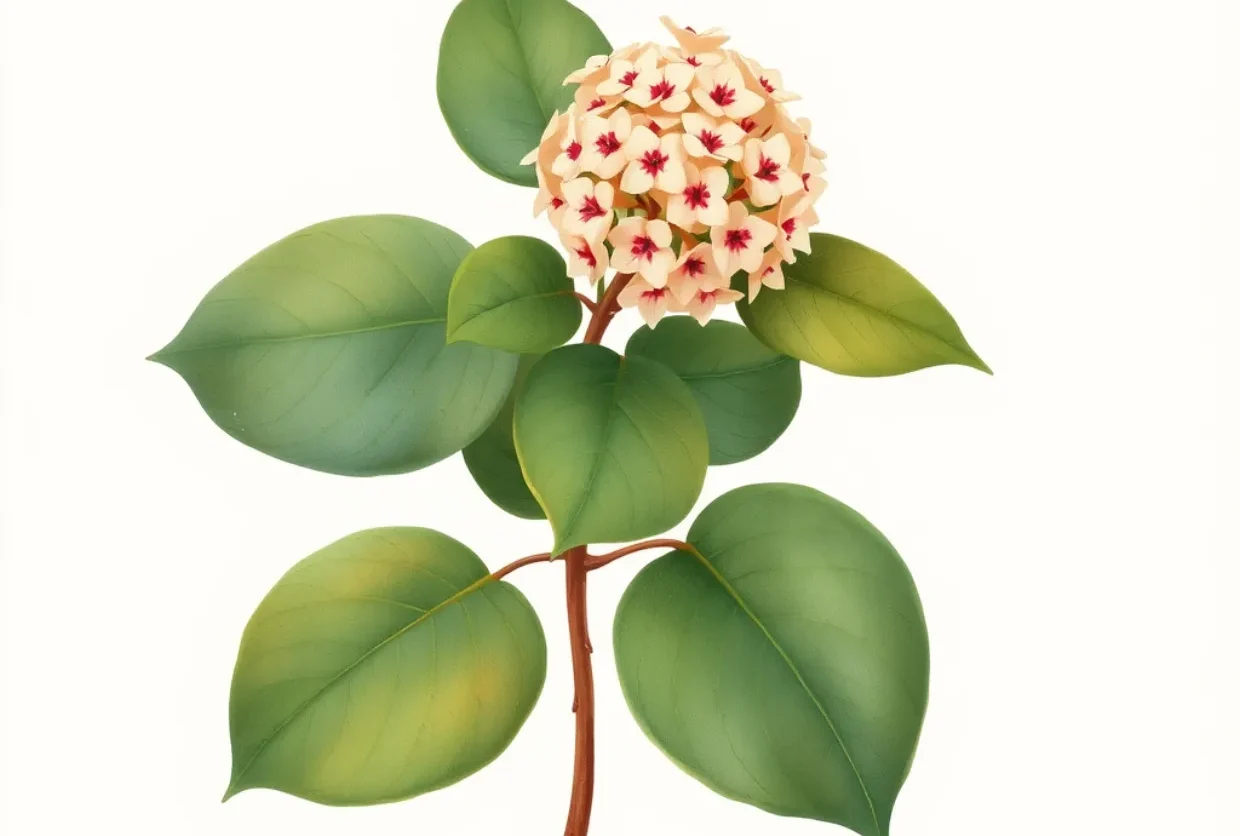
Do not cut off the bare stalk left after the flowers drop. It reflowers for years, and removing it is the most common way people delay the next bloom.
The record
Every plant in the database answers the same questions in the same order, so two entries can be read line for line. 13 of 15 fields sourced.
- Light
- Part sun
- Light detail
- Bright indirect year-round; this is the biggest factor in whether it flowers
- Water
- Low
- Water detail
- Let the mix dry between waterings; both too wet and too dry cause leaf drop
- Soil
- Loose, fast draining, high in organic matter
- Soil pH
- not recorded
- Mature size
- not recorded
- Toxicity
- NC State lists Hoya carnosa as non-toxic to cats, dogs and horses.
- Lifecycle
- Houseplant
- Difficulty
- Easy
- Humidity
- High
- Potting mix
- Loose fast-draining mix with real drainage; many hoyas are epiphytes
- Repotting
- Only when outgrown, and no more than 2 in larger; never while budding or flowering
- Temperature range
- Bring indoors below 50 F
- Safe for pets
- Yes
Before it flowers at all. A young hoya that has not bloomed is not doing anything wrong, and every peduncle left on the plant is flowering capacity banked for later years.
Toxic to pets
NC State lists Hoya carnosa as non-toxic to cats, dogs and horses.
Do not cut off the flower stalk
This is the single most useful thing to know about hoyas, and almost everyone learns it by getting it wrong once.
After the flowers fade, the plant leaves behind a short bare stalk called a peduncle, or spur. It looks like a dead stub and the instinct is to tidy it away. NC State’s instruction is the opposite: resist pruning the peduncle where flowers have been produced, because it will repeatedly produce flowers over several years.
Cut it off and you have removed the flowering point. The plant has to build a new one, which takes time on a species that is already slow to bloom.
That is also why an old hoya covered in stubby brown spurs is a good hoya rather than an untidy one. Those spurs are the flowering capacity accumulated over years.
Patience, and what it takes to flower
NC State’s timing is plain: plants typically flower after two to three years. A young hoya that has not bloomed is not doing anything wrong.
Flowering happens in spring, summer or autumn, in tight domed clusters of small waxy star-shaped flowers, often scented, and often producing nectar that drips.
Three things bring it forward. Bright indirect light year-round, which is the biggest factor. Being slightly potbound, which is why NC State says to repot only when outgrown and to go up no more than two inches. And not being disturbed, which is why repotting during budding or flowering is specifically discouraged.
A hoya moved, repotted and fussed over every year will grow perfectly well and rarely flower.
Care
- Bright indirect light, all year
Not direct sun through glass, which scorches the thick leaves, and not a dim corner, where it will grow but not bloom.
- Let the mix dry between waterings
NC State warns that both overly wet and overly dry conditions cause leaf drop, so this is a genuine middle rather than benign neglect.
- Use a loose, fast-draining mix
High in organic matter with real drainage. Many hoyas grow as epiphytes in the wild and want air around the roots.
- Raise the humidity if the air is dry
A humidifier or the pot on wet pebbles. Dry air is also what brings spider mites.
- Bring it in below 50°F
NC State’s threshold for a plant summering outdoors. It can spend summer outside in partial shade, and that often triggers flowering.
Hoya varieties, and which hoya plant you are buying
The genus runs to two or three hundred species and most of what is sold is one of a handful. They differ far more in the leaf than in the care, which stays broadly the same across the group.
| Variety | The leaf | Worth knowing |
|---|---|---|
| H. carnosa, the plain wax plant | Thick, glossy, deep green ovals on a long twining vine | The species behind most cultivars, and the toughest of the group. The one to start with |
| Krimson Queen, sold as Tricolor | Variegation on the edges of the leaf, cream to pink, with a green center. Thinner, larger, less waxy leaves and brown stems | The most-bought variegated hoya. Pink new growth is the selling point |
| Krimson Princess | Variegation in the center of the leaf, with green edges. Shorter, thicker, more succulent leaves and pinkish-red stems | The mirror image of the Queen. See the note below, because the two are constantly mislabeled |
| Compacta, the Hindu rope | Leaves crowded and curled tightly along the stem into a twisted rope | Slow, and the crowded growth traps moisture, so it needs more air movement than the others |
| H. bella | Small pointed leaves on fine trailing stems rather than a heavy climbing vine | A trailing hoya for a hanging pot rather than a trellis. Wants more humidity and more warmth than carnosa |
| H. kerrii, the sweetheart plant | Thick heart-shaped leaves several inches across | See the warning below before buying one as a single leaf |
| H. pubicalyx | Long speckled leaves, fast growing | Among the quickest to reach flowering size, which on this genus is worth a lot |
Krimson Queen vs Krimson Princess
The two are told apart by where the variegation sits, and there is a mnemonic that works: Queen has the variegation on the edges, Princess has it inside. A Queen leaf is green in the middle with cream and pink margins; a Princess leaf is cream or pink in the middle with green margins.
Two supporting differences confirm it. Princess leaves are shorter, thicker and more succulent, with pinkish-red stems; Queen leaves are larger, thinner and less waxy, with brown stems.
Be aware that the trade mislabels these constantly, and some sellers treat Princess as a marketing name rather than a distinct cultivar. Buy on the leaf in front of you rather than on the tag.
Hoya kerrii sold as a single leaf
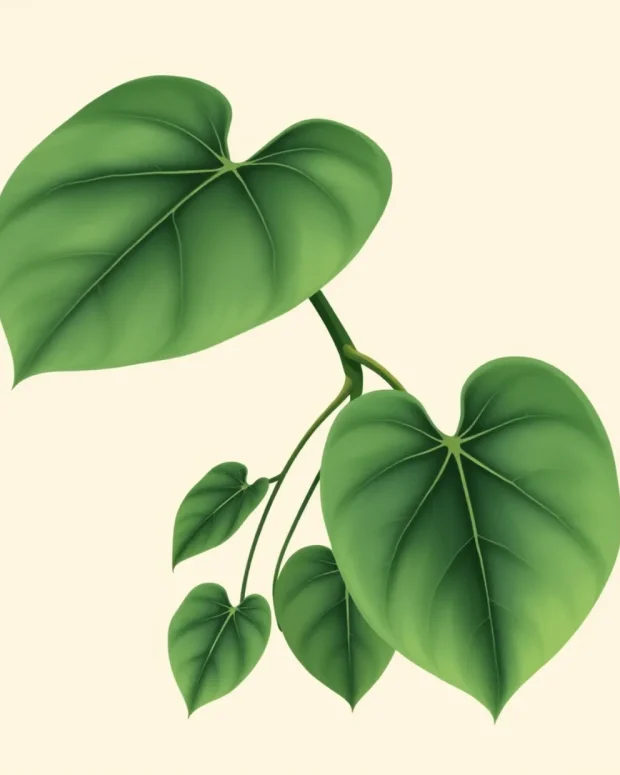
This one is worth a direct warning, because it is sold everywhere around Valentine’s Day. A single heart-shaped H. kerrii leaf potted on its own will never grow into a plant.
The leaf roots readily, which is why it survives for years and looks healthy, but a hoya can only produce new stems from a node, and a leaf cutting taken without a piece of stem has no node on it. It will sit as a leaf indefinitely and eventually decline. If you want a kerrii that grows, buy one with stem and at least one node, or check that the potted leaf has a short length of stem attached.
Blue hoya flowers
There are none. Hoya flowers come in white, cream, pink, red, yellow and some very dark near-black reds, and no species produces a true blue. Blue hoya photographs and blue hoya seed listings are edited images or outright scams, in the same way blue rose and blue tulip seed listings are.
Buying hoya from seed is a bad idea in general: the plants are slow from seed, seed is rarely viable by the time it is sold, and the genus is propagated from stem cuttings by everyone who actually grows it.
What goes wrong
NC State lists mealybugs, fungus gnats attracted to overly wet soil, and spider mites when the air is too dry.
Those two pests are diagnostic. Fungus gnats mean the mix is staying too wet; spider mites mean the air is too dry. Between them they describe the two ends of the range the plant wants to sit in the middle of.
Leaf drop is the other main complaint, and NC State’s note that both wet and dry conditions cause it is the answer: check the mix before assuming which direction the mistake went.
Shriveled, puckered leaves usually mean underwatering or root damage from being too wet. Yellowing leaves at the base of a wet plant mean root rot. And no flowers on a healthy plant usually means too little light, too much repotting, or simply that it is not old enough.
Light, lifespan and repotting
Three practical questions that come up repeatedly and have short answers.
- Will a hoya take low light? It will survive it and it will not flower in it. Hoyas tolerate lower light than most flowering houseplants, which is why they are sold as easy, but bright indirect light is what produces the flower spurs described above. A hoya that has never bloomed in five years is nearly always a hoya in a dim corner.
- How long do they live? Decades. This is one of the longest-lived houseplants commonly sold, and plants passed down through families are ordinary rather than remarkable. That is worth knowing because it changes the calculation on a slow plant: the years it takes to reach flowering size are a small part of its life.
- When to repot? Rarely, and reluctantly. Hoyas flower better slightly pot-bound, and repotting sets back both growth and flowering. Move one up a size only when it is genuinely root-bound and drying out within a day or two, and go up one pot size rather than several.
Toxicity, in plain terms
NC State lists Hoya carnosa as non-toxic to cats, dogs and horses. That is a positive statement of safety rather than an absence of a listing.
It is one of the reasons hoya is a sensible choice for a household with animals, alongside the fact that it is usually grown high up in a hanging basket where nothing reaches it anyway.
Frequently asked questions
- Should I cut off the stalk after the flowers drop?
- No. NC State is explicit that the peduncle should be left, because it produces flowers repeatedly over several years. Removing it costs you the flowering point and the plant has to build another.
- Why has mine never flowered?
- Usually age or light. Hoyas typically flower after two to three years, and they need bright indirect light year-round. Frequent repotting also delays it, since they bloom better slightly potbound.
- Should I repot it?
- Only when it has outgrown the pot, and then no more than two inches larger. Avoid repotting while it is budding or flowering, which is when disturbance costs the most.
- The leaves are dropping. Too wet or too dry?
- Either. NC State names both overly wet and overly dry conditions as causes, so check the mix rather than guessing. Fungus gnats point at too wet; spider mites point at air that is too dry.
- Are hoyas safe around pets?
- Yes. NC State lists Hoya carnosa as non-toxic to cats, dogs and horses, which is a positive statement rather than simply an absence of a warning.
Companion plants
How this entry is compiled
- Care values come from university extension publications and the USDA hardiness map, never from other gardening sites.
- Toxicity follows the ASPCA listing and is quoted rather than summarized.
- A value we cannot source is printed as not recorded, never estimated.
Compiled and checked by the Gardnicks editorial desk · last checked 2026-08-16
Sources for this entry
Where two sources disagree, the entry follows the one closest to the plant’s own growing region and says so in the text.
What kills it
Three failures cover almost everything readers write in about.
More in Houseplants
Plates are illustrations, not photographs of a specific plant, and are not evidence of a variety, place or season.