Snake plant
Dracaena trifasciata
Sansevieria trifasciata / mother-in-law's tongue / good luck plant
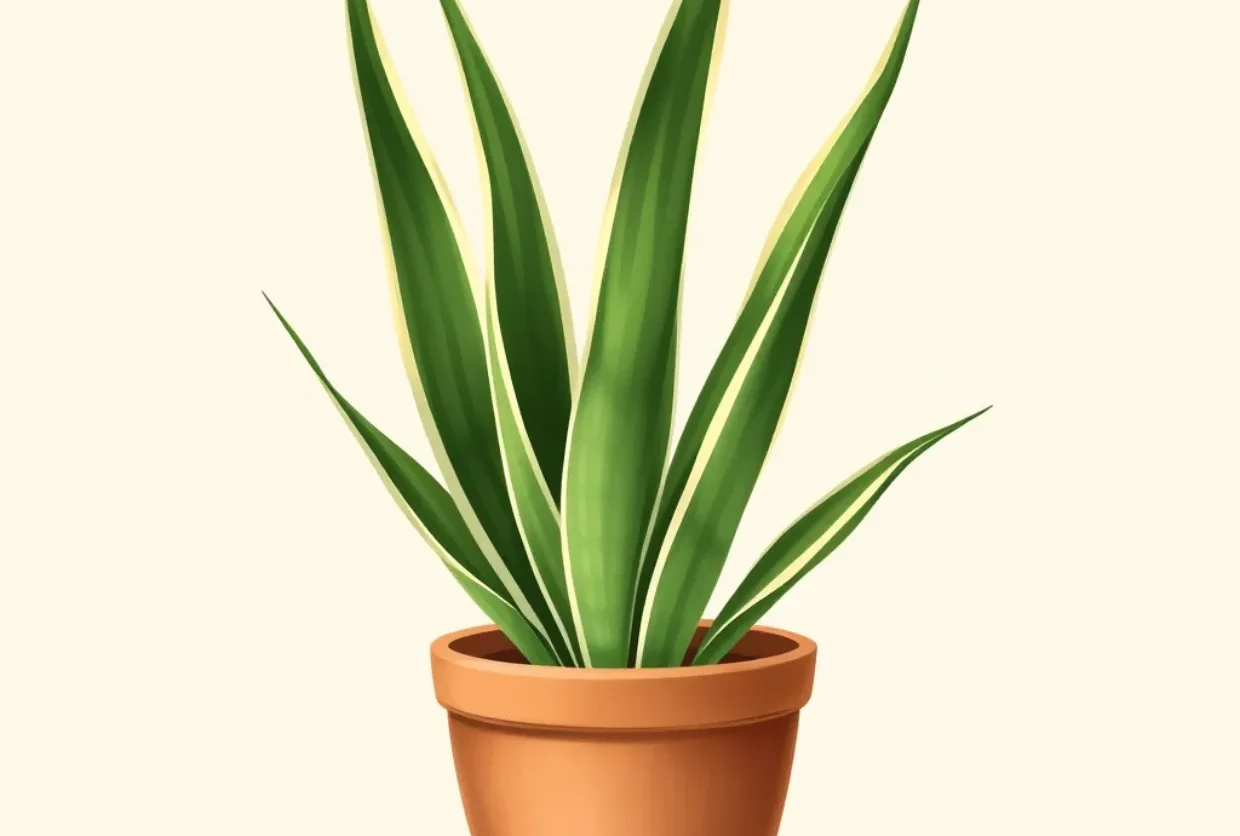
Almost unkillable, with one exception: a pot that stays wet. Water it hard, then leave it alone until the mix is dry all the way through.
The record
Every plant in the database answers the same questions in the same order, so two entries can be read line for line. 14 of 15 fields sourced.
- Light
- Part shade
- Light detail
- Bright indirect; tolerates dim, fades in it
- Water
- Low
- Water detail
- Only when the mix is dry through; every 1 to 2 months in winter
- Soil
- Cactus mix, or potting mix with perlite
- Soil pH
- 6.0 to 8.0, neutral to alkaline
- Mature size
- Leaves to 4 ft long, 2 to 4 in wide
- Toxicity
- NC State lists it toxic if ingested (saponins) in flowers, fruits, leaves, roots, sap and stems: vomiting, occasionally with blood, depression, nausea, diarrhea, anorexia, hypersalivation, dilated pupils in cats. Sap can irritate skin.
- Lifecycle
- Houseplant
- Difficulty
- Easy
- Humidity
- Low
- Potting mix
- Free draining, cactus mix or potting mix with perlite
- Repotting
- Only when roots force it out of the pot; tolerates being pot bound
- Temperature range
- 70 to 90 F ideal; no frost tolerance
Toxic to pets
NC State lists it toxic if ingested (saponins) in flowers, fruits, leaves, roots, sap and stems: vomiting, occasionally with blood, depression, nausea, diarrhea, anorexia, hypersalivation, dilated pupils in cats. Sap can irritate skin.
The plant that dies of attention
Snake plant is the one houseplant that is genuinely hard to kill, with a single exception, and the exception is you. Illinois Extension states it as plainly as it can be stated: over-watering is the main reason for failure.
Everything else about this plant is tolerant. It will sit in a dim hallway for a year and stay alive. It will take a bright window. It will go weeks without water and not complain. What it will not survive is a pot that stays wet, because the roots rot, the leaves yellow at the base and go soft, and by the time the damage is visible above the soil it is usually finished below it.
If you take one instruction from this entry, take this one: water it, then leave it alone until the mix is dry all the way through.
Names, because they changed
The accepted botanical name is now Dracaena trifasciata. For decades it was Sansevieria trifasciata, and most plants are still sold and labeled under the old name. They are the same plant.
Common names include snake plant, mother-in-law’s tongue, good luck plant and golden bird’s nest, which is more names than any one plant needs and a fair indication of how widely it has traveled.
Types of snake plants
NC State lists fourteen registered cultivars of the one species, and the useful thing about that is how little it changes. They differ in leaf shape, height and markings; the care is identical across all of them, so the choice is a matter of what fits the space.
| Cultivar | Leaf | Where it suits |
|---|---|---|
| The plain species | Upright, banded dark and light green, up to 4 ft long and 2 to 4 in wide | A floor pot. The full-size form |
| Laurentii | Dark green with lighter green zigzags and yellow edges | The most-sold variegated form. Note the propagation caution below |
| Hahnii | Dwarf, forming a short funnel-shaped rosette with horizontal stripes | A shelf or a desk. This is what is sold as bird’s nest snake plant |
| Black Gold | Very dark green with bright gold edging | The high-contrast version of Laurentii |
| Moonshine | Silvery gray with light green blotches, and almost no banding | Where the plant is wanted as a pale shape rather than a striped one |
| Silver Queen | Silver green with light green horizontal bands | A softer alternative to the species |
Beyond those, the registered list runs to Bantel’s Sensation, Black Jack, Black Robusta, Futura Robusta, Futura Superba, Golden Flame, Metallica, Twisted Sister and Whitney. The pale and silver cultivars carry less chlorophyll and are correspondingly slower and hungrier for light, so the ones chosen for a dim corner should be the plain green forms rather than Moonshine.
Light
The honest answer is a range rather than a requirement. Illinois Extension says it will grow in any light intensity from a dim interior to full sun, and NC State records it as a partial shade plant taking two to six hours of direct light.
Bright indirect light is where it performs: bright enough to cast a soft shadow, without the sun’s disc falling on the leaves for hours. In genuinely low light it survives rather than grows, and the variegation fades toward plain green, which is the plant telling you it has less light than it would like rather than that it is in trouble.
Moving one straight from a dim corner into direct summer sun will scorch it. Shift it in stages over a couple of weeks.
Water
Water only when the mix has dried out completely, and then water thoroughly until it runs from the drainage hole.
In practice this means every few weeks in summer, and much less in winter. NC State gives every one to two months as the winter interval, and Illinois Extension’s version is to water just enough to keep the foliage from shriveling. Both are describing the same thing: a plant that is barely growing does not need the water a growing one does.
Three specific ways people drown this plant without meaning to: a pot with no drainage hole, a decorative outer pot that collects what drains through, and a saucer left full after watering. All three keep the roots wet after the watering has finished. If the pot you like has no hole, keep the plant in a plastic liner inside it and lift the liner out to water.
Mix and pot
Free-draining. A cactus and succulent mix, or a standard potting mix with perlite added, both work; ordinary compost on its own holds more water than this plant wants.
Terracotta helps if you tend to water generously, because it loses moisture through the sides. Glazed or plastic pots are fine if you are disciplined. The drainage hole is not optional in either case.
Snake plant is comfortable being pot-bound and does not need frequent repotting. Move it up a size when roots are pushing the plant out of the pot or the pot is being deformed, and not on a schedule.
Temperature and humidity
Ordinary indoor conditions suit it, and it prefers the warmer end: around 70 to 90 degrees Fahrenheit is ideal. Illinois Extension pairs moderate to warm temperatures with low humidity, which is exactly what a heated house delivers in winter, and one of the reasons this plant does well where tropical foliage plants sulk.
NC State lists it as hardy only in zones 10a through 12b, so outside the far south it is an indoor plant that can holiday outside in summer. Bring it in well before the first cold nights, because it has no frost tolerance at all.
Propagation
Division or leaf cuttings, both straightforward.
Division is the reliable one: turn the plant out, separate a clump with roots attached, and pot it into the same free-draining mix. Leaf cuttings work too, and take longer.
One thing worth knowing before you cut: variegated forms with yellow leaf margins do not come true from leaf cuttings, and the new plants revert to plain green. If you want to keep the variegation, divide the plant instead.
Propagating snake plant, step by step
There are three routes and they are not equivalent. Choosing between them comes down to one question: does the cultivar you have matter to you?
Division is the reliable method and the only one that keeps a variegated plant variegated. The plant spreads by underground rhizomes, and a mature clump is several plants already joined at the base.
- Turn the whole plant out of its pot and shake the mix off the roots so you can see where the clumps separate.
- Separate a section that has both leaves and roots of its own. A clean cut through the rhizome is better than tearing it.
- Let the cut surfaces dry for a day before potting, the same rule as for any thick-tissued plant.
- Pot into the same free-draining mix, in a pot only slightly larger than the roots, and wait a week before the first watering.
The result is a plant, not a cutting: it has roots from the first day and carries on growing rather than starting over.
Leaf cuttings in mix are slower and produce plain green plants from variegated parents. Cut a healthy leaf into three or four inch sections and keep track of which end was down, because a section planted upside down never roots and this is the mistake that wastes a whole batch. Let the cuts callus for a day or two, then set them base-down an inch into gritty mix.
Leaf cuttings in water follow the same preparation, then stand base-down in an inch of water with the water changed weekly. Roots appear in four to eight weeks and the pup that becomes the new plant comes later still. Water rooting is easier to watch and no faster, and the roots it makes are water roots that have to adapt when they are potted, so pot them on early rather than leaving them to grow long in the glass.
Across all three, timing helps: propagate in spring or summer when the plant is growing, since a division taken in December sits and does nothing for months, and sitting wet in a cold pot is how they rot.
What goes wrong
NC State lists mealybugs, spider mites, and root rot from overwatering.
Root rot presents as yellowing leaves that go soft at the base and pull away easily, and by then the roots are usually gone. If a plant is caught early, tip it out, cut away anything soft and brown, and repot into dry, fresh, gritty mix in a smaller pot.
Mealybugs show as white cottony deposits in the leaf joints; spider mites as fine stippling and, in bad cases, webbing. Both are far more common on stressed, crowded plants, and both are easier to remove by hand at the first sign than to treat once established.
Leaves that fall outward from the center rather than standing upright are usually a sign of too little light, too much water, or a plant that needs dividing, in that order of likelihood.
Snake plant turning brown
Brown is a different signal from yellow on this plant, and where it appears on the leaf narrows it down quickly.
- Dry brown tips, with the rest of the leaf firm. The commonest and least serious. It follows a spell of going too dry, or dry heated air over winter, and once a tip has browned it stays brown. Trim it or leave it, but do not start watering more often as a correction, because the leaf below it is telling you the plant is otherwise fine.
- Soft brown at the base, spreading upward. Root rot. This is the failure mode described above, and it is the one that kills. Tip the plant out and check the roots rather than waiting.
- Dry brown patches on the upper surface, on the side facing a window. Sunburn, usually after moving a plant from a dim spot into direct sun without a transition. Permanent on that leaf and preventable on the next.
- Brown crisping along one whole side after a cold night. Cold damage. It has no frost tolerance, and a plant left out too late in autumn or sitting against a cold pane will show it.
Snake plant fungal infection
Worth answering directly, because the phrase turns up more often online than the problem does in extension records. The disease NC State lists for this plant is root rot from overwatering, and no foliar fungal disease. The insect problems it does list are mealybugs, spider mites, banded greenhouse thrips and fern scale.
That does not mean a snake plant can never pick up a leaf infection, but it does mean that a diagnosis of a fungal leaf problem on a snake plant is usually wrong, and that the more likely explanations are the four in the list above. If a plant is genuinely declining, the sequence is: look at the roots first, then the leaf joints for mealybugs, then the growing conditions. Reaching for a fungicide is nearly always treating the wrong thing.
Where fungus does become the answer is in a pot that has stayed wet, and there the treatment is not a spray. Cut back to firm tissue, let the cuts dry, repot into dry gritty mix in a smaller pot, and change the watering habit that caused it.
Frequently asked questions
- How often should I water a snake plant?
- When the mix is dry all the way through, which in a bright room in summer is every two to three weeks and in a dim room in winter can be once a month or less. There is no schedule that works year round, because the same pot dries at very different speeds in July and January.
- What does an overwatered snake plant look like?
- Leaves that go soft and yellow from the base upward, and fall over at the soil line rather than drooping from the tip. Tip the plant out: brown mushy roots confirm it. Cut back to firm tissue, let the cuts dry, and repot into dry gritty mix rather than watering it again.
- Do snake plants need light?
- They tolerate low light better than almost any houseplant, which is not the same as preferring it. In a dim corner growth nearly stops and variegation fades toward plain green. Bright indirect light gives faster growth and keeps the markings, and a few hours of direct sun does no harm.
- How do I propagate a snake plant in water?
- Cut a healthy leaf into three or four inch sections, keeping track of which end was down, because a section planted upside down never roots. Let the cuts callus for a day or two, then stand them base-down in an inch of water and change it weekly. Roots take four to eight weeks, pups later still.
- Why do water-grown cuttings sometimes lose their variegation?
- Because leaf cuttings of variegated cultivars usually revert to plain green, whatever the rooting medium. The variegation lives in the tissue at the base of the plant rather than in the leaf, so the reliable way to keep it is division of a pup with its own roots.
- What are the main types of snake plant?
- Most are cultivars of one species: the upright banded form, the yellow-edged Laurentii, the compact rosette forms sold as bird’s nest, the near-black cultivars, and the cylindrical-leaved kinds. They want identical care, so the choice is about size and shape rather than about growing conditions.
Planters, coffee grounds, and the disadvantages
Choosing a planter
The pot matters more on this plant than on most, because the one thing that kills it is water sitting around the roots, and the planter decides how long that lasts.
- A drainage hole is not negotiable. Everything else on this list is a preference; this is a requirement.
- Terracotta forgives a generous hand. It loses moisture through the sides, which shortens the wet period after each watering. Glazed ceramic and plastic hold it longer and suit someone disciplined about the dry-out.
- Heavy over tall. A four-foot leaf in a light plastic pot topples. A wide, weighted base is worth more here than depth, since the roots are shallow and the plant is happy pot-bound.
- Cachepots need a liner. If the decorative planter has no hole, keep the plant in a plastic liner inside it and lift the liner out to water and drain. A decorative outer pot collecting what drains through is one of the three commonest ways this plant is drowned.
Do snake plants like coffee grounds?
No, and the reasoning is worth having because the same answer applies to most houseplants.
Coffee grounds are not a fertilizer. They run 1 to 2 percent nitrogen with small amounts of micronutrients, which is not a meaningful source of plant nutrition, and their real effect is on soil life and structure rather than on feeding. Applied directly rather than composted first, they cause three specific problems: soil microbes tie up nitrogen while breaking them down, caffeine residues can slow growth, and a layer of grounds on the surface reduces water infiltration and can turn water-repellent.
That last point is the one that matters most on a snake plant. A crust on the surface of the mix makes it harder to judge whether the pot has actually dried out, and misjudging that is precisely how the plant dies. Feed it lightly with an ordinary houseplant fertilizer in the growing season if you feed it at all, and put the coffee grounds in the compost heap, which is where extension services do recommend them.
The disadvantages, honestly
It is worth being straight about the trade-offs on a plant that gets recommended as unkillable.
- It is toxic to pets and children. NC State rates the severity low, but ingestion causes vomiting, occasionally with blood, along with nausea, diarrhea and depression in dogs, cats, horses and children. The toxic principle is saponins. Low severity is not the same as safe.
- It is slow. Tolerating a dim corner and growing in one are different things, and in low light it will produce very little for years. Anyone wanting visible progress should look elsewhere.
- Damage is permanent. A leaf that is scorched, browned or bent stays that way, because the plant does not repair leaves and does not replace them quickly. One bad winter or one sunburn marks a plant for a long time.
- Variegation is fragile in two directions. It fades toward plain green in low light, and it does not survive leaf-cutting propagation.
- It is not a temperate outdoor plant. Hardy only in zones 10a to 12b and with no frost tolerance at all, so in most of the country it is indoors from autumn to late spring whether you want it to be or not.
Toxicity, in plain terms
This matters more than usual, because a snake plant sits on the floor within reach of a cat or a dog.
NC State lists it as toxic if ingested, with saponins as the toxin, present in flowers, fruits, leaves, roots, sap and stems. The symptoms listed are vomiting, occasionally with blood, depression, nausea, diarrhea, loss of appetite, excessive salivation and, in cats, dilated pupils. The sap can also irritate skin.
If a pet has chewed the leaves and is showing any of that, ring a vet or an animal poison line rather than waiting it out. In a household where the cat chews plants, this one belongs somewhere it cannot be reached.
How this entry is compiled
- Care values come from university extension publications and the USDA hardiness map, never from other gardening sites.
- Toxicity follows the ASPCA listing and is quoted rather than summarized.
- A value we cannot source is printed as not recorded, never estimated.
Compiled and checked by the Gardnicks editorial desk · last checked 2026-08-16
Sources for this entry
- NC State Extension Gardener Plant Toolbox, Dracaena trifasciata
- Penn State Extension, Snake Plant: A Forgiving, Low-maintenance Houseplant
- University of Illinois Extension, Mother-in-Law Tongue
Where two sources disagree, the entry follows the one closest to the plant’s own growing region and says so in the text.
What kills it
Three failures cover almost everything readers write in about.
More in Houseplants
Plates are illustrations, not photographs of a specific plant, and are not evidence of a variety, place or season.