Fern
Nephrolepis exaltata and others
Boston fern / sword fern
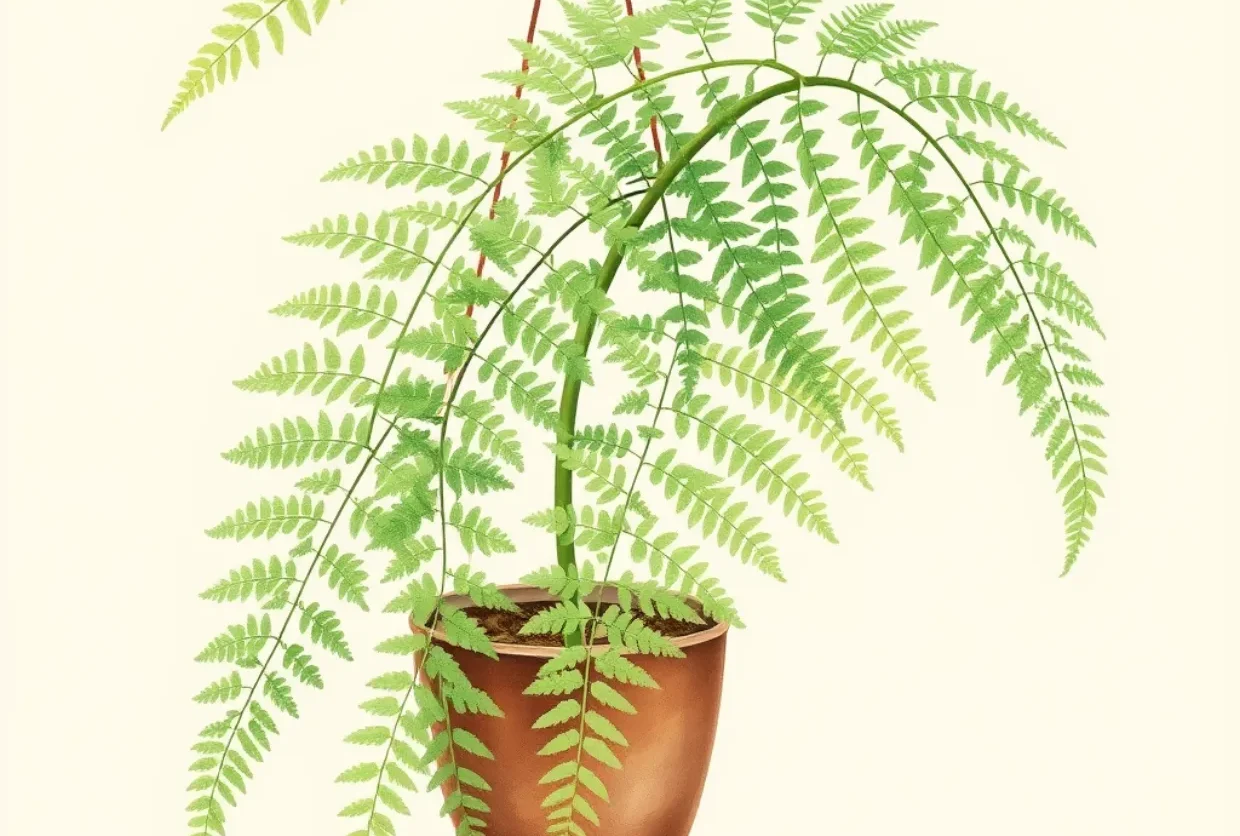
Brown frond tips have three different causes with nearly identical symptoms, and misting fixes none of them. Consistent watering does more than any spray bottle.
The record
Every plant in the database answers the same questions in the same order, so two entries can be read line for line. 10 of 15 fields sourced.
- Light
- Part shade
- Light detail
- Medium light, within a few feet of a window or an eastern exposure; direct sun scorches
- Water
- Moderate
- Water detail
- Consistently moist, never soggy; one thorough drying out browns fronds permanently
- Soil
- Highly organic, porous and moisture retentive
- Soil pH
- not recorded
- Mature size
- not recorded
- Toxicity
- not recorded
- Lifecycle
- Houseplant
- Difficulty
- Moderate
- Humidity
- High
- Potting mix
- Potting mix with a large percentage of peat moss
- Repotting
- Every few years in spring; divide by cutting the root ball vertically
- Temperature range
- not recorded
- Safe for pets
- not recorded
Fertilizer strength, every 4 to 6 weeks. Ferns are damaged by over-feeding more easily than most houseplants, and the damage begins at the frond tips and looks exactly like dry air.
Brown frond tips have three different causes, and misting fixes none of them
The fern question is always the same: why are the tips going brown. There are three usual answers and they need different responses, which is why one blanket fix does not work.
Dry air. Ferns need high humidity, and Clemson notes the tips and edges of the pinnae turn brown in dry interiors, especially in winter.
Over-fertilizing. This one surprises people. Ferns have modest fertilizer needs and are damaged more easily than most houseplants by too much, and the damage shows as browning and drying that begins at the tips and works back into the frond. The symptom is nearly identical to dry air.
Heat and position. The higher a fern is placed, the hotter and drier the air around it, particularly in summer. A hanging basket near a ceiling is in the worst air in the room.
On misting, Minnesota Extension is blunt: it is not very effective. Since improving humidity indoors is genuinely difficult, the advice is to concentrate on proper watering to reduce moisture stress instead. That is a more useful instruction than any spray bottle.
What ferns actually want
Light: medium. Boston ferns do well within several feet of a light source or in an eastern exposure. They tolerate low light and prefer medium, and direct sun scorches the fronds.
Soil: highly organic, porous and moisture-retentive at the same time. When potting up, choose a mix with a large percentage of peat moss.
Water: consistently moist, never soggy, because soggy soil encourages root rot. This is the balance the whole plant turns on.
Feed: sparingly. Liquid or slow-release houseplant fertilizer at half strength every four to six weeks while actively growing, and nothing while growth has stopped.
Care through the year
- Keep it out of drafts and away from radiators
Both dry the air locally far more than the room average suggests, and a fern reads the air immediately around it.
- Water before the mix dries out
Ferns have no reserve. A single thorough drying out browns fronds that will not recover, unlike most houseplants which simply wilt and revive.
- Feed at half strength, and skip it in winter
Over-feeding produces exactly the brown tips people then treat as a humidity problem.
- Put it lower rather than higher
The hottest, driest air in a room is at the top. A plant stand does more for a fern than a ceiling hook.
- Repot and divide every few years in spring
Cut the root ball vertically with a sharp knife into halves or quarters, keeping as many fronds as possible on each division.
Which fern to buy
Boston fern is the classic and one of the more forgiving, provided it is watered properly.
Bird’s nest fern has broad undivided fronds rising from a central rosette, and it tolerates ordinary indoor humidity better than the finely divided types, because there is less surface area losing water.
Rabbit’s foot fern grows from furry surface rhizomes that creep over the pot edge, and it is more tolerant of drying than most.
Staghorn fern is mounted on a board rather than potted and is a different proposition altogether.
Maidenhair fern is the beautiful one that dies. Its fronds are thin enough that a few hours of dry air browns them, and it genuinely needs a bathroom, a terrarium or a humidifier. Buying one for a normal living room is the most common fern disappointment.
Types of indoor ferns, sorted by how much humidity they need
Every fern wants more humidity than a heated room provides. What separates them is how much they mind, and that single axis predicts whether a given fern will survive on your shelf or belong in a terrarium.
| Fern | The frond | Light | Humidity tolerance |
|---|---|---|---|
| Bird’s nest, Asplenium nidus | Broad, glossy, undivided lance-shaped leaves with wavy edges, whorled around a central rosette. Does not look like a fern at all | Bright indirect | The most forgiving. Less cut surface means less water lost, and it does not shed the way divided ferns do |
| Rabbit’s foot, Davallia fejeensis | Long lacy dark green fronds, with furry gray-brown rhizomes creeping over the pot rim | Bright indirect, tolerates less | High. The rhizomes store water, which is exactly why it rides out dry spells |
| Staghorn, Platycerium | Antler-shaped fronds over a flat shield frond. Usually mounted on a board rather than potted | Bright indirect | High. Watered by soaking the whole mount for 10 to 20 minutes every week or two |
| Button, Pellaea rotundifolia | Small round leaflets along wiry dark stems | Bright, and it manages lower light | Good. A New Zealand native that adapts to average home conditions |
| Boston and the sword ferns, Nephrolepis exaltata | The classic arching divided frond. Kimberly Queen is an upright sword fern in the same genus | Indirect, with some direct morning sun acceptable | Moderate. Wants consistent moisture and real humidity, and browns if handled |
| Kangaroo paw, Microsorum | Dark glossy fronds lobed like a footprint | Bright indirect | Moderate. Trails, so it suits a hanging basket |
| Maidenhair, Adiantum | Tiny fan-shaped leaflets on fine black stems | Filtered light, a north window | The fussiest. Genuinely needs terrarium humidity. Beautiful, and the one most often killed |
Read that last column before the first two. If the plant is going on an open shelf in a heated room, buy a bird’s nest, a rabbit’s foot or a button fern. If it is going in a bathroom with a window or a terrarium, maidenhair becomes possible. Buying a maidenhair for a living room is the single most common fern mistake, and no amount of misting corrects it, for the reasons given at the top of this page.
Lemon button fern, which is not the button fern above
Two different plants are sold as button ferns and the names are close enough to cause real confusion at the till.
Button fern is Pellaea rotundifolia, the New Zealand plant in the table above, with round leaflets on wiry dark stems. Lemon button fern is Nephrolepis cordifolia Duffii, a compact relative of the Boston fern, with small rounded leaflets running up arching fronds and a faint lemon scent when the foliage is crushed. They are in different genera and only the word button connects them.
Lemon button fern is the more useful houseplant of the two for most people. It stays small, roughly 4 to 12 inches, which makes it one of the few ferns that genuinely suits a terrarium or a small shelf rather than needing one. It wants partial shade and warmth, and soil kept consistently moist: check every couple of days and water once the surface feels dry. Too much sun damages the foliage and stunts it. Outdoors it is hardy in about zones 8b to 9b and survives short dips to around 15°F.
Australian tree fern, the one that is not a houseplant
Cyathea cooperi is the tree fern people mean, and it is worth knowing what it actually is before buying one as an indoor plant. It forms a genuine trunk and reaches 20 feet or more, spreading up to 12 feet, and it is the fastest-growing of the tree ferns: a young plant can widen by several feet in a single year.
It is semi-tender rather than tropical. It takes short dips to around 27°F, but sustained frost defoliates it or kills the crown outright, so it is an outdoor plant in mild frost-free climates and a conservatory plant elsewhere. What it needs is dappled light, high humidity, and soil kept consistently moist, with the base of the trunk damp but never waterlogged. Watering the trunk itself matters as much as watering the ground, because the roots run through it.
In an ordinary heated room it fails on all three counts at once, and the fact that it is sold small in a pot does not change what it is going to try to become.
Three plants sold as ferns that are not ferns
Worth knowing before buying, because the care instructions differ completely.
- Foxtail fern and asparagus fern are Asparagus densiflorus, relatives of the vegetable rather than ferns at all. They have proper roots and tubers, tolerate far more light and far more drought than any true fern, and grow well in containers outdoors in summer. They are also less cold tolerant than they look and come in before frost.
- Java fern, Microsorum pteropus, is a genuine fern but an aquatic one, grown submerged in aquariums and attached to wood or rock rather than planted in substrate. Nothing on this page applies to it.
- Shinobu is not a species but a style: a rabbit’s foot or similar fern trained over a moss ball, sold as a Japanese craft object. Care is the fern’s own, with the ball soaked rather than watered from above.
Dividing ferns, and when they need it
Ferns split easily, and on some of them it is maintenance rather than propagation. Boston ferns in particular are fast growers that should be divided about once a year: if the roots pack too densely the center of the plant dies out, leaving a ring of growth around a dead middle.
- Turn the plant out and look at the crown. A dead or woody center means it is overdue.
- Discard the dead center and pull or cut the living outer sections apart, each with roots and fronds attached.
- Repot the divisions and cut the foliage back to the soil line. It looks drastic and fresh growth comes quickly.
- Keep the divisions warm and evenly moist while they re-establish.
Rhizomatous ferns such as rabbit’s foot are divided differently: a length of rhizome with a few fronds attached, pinned onto the surface of fresh mix rather than buried, since burying the rhizome rots it. Staghorns produce offsets called pups at the base of the shield frond, which are cut away with a piece of the parent and mounted separately.
What goes wrong
Beyond the browning question, ferns are not troubled by much. Scale and mealybugs occur, and both are harder to treat here than on most houseplants because fern fronds are sensitive to the oils and soaps normally used, so test any treatment on a single frond first.
Whole fronds yellowing and dying off one at a time, from the oldest inward, is normal aging and not a problem. Cut them at the base.
Dark specks in neat rows on the underside of a frond are spores, not pests. They are how the plant reproduces and they alarm people every year.
Toxicity, in plain terms
True ferns are generally regarded as non-toxic and Boston fern is a standard recommendation for homes with pets. No extension toxicity listing was consulted for this entry, so the record reads not recorded rather than repeating that as a sourced claim.
One name is worth flagging: asparagus fern is not a fern at all, and it is toxic. If the plant in question is that one, the answer here does not apply to it.
Frequently asked questions
- Why are my fern’s tips brown?
- Three usual causes with nearly identical symptoms: dry air, over-fertilizing, and a position where the air is hot and dry. Since indoor humidity is hard to change, extension guidance is to concentrate on consistent watering, feed at half strength, and move the plant lower and away from heat.
- Does misting help?
- Not much. Minnesota Extension describes it as not very effective, because the humidity lift lasts minutes. A humidifier, a pebble tray or grouping plants does more, and correct watering does the most.
- How much light does a fern need?
- Medium. Within several feet of a light source, or an eastern exposure. They tolerate low light and prefer medium, and direct sun burns the fronds.
- How often should I feed it?
- Half-strength liquid or slow-release fertilizer every four to six weeks while it is actively growing, and none in winter. Ferns are damaged by over-feeding more easily than most houseplants, and the damage looks exactly like dry air.
- What are the brown dots under the leaves?
- Spores, arranged in regular rows or patches. They are how ferns reproduce and are not a pest or a disease. Pest damage is irregular; spores are neat and symmetrical.
Companion plants
How this entry is compiled
- Care values come from university extension publications and the USDA hardiness map, never from other gardening sites.
- Toxicity follows the ASPCA listing and is quoted rather than summarized.
- A value we cannot source is printed as not recorded, never estimated.
Compiled and checked by the Gardnicks editorial desk · last checked 2026-08-16
Sources for this entry
- University of Minnesota Extension, Growing tropical ferns indoors
- Clemson HGIC, Indoor Ferns
- Wisconsin Horticulture, Boston Fern
- Clemson HGIC, Bird's Nest Fern
Where two sources disagree, the entry follows the one closest to the plant’s own growing region and says so in the text.
What kills it
Three failures cover almost everything readers write in about.
More in Houseplants
Plates are illustrations, not photographs of a specific plant, and are not evidence of a variety, place or season.