Aloe vera
Aloe vera
Medicinal aloe / burn plant
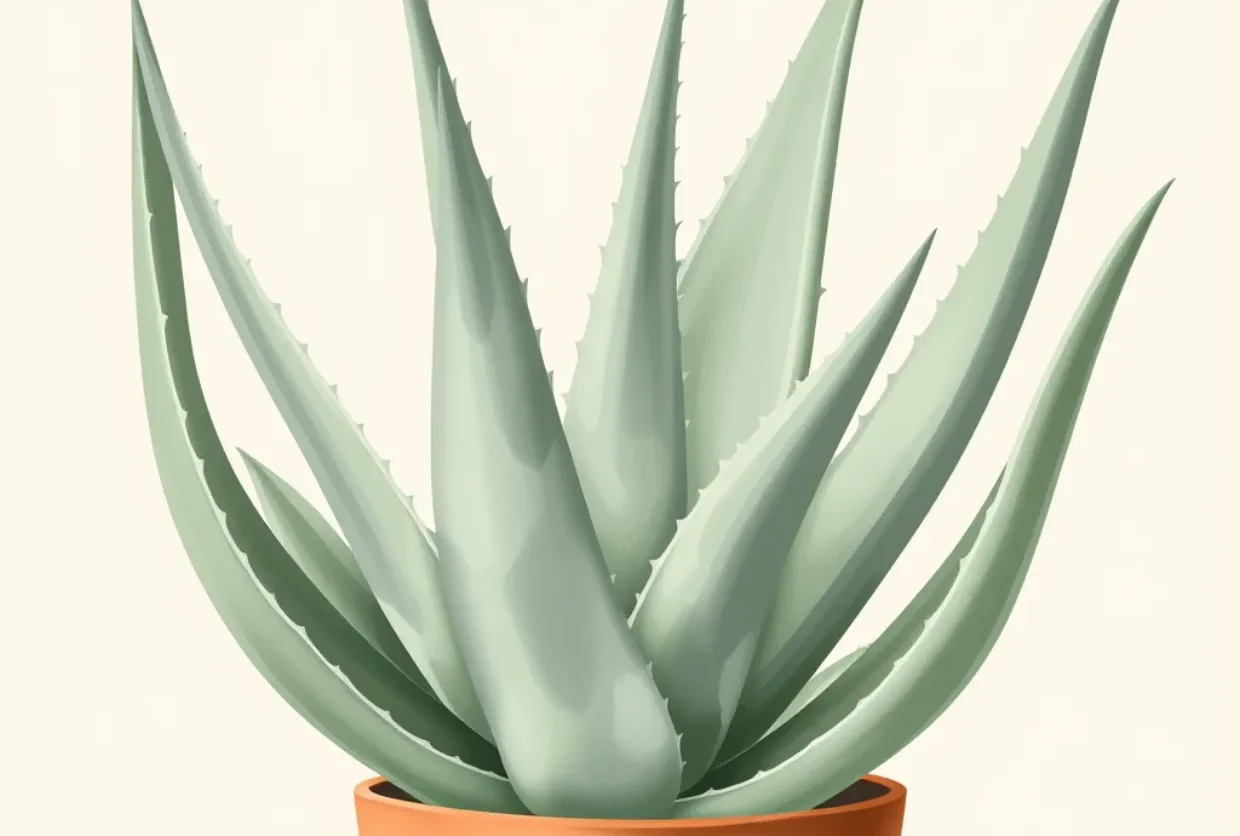
Kept on a kitchen windowsill and watered like a kitchen plant, which is the one thing it cannot survive. The soil has to dry completely between waterings.
The record
Every plant in the database answers the same questions in the same order, so two entries can be read line for line. 13 of 15 fields sourced.
- Light
- Full sun
- Light detail
- 6 hours or more, or 2 to 6 in partial shade; indoors the brightest window
- Water
- Low
- Water detail
- Only when the soil has dried completely through; much less in winter
- Soil
- Well draining succulent mix, loam or sand based
- Soil pH
- not recorded
- Mature size
- 1 to 2 ft tall, 1 to 2.5 ft wide
- Toxicity
- NC State rates aloe low severity: poisonous through ingestion or dermatitis, with abdominal cramping, diarrhea and red urine, plus skin irritation from the latex. It affects humans, cats, dogs and horses.
- Lifecycle
- Houseplant
- Difficulty
- Easy
- Humidity
- Low
- Potting mix
- Gritty succulent mix in a clay pot with a drainage hole
- Repotting
- When offsets crowd the pot; divide them at the same time
- Temperature range
- not recorded
- Safe for pets
- No
The coldest zone it survives outdoors. Hardy from 10a to 12b and a houseplant everywhere else, though it can spend a temperate summer outside if it is moved into sun gradually.
Toxic to pets
NC State rates aloe low severity: poisonous through ingestion or dermatitis, with abdominal cramping, diarrhea and red urine, plus skin irritation from the latex. It affects humans, cats, dogs and horses.
The plant people keep for burns, and kill with kindness
Aloe vera is bought as a kitchen-windowsill first-aid plant and then watered like a kitchen-windowsill plant, which is the one thing it cannot survive.
NC State’s instruction is a single sentence and it is the whole of the care: allow the soil to completely dry between waterings. Root rot from overwatering is the standard cause of death, and it is far more common than any pest on the list.
Completely dry means all the way through, not dry on top. In a bright warm room that is every two to three weeks; in winter it can stretch much longer, because the plant is barely growing and NC State’s guidance is explicitly to water less frequently in the winter months.
The plant tells you when it genuinely needs water, and the signal is the opposite of what people watch for. Thirsty aloe leaves thin, curl inward and go slightly wrinkled. Overwatered aloe leaves go soft, translucent and yellow at the base, and by then the roots are usually gone.
Light, soil and pot
Full sun at six hours or more, or partial shade at two to six. Indoors that means the brightest window in the house, and a plant that stretches and leans pale is asking for more.
Soil should be a well-draining succulent mix, loam or sand based, tolerating occasional dryness. Ordinary potting compost holds far too much water for this plant even when the watering is disciplined.
NC State names the pot too: containers must have drainage holes, and clay pots are ideal because they are porous and dry faster. That combination, gritty mix in a clay pot with a hole, forgives a great deal of over-enthusiastic watering.
How to make soil for aloe vera
A bagged cactus and succulent mix is the simple answer and it works. If you would rather mix your own, or improve a bag that still feels too peaty, the principle is that roughly half to two thirds of the volume should be mineral rather than organic.
One part ordinary potting mix to two parts perlite, pumice or coarse grit gives a medium that holds enough moisture to matter and drains before the roots notice. What does not work is regular houseplant compost or garden soil on its own: both are far too heavy and hold water for too long, and that is the single most common setup behind the root rot described below.
Terracotta is worth the preference rather than plastic, because the clay is porous and pulls moisture out of the mix through the sides of the pot. On a plant whose failure mode is staying wet, an error in that direction is the one you want.
How big do aloe vera plants get, and the outdoor question
It reaches 1 to 2 feet tall and 1 to 2.5 feet wide, hardy outdoors only in zones 10a to 12b. Everywhere colder it is a houseplant, and it can spend the summer outside in a temperate climate before coming back in.
Move it out gradually if you do. A plant that has spent winter indoors will scorch in a day of unfiltered sun, and the damage does not grow out.
Flowers are orange-yellow tubes in a tall spike, in spring and winter, and they only appear on mature plants, which then bloom repeatedly. An aloe that has never flowered is usually young rather than unhappy.
Making more of them
- Wait for the offsets
A healthy mature plant sends up small pups around the base. Division of those offsets is the propagation method, and it is close to foolproof.
- Let the pup reach a few inches
A larger offset has its own roots and establishes without difficulty. A tiny one usually rots.
- Cut it away with roots attached
Tip the parent out, separate the pup with a clean knife, keeping whatever roots come with it.
- Let the cut dry for a day or two
A callused cut is what stops rot getting in at the wound.
- Pot it dry, then wait a week
Into gritty mix, and no water for the first week. This is the opposite of what feels right and it is why aloe divisions succeed.
Propagating a pup that has no roots
Offsets do not always come away with roots attached, particularly when they are taken from a crowded pot or snapped off rather than teased free. A rootless pup is not a failure and it does not need rooting hormone or water. It needs the same treatment as a cutting.
Let the broken end dry and callus over for several days somewhere shaded and out of direct sun, then pot it into dry succulent mix in the smallest container that will hold it upright. Do not water for the first week or two. Roots form into dry medium far more readily than into wet, and watering early is what rots a pup that would otherwise have taken.
One thing aloe will not do, unlike echeveria and several other succulents, is grow from a detached leaf. A leaf laid on soil rots rather than rooting. Offsets are the method, and on a plant that only begins producing them at around three years old, patience is part of it.
Reading the leaves
Almost everything this plant is going to tell you, it tells you through the leaves, and the signals are easy to confuse because several of them look like a plant that wants water. This is the whole diagnosis in one place.
| What the leaf does | What it means | What to do |
|---|---|---|
| Thin, curled inward, slightly wrinkled | Thirsty. The plant is drawing on its own reserves | Water thoroughly. It recovers within a day or two |
| Soft, translucent, yellow at the base. Plant lifts out of the pot without resistance | Root rot from overwatering. By the time it shows, the roots are usually gone | Tip it out and cut back to firm tissue. See below |
| Uniformly pale or washed out, with the leaves stretching toward the window | Too little light | A brighter position, moved gradually over a week or two |
| Patchy white or straw-colored, on one side, no stretching | Sunburn from an abrupt move into full sun | Nothing. The damage is permanent; only new growth comes in clean |
| Brown, dry, papery tips | Underwatering or dry air | Check the watering interval first. Tips do not recover |
| Flat and splayed, opening out from the middle | Too little light again, further along | As above |
| Red or brown tinge across the whole leaf | Not a problem. Strong sun, and often a good sign | Nothing |
| White cottony blobs where leaf meets stem | Mealybugs | Remove one at a time on a cotton bud |
| Flat brown discs on the leaf | Scale | The same, scraped off by hand |
Two rows in that table cause most of the wrong decisions. Thirsty and overwatered look nothing alike once you know what to look for, but both get treated with water: thin and wrinkled is dry, soft and translucent is drowning, and watering the second one finishes it. And pale is decided by whether the plant is stretching, not by the shade of pale. Stretching means it wants light; no stretching, on one side only, means it has had too much.
What goes wrong
NC State lists mealybugs, aphids, scale, leaf spot, aloe rust and sooty mold, with root rot from overwatering.
Mealybugs, the white cottony blobs tucked where leaves meet the stem, are the common indoor pest and are removed one at a time on a cotton bud. Scale shows as flat brown discs.
Most complaints are not pests. Soft mushy leaves and a plant that lifts out of the pot without resistance is root rot. Brown, dry, papery leaf tips are usually underwatering or dry air. Flat, splayed growth that opens out from the middle instead of standing upright is too little light. A red or brown tinge across the leaves, by contrast, is often just strong sun and is not a problem.
Pale or whitish leaves, which is a third case
The paragraph above covers the two obvious light problems. There is a third that gets searched for on its own: leaves that go pale, washed-out or almost white rather than flat or red.
The usual cause is too little light, and it comes with a companion symptom. A plant short of light weakens, the color drains toward pale green, and the leaves elongate and stretch toward the window. Pale plus stretched is a light shortage, and the answer is a brighter position, moved gradually rather than in one step.
The less common cause is the opposite, and it is bleaching rather than paling. A plant moved abruptly from indoors into full sun scorches, and the damaged tissue goes white or straw-colored in patches rather than uniformly, usually on the side that faced the sun. That damage does not recover; the leaves stay marked, and only new growth comes in clean.
The two are told apart by pattern. Uniform pallor across the whole plant, with stretching, is too little light. Patchy white on one side, with no stretching, is sunburn.
Root rot, and whether the plant can be saved
Overwatered aloe leaves turn yellow and go mushy, and if nothing changes the rot moves down into the roots. A plant that lifts out of its pot with no resistance has already lost them.
It is usually still recoverable, because aloe roots readily from healthy tissue.
- Take it out of the pot and cut away everything soft, brown or sour-smelling, back to firm white or pale tissue. Be more ruthless than feels reasonable; anything left that is already rotting will carry on.
- Leave the cut plant somewhere dry, shaded and airy for about a week so the wound calluses over. Putting a fresh cut straight into soil is how the rot restarts.
- Repot into fresh dry mix in the smallest pot that will hold the plant upright, since a plant with no root ball in a large pot sits in damp medium it cannot use.
- Do not water for a week or two after repotting, and then water sparingly until there is visible new growth.
Toxicity, in plain terms
The gel inside the leaf is what people use, and it is not the same substance as the latex just under the skin.
NC State rates aloe low severity and specific: poisonous through ingestion or dermatitis, with symptoms including abdominal cramping, diarrhea and red urine, plus skin irritation from the latex, affecting humans, cats, dogs and horses.
So a dog that chews a leaf can get an upset stomach, and the yellow latex is the part responsible. This is the reason a plant kept for its soothing gel still belongs out of reach of an animal that eats things.
Frequently asked questions
- How often should I water aloe vera?
- Only when the soil has dried completely all the way through, which is usually every two to three weeks indoors and much less in winter. NC State’s instruction is explicit on both points, and overwatering is the main cause of death.
- The leaves have gone soft and yellow. What now?
- That is root rot from too much water. Tip the plant out and check the roots; if they are brown and mushy, cut back to firm tissue or take a healthy offset instead, let the cut callus, and repot into gritty mix in a pot with a drainage hole.
- Why is mine flat and spreading instead of upright?
- Too little light. Aloe wants six hours or more, and indoors that means the brightest window available. The splayed growth stays splayed; new growth from a brighter position comes in upright.
- How do I get more plants from it?
- Divide the offsets that appear around the base of a mature plant. Wait until a pup is a few inches, separate it with whatever roots it has, let the cut dry a day or two, pot it in gritty mix and do not water for the first week.
- Why is my aloe turning white or pale?
- Uniform pallor with stretched, elongated leaves is too little light, and the fix is a brighter spot introduced gradually. Patchy white or straw-colored marks on one side, without stretching, is sunburn from being moved into full sun too fast. Sunburned tissue does not recover; only new growth comes in clean.
- Can I propagate an aloe pup that has no roots?
- Yes. Let the broken end callus over for several days in a shaded spot, then pot it into dry succulent mix in the smallest pot that holds it upright and leave it unwatered for a week or two. Roots form into dry medium more readily than wet. Aloe will not grow from a detached leaf, only from offsets.
- Is aloe vera a cactus?
- No. Cacti are a separate family, and aloe belongs with the asphodels, closer to daylilies than to anything spiny. It is a succulent, which describes how a plant stores water rather than what it is related to, and that is why the two get confused.
- Is aloe vera safe for cats and dogs?
- No. NC State lists it as low severity poison for humans, cats, dogs and horses, causing abdominal cramping, diarrhea and red urine, with the latex under the leaf skin also irritating skin. The gel people use is a different part from the latex that causes the trouble.
Companion plants
How this entry is compiled
- Care values come from university extension publications and the USDA hardiness map, never from other gardening sites.
- Toxicity follows the ASPCA listing and is quoted rather than summarized.
- A value we cannot source is printed as not recorded, never estimated.
Compiled and checked by the Gardnicks editorial desk · last checked 2026-08-16
Sources for this entry
- NC State Extension Gardener Plant Toolbox, Aloe vera
- University of Minnesota Extension, Cacti and succulents
- Iowa State Extension, Growing Succulents Indoors
Where two sources disagree, the entry follows the one closest to the plant’s own growing region and says so in the text.
What kills it
Three failures cover almost everything readers write in about.
More in Houseplants
Plates are illustrations, not photographs of a specific plant, and are not evidence of a variety, place or season.