Lupine
Lupinus perennis
Wild lupine / sundial lupine
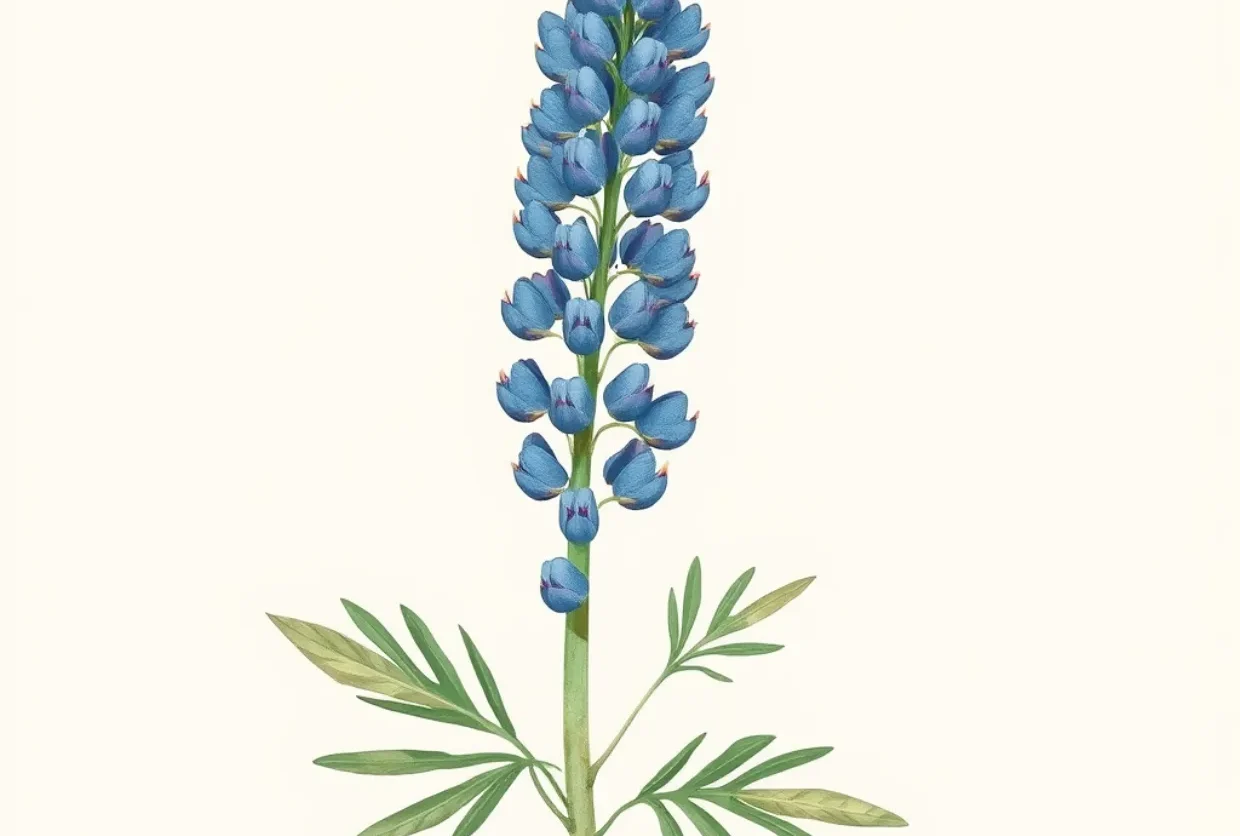
Two different plants are sold under the name. Only the eastern native is a host plant for the Karner blue butterfly, and only it wants poor sandy ground.
The record
Every plant in the database answers the same questions in the same order, so two entries can be read line for line. 16 of 17 fields sourced.
- Light
- Full sun
- Light detail
- Full sun to partial shade at 2 to 6 hours
- Water
- Low
- Water detail
- Sharp drainage; tolerates moist through to very dry, and rots in rich wet ground
- Soil
- Loam, sand or shallow rocky, sharply drained
- Soil pH
- Acidic to neutral, below 8.0
- Mature size
- 1 to 2.5 ft tall, 6 in to 1 ft wide
- Toxicity
- NC State rates lupine low severity: seeds are poisonous if eaten in large quantities, causing respiratory depression and slow heartbeat, sleepiness and convulsions. It affects humans, dogs, cats and horses.
- Lifecycle
- Perennial
- Difficulty
- Moderate
- Hardiness zones
- 3 to 8
- Bloom time
- Late spring into early summer
- Flower color
- Mostly blue, occasionally pink, lavender or white
- Pollinators
- Host plant for the Karner blue and frosted elfin butterflies; hummingbirds and bees
- Deer resistant
- not recorded
- Spacing
- Under 12 in apart
- Native range
- Eastern and central United States
Hardy in zones 3 to 8. Colder than zone 3, grow it in a container and overwinter it under cover.
Plant the Karner blue caterpillar can eat. Wild lupine and nothing else. A Russell hybrid on the same nursery bench does nothing for it, which is why the species name matters here more than the flower.
The year
Plant or divide and prune, and when it is actually in flower. Everything else is leaving it alone.
Toxic to pets
NC State rates lupine low severity: seeds are poisonous if eaten in large quantities, causing respiratory depression and slow heartbeat, sleepiness and convulsions. It affects humans, dogs, cats and horses.
Two different plants are sold as lupine
The tall, dense, candy-colored spires in garden centers are Russell hybrids, bred from Lupinus polyphyllus, a west coast species. The plant this entry records is Lupinus perennis, wild lupine, the eastern native.
They look related and they are, but they behave differently and only one of them matters ecologically. Wild lupine is smaller, at 1 to 2.5 feet tall and 6 inches to a foot wide, with predominantly blue flowers and occasional pink, lavender or white. The hybrids are taller, denser, in every color, and considerably shorter-lived in most gardens.
If you want a border plant, buy the hybrids and accept that they often behave as short-lived perennials. If you want the plant that supports the butterflies, it has to be the native, and that distinction is not decoration.
Why the native one matters
NC State records Lupinus perennis as the host plant for the Karner blue butterfly and the frosted elfin, while also attracting hummingbirds, bees and butterflies, with the seeds eaten by small mammals and birds.
Host plant is the key phrase. The Karner blue’s caterpillars feed on wild lupine and nothing else, which is why the butterfly has declined alongside the plant across the oak savanna and pine barren habitats they share. Planting a Russell hybrid does nothing for it.
This is one of the clearest cases in a garden where the species matters more than the flower, and it is worth knowing before choosing between two plants on the same bench.
Types of lupine worth knowing apart
The section above splits the wild native from the garden hybrid. Below that, three names cover almost everything sold, and the difference between them decides both how the plant behaves and whether it belongs in your garden at all.
| Type | What it is | Flowers | Where it belongs |
|---|---|---|---|
| Wild or sundial lupine, Lupinus perennis | The eastern North American native, lower and looser than the garden types | Blue to violet, in slimmer spikes | Native and meadow plantings, dry sandy ground. The host plant for the Karner blue butterfly, which is the ecological argument for it |
| Big-leaved lupine, Lupinus polyphyllus | The western North American native and the parent of the garden hybrids | Blue, pink and purple | Prefers moister ground than the eastern native. Invasive outside its home range, so worth checking locally |
| Russell hybrids | Bred from L. polyphyllus in the 1930s, and the group all modern garden lupines descend from | The dense candy-colored spires: red, yellow, cream, bicolors | Borders and cutting. Be patient, because it can take a full year before they flower properly |
Which one you want follows from the purpose. For wildlife value in the east, the native L. perennis is the only one that does the job. For the flower spike people picture when they say lupine, it is a Russell hybrid, and the trade is that it is shorter-lived and does nothing for native insects.
What it wants
Hardy in zones 3a to 8b, in full sun to partial shade at two to six hours or more.
Soil is the demanding part, and it is demanding in an unusual direction: loam, sand or shallow rocky ground, acidic to neutral below pH 8.0, with good drainage, tolerating conditions from moist to very dry.
Sandy, poor, sharply drained ground is what it evolved in. Rich garden soil produces soft growth that flops and rots, which is the opposite of the instinct to improve a bed before planting something.
Space under 12 inches apart. Flowering runs late spring into early summer.
Acidity is worth pinning down more tightly than that, because it is easy to get wrong while trying to help. Lupines want slightly acidic to acidic ground, roughly pH 5.5 to 6.5. On limey soil they struggle in a way no amount of care corrects, and the intervention that helps there is an acidifying amendment rather than compost.
On light, the range is wider than for most sun-loving perennials. Full sun gives the strongest spikes, but lupines genuinely perform in partial sun, and in hot southern gardens afternoon shade is an advantage rather than a compromise. Deep shade is the limit: there the spikes come thin and the plant leans.
Light requirements, stated plainly
Lupine light requirements are wider than for most sun-loving perennials: full sun to partial sun, with full sun giving the strongest spikes and afternoon shade being an advantage rather than a compromise in hot southern gardens. Deep shade is the limit, where the spikes come thin and the plant leans.
Planting, and the part people get wrong
Lupines are legumes with a deep taproot, and that shapes everything about how they are established.
- Grow from seed where it is to stay
Root cuttings and seed are the propagation methods. Sowing in place avoids disturbing the taproot, which is what transplanted lupines resent.
- Scarify the seed first
Seed scarification improves germination. Nick the hard coat with a file or soak the seed overnight; untreated seed germinates erratically over months.
- Do not enrich the soil
Poor, sandy, sharply drained ground is what it wants. As a legume it fixes its own nitrogen, so feeding it is both unnecessary and counterproductive.
- Leave established plants where they are
A deep taproot means a mature lupine moves badly. Plan the position once. If you do have to raise plants in pots, move them out at four to six weeks old, before the taproot has formed, and use biodegradable pots that go into the ground whole so the roots are never handled.
- Let some seed drop
Individual plants are not long-lived. A colony persists by self-sowing, so deadheading every stem eventually removes the planting.
Cold stratification, pruning, and the two jobs people skip
Does lupine need cold stratification?
Yes, and it is a separate step from the scarifying described above, which is why seed treated only one way still germinates poorly. Scarifying breaks the hard coat so water can get in. Cold stratification gives the embryo the winter signal it is waiting for before it will grow at all.
- Indoors: hold the seed cold and slightly damp for several weeks, in a refrigerator, then nick the coat with a file or nail clippers and soak it in warm water for a few hours before sowing. Stratify first, scarify second.
- Outdoors: sow in fall where the plants are to stay and let winter do the stratification. This is easier, it costs nothing, and it suits a plant that resents transplanting anyway.
Seed sown in spring without either treatment is the usual reason a packet produces almost nothing.
Pruning lupine, which is really two decisions
Lupines are not pruned in the shrub sense; there is nothing woody to cut. What there is amounts to two decisions about the flower spikes.
- Through flowering: cut the first spikes off as they fade, taking the stem down to the foliage. This often produces a smaller second flush and it keeps the plant tidy.
- At the end: stop, and leave the last spikes standing so the seed drops. That is how the colony replaces itself, and it matters more on this plant than the second flush does.
Cut the foliage back only once it has yellowed and died down in autumn. Removing green leaves earlier takes away what the crown is living on.
What goes wrong
NC State describes it as generally problem-free, with aphids, brown-spot fungus and powdery mildew the exceptions.
Aphids on lupines can be spectacular, arriving in dense colonies on the flower spike. On an established plant they are cosmetic and are washed off with water.
There is a caveat, and it is why aphids on lupine are searched for as often as they are. Aphids carry cucumber mosaic virus, and the two travel together: the insects move it from plant to plant as they feed. The aphids are a nuisance; the virus is not treatable. A plant showing mottled, distorted, yellow-streaked foliage has it and needs removing and destroying rather than nursing. So the reason to hose aphids off promptly is not the damage they are doing, it is what they may be carrying.
Everything else on the list sorts into three groups.
- Foliage fungi: powdery mildew is the common one, a white dusting on the leaves late in the season, with brown spot and the other leaf spots behaving the same way. In damp gardens anthracnose, botrytis and rust appear too. All of them are conditions of crowding and humidity rather than faults of the plant, and spacing so air moves between the plants does more than any treatment. Lupines are often set too close because the young rosettes look small.
- Crown and root rot, from phytophthora and rhizoctonia: the one that actually kills, and the disease end of the drainage requirement above. A lupine collapsing at the base in wet ground has it, and there is nothing to be done once it does.
- Slugs and snails: holes chewed in the foliage in damp weather. They matter most on seedlings, where a young plant can disappear overnight, and barely at all on an established clump.
Short-lived is the design, not the failure
The most common complaint about lupines is not on that list. The plant is glorious for two or three years, then thins and dies, and NC State records the species as short-lived. Individual plants are meant to be temporary.
What that changes is how you manage the planting rather than the plant. A lupine colony persists by replacing itself: seed drops, seedlings come up around the parents, and the stand continues indefinitely while no single plant does. That is the practical reason the planting section above says to let some seed fall. Deadhead the first flush if you want a longer display, but leave the last spikes standing.
It also means the usual instinct on a declining perennial, to lift and divide it, is the wrong one here. A lupine cannot be divided, because of the taproot. Replacement comes from seed or it does not come at all.
The real failures are cultural. A lupine in rich, moist, heavy soil rots or flops. One moved as a mature plant usually sulks and dies. And a planting that vanishes after three or four years has generally been deadheaded too thoroughly to replace itself.
Toxicity, in plain terms
NC State rates lupine low severity and locates the risk precisely: seeds poisonous if eaten in large quantities, causing respiratory depression and slow heartbeat, sleepiness and convulsions. It affects humans, dogs, cats and horses.
The seeds are in pea-like pods that a child might well pick, which is the practical reason to know this. Grazing animals eating quantities of lupine is the other documented case, and it is a real problem in livestock rather than in gardens.
Frequently asked questions
- What is the difference between wild lupine and garden lupine?
- Garden center lupines are usually Russell hybrids from the western Lupinus polyphyllus: taller, denser, in every color, often short-lived. Lupinus perennis is the eastern native, smaller and mostly blue, and it is the one that is a host plant for the Karner blue butterfly.
- Why did mine die after a couple of years?
- Either rich wet soil, which rots them, or a plant that was moved once established and never recovered from the disturbed taproot. Individual plants are also naturally short-lived, and a colony persists by self-seeding rather than by longevity.
- Should I improve the soil before planting?
- No. It wants loam, sand or shallow rocky ground, sharply drained and acidic to neutral. As a legume it fixes its own nitrogen, so feeding produces soft growth that flops.
- Why did my seed not come up?
- A hard seed coat. Scarification improves germination, so nick the seed with a file or soak it overnight before sowing. Sow where the plant is to stay, because the taproot makes transplanting risky.
- Is lupine poisonous?
- The seeds are, at low severity, if eaten in quantity: NC State lists respiratory depression, slow heartbeat, sleepiness and convulsions, affecting people, dogs, cats and horses. The pea-like pods are the part a child might pick.
Companion plants
How this entry is compiled
- Care values come from university extension publications and the USDA hardiness map, never from other gardening sites.
- Toxicity follows the ASPCA listing and is quoted rather than summarized.
- A value we cannot source is printed as not recorded, never estimated.
Compiled and checked by the Gardnicks editorial desk · last checked 2026-08-16
Sources for this entry
Where two sources disagree, the entry follows the one closest to the plant’s own growing region and says so in the text.
What kills it
Three failures cover almost everything readers write in about.
More in Flowers
 Lantana
Full sun · zones 7 to 11
Lantana
Full sun · zones 7 to 11
 Yarrow
Full sun · zones 3 to 9
Yarrow
Full sun · zones 3 to 9
 Petunia
Full sun · zones not recorded
Petunia
Full sun · zones not recorded
 Witch hazel
Full sun to partial shade · zones 3 to 9
Witch hazel
Full sun to partial shade · zones 3 to 9
Plates are illustrations, not photographs of a specific plant, and are not evidence of a variety, place or season.