Lavender
Lavandula angustifolia
English lavender / true lavender / common lavender
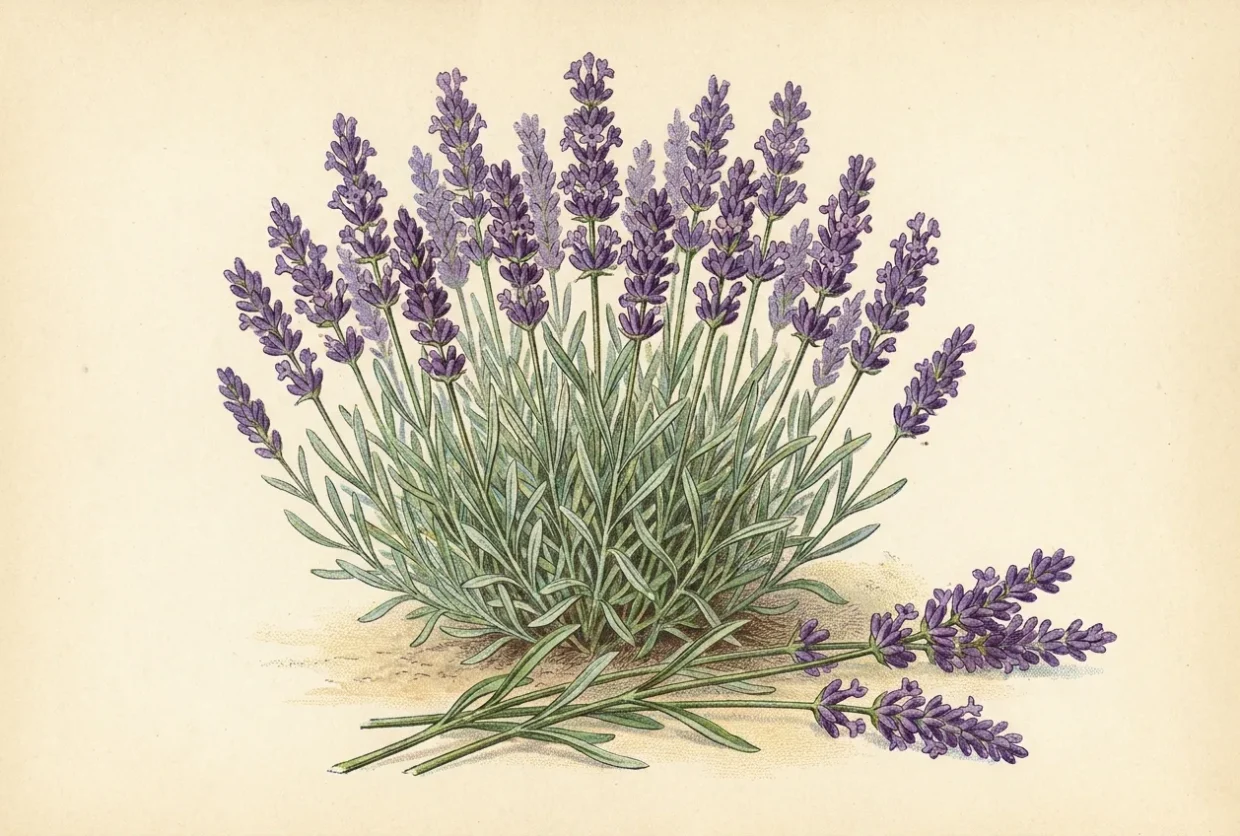
Lavender fails from wet feet, not from cold. Give it sharp drainage, full sun and one cut a year that never goes into bare wood, and it will run for years.
The record
Every plant in the database answers the same questions in the same order, so two entries can be read line for line. 16 of 17 fields sourced.
- Light
- Full sun
- Light detail
- 6 hours minimum, 8 preferred
- Water
- Low
- Water detail
- Every 2 to 3 weeks until buds form, then weekly to harvest
- Soil
- Sharply drained, low in organic matter
- Soil pH
- 6.0 to 8.0, neutral to alkaline
- Mature size
- 12 to 24 in tall, 24 to 36 in wide
- Toxicity
- The ASPCA lists lavender as toxic to dogs, cats and horses. Toxic principles: linalool, linalyl acetate. Clinical signs: nausea, vomiting (not in horses), inappetence.
- Lifecycle
- Perennial
- Difficulty
- Easy
- Hardiness zones
- 5 to 9
- Bloom time
- Summer, with a possible second flush after shearing
- Flower color
- Purple, pink or white
- Pollinators
- Bees and butterflies
- Deer resistant
- not recorded
- Spacing
- 2 to 3 ft in the row, 3 to 6 ft between rows
- Native range
- Mediterranean: France, Italy, Spain
Hardy in zones 5 to 9. Colder than zone 5, grow it in a container and overwinter it under cover.
Years a well-sited plant lives. Lavender is a woody perennial, not a short-lived one, and almost every plant that dies early was drowned rather than aged out.
The year
Plant or divide and prune, and when it is actually in flower. Everything else is leaving it alone.
Toxic to pets
The ASPCA lists lavender as toxic to dogs, cats and horses. Toxic principles: linalool, linalyl acetate. Clinical signs: nausea, vomiting (not in horses), inappetence.
Where lavender actually fails
Almost every dead lavender in a garden died of the same thing, and it was not cold. It was water sitting around the roots, usually over winter, in ground that drains too slowly for a plant that evolved on thin Mediterranean hillsides.
Illinois Extension puts the consequence plainly: soil that stays wet or drains poorly, especially over winter, produces plants with a short garden life. That is the sentence to keep in mind while you choose where to put it, because no amount of correct pruning or feeding later will rescue a plant that is standing in cold, wet ground from November to March.
The practical version is that drainage outranks everything else on this page. A lavender in poor soil with sharp drainage will do better than a lavender in rich soil that holds moisture, and it is not close.
Which lavender you are actually buying
Three groups are sold under the same word, and they are not interchangeable.
English lavender, Lavandula angustifolia, is the hardy one and the subject of this entry. North Carolina State Extension lists it across zones 5a to 9b, and it is the group to plant if your winters are genuinely cold.
Lavandin, Lavandula × intermedia, is a hybrid grown for larger plants and heavier oil yield. It flowers later and is generally less cold hardy, though the cultivar ‘Phenomenal’ is singled out by Illinois Extension as highly tolerant of heat and humidity, which is the harder problem in the south.
Spanish and French lavender, L. stoechas and L. dentata, carry the tufted, rabbit-ear flower heads people recognize from photographs. They are the least cold hardy of the three and are grown as annuals or container plants over much of the country.
If a label just says “lavender”, the botanical name on the back of the tag is the part that tells you whether it survives your winter.
Below the group sit the named varieties, and this is where the two names people search for most often appear. These are the cultivars NC State lists under each species.
| Cultivar | Group | Size | What it is known for |
|---|---|---|---|
| Hidcote, sold as Hidcote Blue | English | Compact mound to about 20 in | Deep violet-blue spikes on the most compact of the common English types. One of the two least likely to be killed to the ground in zone 5 |
| Munstead | English | Toward the small end of 1 to 2 ft | The other reliably cold-hardy English cultivar, and the usual choice for culinary use |
| Phenomenal | Lavandin | 24 to 30 in tall by 48 to 54 in wide, per the grower | Blooms early, bright violet-blue. Bred for tolerance of heat and humidity, and it suffers very little dieback in cold zones, which is a rare combination |
| Grosso | Lavandin | 2 to 3 ft tall and wide | The strongest fragrance of any commonly grown lavender, and the one behind most sachets and scented products |
| Provence | Lavandin | 1 to 3 ft tall and wide | NC State singles it out as the best for humid conditions. Grown commercially in the region it is named after |
| Hidcote Giant | Lavandin | 2 to 3 ft | Bright violet spikes at full lavandin size. Not a larger version of Hidcote despite the name, and not in the same species |
| Anouk and Silver Anouk | Spanish | 2 to 3 ft for the species | The tufted rabbit-ear flower heads, and the group that handles heat and humidity best. Least cold hardy |
Two traps are worth naming. Hidcote and Hidcote Giant are different species, so buying the second because you liked the first gives you a plant twice the size with a different scent. And Phenomenal appears in NC State’s listings under both English lavender and lavandin, which reflects a genuine disagreement about where the plant belongs; treat it as a lavandin for spacing and pruning, because that is how it behaves.
Scent, which is not the same across the three groups
The groups do not smell alike, and for a plant most people buy for its fragrance that is a larger difference than the hardiness figures above. It comes down to camphor.
- English lavender is the lowest in camphor, which gives it the soft, sweet, familiar scent and makes it the only group generally recommended for the kitchen. Munstead is the usual culinary variety, and Jean Davis is the popular pink-flowered one where a change of color is wanted in a herb garden.
- Lavandins are crosses with Lavandula latifolia, the parent that carries the camphor, and they yield far more oil. The scent is stronger, sharper and slightly medicinal beside an English lavender. Grosso is the most fragrant of any commonly grown lavender and Provence is the one grown commercially for the perfume trade, which is why both dominate dried bundles, sachets and soaps.
- Spanish and French lavenders are grown for the tufted flower heads and the long season rather than for scent quality, and they are not the group to plant if fragrance is the reason for planting at all.
Two practical consequences. Cooking with a lavandin is the usual reason lavender in food tastes soapy or medicinal rather than floral, because the camphor comes through. And the lean soil this page insists on is not only about drainage: rich ground produces soft growth and a weaker scent in every group, so feeding a lavender works directly against the thing it was bought for.
What lavender actually looks like
Lavender is a shrub. That is the sentence that resolves most of the confusion around it, because it is sold beside the perennials, priced like a perennial and often written about as a herb, and NC State in fact files it under all three headings at once: shrub, herbaceous perennial and edible. What it is not is an annual bedding plant, and treating it as one is behind a good share of the failures described further up this page.
The plant is a low mound of woody stems, 1 to 2 feet tall and 2 to 3 feet wide on English lavender, with the lower part becoming genuinely woody with age. Leaves are opposite and simple, narrow and strap-shaped, under an inch long and less than an inch wide, gray-green to bluish green with a fine white felting that gives the plant its silver cast. They are aromatic when bruised, which is the practical identification test: crush a leaf.
The flowers sit well above the foliage rather than in it, which is the part that makes lavender read from a distance. Each spike is a small dense head, less than an inch across per floret, carried at the end of a bare stalk two to six inches long, so the plant reads as a gray mound with a haze of color floating over it. So yes, lavender is a flower in the everyday sense, and the flower is the smallest part of the plant.
Color runs from the familiar lavender-purple through violet-blue, and pink and white forms exist and are sold under cultivar names. The color word came from the plant rather than the other way around.
Plants that look like lavender but are not
Several unrelated perennials get bought as lavender, or get blamed for lavender’s faults. All of them are in the same family, which is why the flowers look similar, and none of them want the same treatment.
- Russian sage, Salvia yangii, long sold as Perovskia. Finely cut, almost feathery leaves and airy branched flower stems rather than dense spikes. Taller and looser, and far more forgiving of ordinary garden soil.
- Catmint, Nepeta. Small scalloped leaves and a sprawling, mounding habit that flops outward rather than standing up. It reblooms readily after shearing, which lavender does not.
- Anise hyssop, Agastache. Broad mint-shaped leaves and dense upright bottlebrush spikes. The leaf is the giveaway: nothing about it is narrow or silver.
- Ornamental salvias. Upright violet spikes over green foliage, and the leaves are broader and not silver.
The quick test in a garden center is the foliage, not the flower. If the leaves are narrow, silver-gray and aromatic when crushed, it is lavender. If they are green and broad, it is one of the others, and it will want richer, moister soil than this page recommends.
Site and soil
Full sun, and more of it than most plants need to be described that way. NC State’s requirement is six or more hours of direct sun; Colorado State works to eight. In the northern half of the country, treat eight as the target and accept six as a minimum, because a lavender in partial shade grows soft, flops open in the middle and flowers thinly.
Soil should be neutral to alkaline, in the range of 6.0 to 8.0, and low in organic matter. This is the instruction people find hardest to follow, because the reflex with any new planting is to dig in compost. Colorado State is explicit that lavender wants alkaline soil with very little organic matter, and rich soil produces exactly what you do not want: soft growth, weaker scent and roots sitting in moisture that a lean soil would have shed.
On heavy clay, improving the existing hole is not enough. A hole of good soil inside clay behaves like a bucket, and the plant drowns in it slowly. Raise the planting instead: a berm, a raised bed, or a slope. Colorado State’s approach for clay is to till a quarter-inch bark mulch in at one inch depth across a working depth of six to eight inches, which changes the structure of the whole bed rather than one hole in it.
Planting
Spring through autumn both work, and in cold-winter regions autumn planting has a real advantage: Colorado State reports that fall-planted lavender survives better, establishes faster and flowers more the following season.
- Pick the driest, sunniest spot you have
A south-facing slope, the base of a wall, the edge of a gravel path. Anywhere water leaves quickly, and where it gets six hours of direct sun at minimum.
- Space it properly, and hold your nerve
Two to three feet apart within a row, three to six feet between rows depending on the cultivar. It looks generous in year one and stops looking generous in year two.
- Cut heavy soil across the whole bed
Not one improved hole. Colorado State tills a quarter-inch bark mulch in at one inch depth, worked six to eight inches down, so the structure of the bed changes rather than the structure of one pocket in it.
- Skip the compost
Lavender wants alkaline soil with very little organic matter. Rich soil produces soft growth, weaker scent and roots sitting in moisture a lean soil would have shed.
- Keep mulch off the crown
Rock or bark mulch is fine, held away from the base of the plant. Mulch packed against the crown traps exactly the moisture the plant is trying to avoid.
Growing lavender in pots, and keeping one indoors
A pot is the standard answer to the drainage problem described above. Where the garden is heavy clay or the site is low and wet, a container lets you give the plant the lean, gritty, fast-draining soil it wants without rebuilding a bed, and it is the reason so many gardeners who have killed lavender in the ground succeed with it in a pot.
- Use the same lean mix as the ground, not potting compost. A rich, moisture-retentive mix in a pot concentrates exactly the conditions that rot lavender roots.
- Drainage holes, and plenty of them. A container that holds water through a wet week does what a clay planting hole does, only faster.
- Give it air. A spot with good air circulation matters as much in a pot as in a bed, because still humid air around a dense gray plant is where the fungal problems start.
- Choose a compact variety. The English cultivars and the Spanish types suit pots best, being naturally small; a full-size lavandin at three feet across needs a container most people are not going to move.
Overwintering, and why lavender is a poor houseplant
Lavender is not a houseplant and it will not behave like one. It is a hardy shrub with a real dormancy, and a warm living room in January asks it to grow at the one time of year it is built to stop.
Where the plant needs bringing in, either because the variety is not hardy in your zone or because the pot would freeze solid, the room matters more than the light. Keep it cool, somewhere in the range of 45 to 60°F, in the brightest window in the house, ideally south-facing. Water sparingly and only when the soil has dried out, because a dormant plant in cool conditions uses very little and the usual houseplant watering routine will kill it.
For hardy varieties left outdoors in cold zones, the container is the vulnerable part rather than the plant, since roots in a pot have none of the insulation open ground provides. Move it somewhere sheltered and mound fallen leaves or mulch over the top. In open ground, a cover of burlap, pine boughs or straw is worth it only where winter winds are drying and snow cover is unreliable, and it comes off in late winter.
What to plant with it
The rule for lavender companions is not about which plants look good together, it is about which plants will accept the same ground. Anything sharing a bed with lavender has to live in full sun, in lean alkaline soil with very little organic matter, and go without summer water. That rules out most bedding plants and nearly everything grown for lush foliage.
What works is the rest of the Mediterranean shelf: rosemary, thyme, sage, santolina, catmint, yarrow and ornamental alliums, along with the silver-leaved plants that evolved in the same conditions. Gravel gardens, dry slopes and the strip along a sunny path are where these combinations do best, because those are the places nothing gets watered.
Roses and lavender are the classic pairing in photographs and the most common disappointment in practice. Roses want rich, moisture-retentive soil and regular feeding; lavender wants the opposite of both. The combination can be made to work with the two at some distance and the ground graded away from the lavender, but planted together in one improved bed, one of them is always in the wrong soil.
Watering
New plants are not drought tolerant, and established plants very much are. Illinois Extension notes that new plantings benefit from regular watering through the first year, which is the season that decides whether the plant ever gets deep enough roots to be independent.
Once established, Colorado State’s schedule is every two to three weeks until buds form, then once or twice weekly until harvest. That is far less than most gardeners give it. One qualifier is worth carrying into winter: the root zone should not be allowed to dry out completely over winter either, which in a dry-winter climate means an occasional soak on a mild day rather than nothing at all from October to April.
Pruning, which is the job that decides the plant’s life
Lavender flowers on new growth, and it will not regenerate from bare wood. Those two facts together are the whole of lavender pruning.
Prune in spring, when green leaves start to emerge from the base of the plant, and take about a third off the top. That timing is Colorado State’s, and it works because you can see where the living growth is before you cut.
You can also cut back after flowering, taking a third to a half, which keeps the plant compact and may bring a second flush of bloom. Whichever timing you use, the hard rule does not change: never cut down into the leafless wood, because it will not regrow. A lavender cut into bare stems does not recover; it just has a bald side for the rest of its life.
Skipping the job entirely is the other common failure. An unpruned lavender opens at the center, sprawls, and turns woody at the base within a few years, and by the time it looks like that, the cut that would have fixed it is a cut into wood you cannot make.
Harvesting
Cut stems as the flowers begin to open, when Illinois Extension notes the spikes carry the strongest scent. For oil concentration, Colorado State recommends harvesting in the morning, when roughly half the buds on the spike have opened.
Dry it in small bunches, hung in a cool, dry, dark, well-ventilated place. In the kitchen, lavender goes with pork, fish and chicken as well as in drinks, and it is used sparingly. It is a strong flavor and easy to overdo.
What goes wrong
NC State lists leaf spot and root rot as the problems to know, and notes that root rot is caused by overwatering. Both point back to the same conditions: too much water, not enough air movement. If an established plant is yellowing and collapsing at the base, look at drainage before you look for an organism.
Beyond that, the list is short and splits cleanly into things that matter and things that do not.
- Phytophthora crown and root rot is the one that kills, and it is the disease end of the drainage problem this page keeps returning to. A plant yellowing and collapsing at the base has it, or has the conditions for it. There is no treatment: remove the plant and the soil around the crown rather than composting it, and do not replant lavender in the same spot without fixing the drainage first.
- Alfalfa mosaic virus is the other fatal one and is far less common. It shows as yellow, curled, distorted leaves, it is carried by aphids, and infected plants have to be removed and destroyed. This is the reason to take aphids more seriously on lavender than their direct damage warrants.
- Aphids and whiteflies do little harm in themselves. A strong jet of water from a hose removes aphids, and whiteflies, though genuinely difficult to eliminate, rarely cause meaningful damage on an outdoor plant.
- Spittlebugs produce the blobs of white foam on the stems in early summer that look like a serious infestation and are not. Hose them off if they bother you and otherwise ignore them.
The most common way a lavender is actually lost is none of the above. It is age combined with the pruning mistake described in the section above: an unpruned plant becomes woody at the base, stops producing foliage low down, splits open in the middle under snow or its own weight, and cannot be brought back, because lavender does not reliably regrow from bare old wood. That is a maintenance failure spread over several years rather than an event, and it is why the pruning section on this page is the longest one.
Propagation is straightforward if you want more: take cuttings right after flowering and expect roots in about three weeks. It is also the sensible insurance policy, since a few cuttings taken from a healthy plant at its peak cost nothing and replace it when it goes woody.
Toxicity, in plain terms
The ASPCA lists lavender as toxic to dogs, cats and horses, with linalool and linalyl acetate as the toxic principles, and lists the clinical signs as nausea, vomiting (not in horses) and loss of appetite. NC State describes it as a low-severity poison, with flowers, leaves and stems all listed.
In practice this is a plant that most animals leave alone because of the scent, and the risk sits with concentrated essential oil rather than with a garden plant. That distinction matters more than the label does: an animal that has eaten lavender oil is a different situation from one that brushed past a bush. If an animal has eaten any part of it and you are worried, ring a vet rather than reading further.
Frequently asked questions
- Does lavender come back every year?
- Yes, across zones 5 to 9. English lavender is a woody perennial rather than a short-lived one, and a well-sited plant with an annual cut runs for years. In colder zones it is grown in a container and moved under cover for winter.
- Why is my lavender not blooming?
- Too little sun, too much nitrogen, or no pruning. It needs six hours of direct sun at an absolute minimum, and it flowers on new growth, so a plant that is never cut has less and less new growth to flower on.
- Can I cut it back hard to rejuvenate it?
- No, and this is the one irreversible mistake with this plant. It will not regrow from leafless wood. Take about a third off the top, staying in green growth, and do it every year rather than once every few years.
- Is lavender safe around dogs and cats?
- The ASPCA lists it as toxic to dogs, cats and horses, with linalool and linalyl acetate as the toxic principles and nausea, vomiting and loss of appetite as the signs. In practice the risk sits with concentrated essential oil rather than with a garden plant most animals walk past.
- Is lavender a flower or a shrub?
- Both, and the shrub part is what people miss. It is a woody subshrub that NC State files as shrub, herbaceous perennial and edible at once. The flowers are small, carried on bare stalks two to six inches above a gray-green mound of woody stems, which is why the plant reads as a haze of color rather than as a block of it.
- Is lavender a perennial?
- Yes, and more than that: a hardy woody shrub that lives for years in the right site. English lavender is rated for zones 5a to 9b. The Spanish and French types are the ones often grown as annuals, because they are the least cold hardy of the three groups.
- What is the difference between Phenomenal and Grosso lavender?
- Both are lavandins. Grosso carries the strongest fragrance of any commonly grown lavender and is the one behind most scented products. Phenomenal was bred for tolerance of heat and humidity while still suffering very little winter dieback, so it is the practical choice in difficult climates rather than the one to grow for scent.
- Can I grow lavender indoors?
- Not really as a houseplant. It is a hardy shrub with a genuine winter dormancy, and a warm room asks it to grow when it should be resting. If a pot has to come in, keep it cool at 45 to 60°F in the brightest south-facing window you have, and water sparingly.
- What plants look like lavender?
- Russian sage, catmint, anise hyssop and the ornamental salvias, all in the same family. The test is the foliage rather than the flower: lavender leaves are narrow, silver-gray and aromatic when crushed. Broad green leaves mean one of the others, and it will want richer, moister soil.
- Which lavender is hardiest?
- English lavender, Lavandula angustifolia, listed by NC State across zones 5a to 9b. Spanish and French types are showier and considerably less cold tolerant, and are grown as annuals over much of the country.
Companion plants
How this entry is compiled
- Care values come from university extension publications and the USDA hardiness map, never from other gardening sites.
- Toxicity follows the ASPCA listing and is quoted rather than summarized.
- A value we cannot source is printed as not recorded, never estimated.
Compiled and checked by the Gardnicks editorial desk · last checked 2026-08-16
Sources for this entry
- NC State Extension Gardener Plant Toolbox, Lavandula angustifolia
- Colorado State University Extension, Growing Lavender in Colorado
- University of Illinois Extension, Lavender (Herbs)
- ASPCA Animal Poison Control, Lavender
Where two sources disagree, the entry follows the one closest to the plant’s own growing region and says so in the text.
What kills it
Three failures cover almost everything readers write in about.
More in Flowers
 Vinca
Part shade · zones 4 to 9
Vinca
Part shade · zones 4 to 9
 Mums
Full sun · zones 5 to 9
Mums
Full sun · zones 5 to 9
 Hydrangea
Part shade · zones 6 to 11
Alstroemeria
Full sun · zones 7 to 10
Hydrangea
Part shade · zones 6 to 11
Alstroemeria
Full sun · zones 7 to 10
Plates are illustrations, not photographs of a specific plant, and are not evidence of a variety, place or season.