Azalea
Rhododendron spp.
Rhododendron
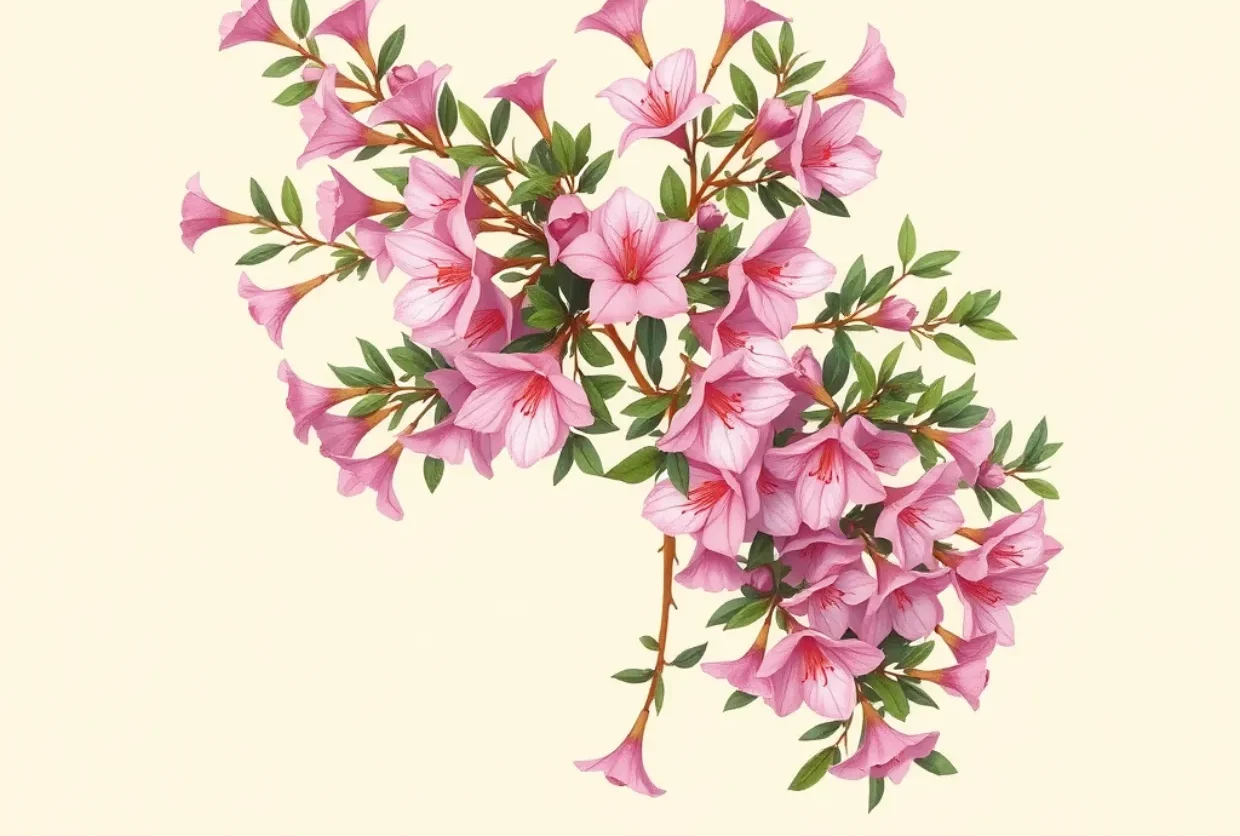
Shallow roots decide everything. The root ball goes several inches above grade, the soil has to be acid, and full sun is what invites the lace bugs.
The record
Every plant in the database answers the same questions in the same order, so two entries can be read line for line. 15 of 16 fields sourced.
- Light
- Part shade
- Light detail
- Dappled sun through a canopy; morning sun with afternoon shade
- Water
- Moderate
- Water detail
- Shallow roots dry out fast and drown easily; mulch holds the middle ground
- Soil
- High organic matter, loam or sand, sharply drained
- Soil pH
- 4.5 to 6.0, acid
- Mature size
- 6 to 10 ft tall, 5 to 8 ft wide
- Toxicity
- NC State rates azalea low severity: the plants contain grayanotoxins in all parts, but ingestion of moderate amounts of nectar or leaves poses little toxic hazard.
- Lifecycle
- Shrub
- Difficulty
- Moderate
- Hardiness zones
- 4 to 8
- Growth rate
- Slow
- Root spread
- Shallow, and easily damaged by wet soil
- Pruning window
- Within 6 weeks of flowering finishing
- Bloom time
- April; rhododendrons later in spring
- Deer resistant
- not recorded
Hardy in zones 4 to 8. Colder than zone 4, grow it in a container and overwinter it under cover.
Where the top of the root ball sits. Several inches proud of the surrounding soil, not level with it. A shallow-rooted shrub set at grade sits in the wettest layer and rots.
The year
Plant or divide and prune, and when it is actually in flower. Everything else is leaving it alone.
Toxic to pets
NC State rates azalea low severity: the plants contain grayanotoxins in all parts, but ingestion of moderate amounts of nectar or leaves poses little toxic hazard.
Plant it too deep and nothing else you do will help
Azaleas are shallow-rooted, and that single fact drives most of the advice on this page.
Clemson’s planting instruction is deliberately counterintuitive: dig a shallow hole so that the top of the root ball is not at ground level but elevated several inches above it. A root ball set at or below grade sits in the wettest layer of soil, and a shallow-rooted plant in wet soil rots.
NC State names the consequence directly, noting that many cultivars are susceptible to phytophthora root rot and that the roots may rot if the soil does not drain well. Phytophthora is a water mold; it does not arrive because of bad luck, it arrives because the ground stays wet.
So the azalea that dies slowly over two seasons in heavy clay was almost always planted too deep, or planted in a spot that needed raising before anything went into it.
Soil, and the pH that is not optional
NC State gives acid soil below pH 6.0, and Clemson narrows it to 4.5 to 6.0, in well-drained organic ground.
This is one of the few plants where soil pH is a genuine make-or-break rather than a preference. Above about 6.0 the plant cannot take up iron, the new leaves come through yellow with green veins, and feeding it more nitrogen makes the display worse rather than better.
Test before planting rather than after. Lowering pH in established ground is slow work, and it is much easier to choose a different plant for alkaline soil than to fight it every year.
Light, and why it decides the pest problem
NC State lists dappled sunlight through an upper canopy, partial shade at two to six hours, or deep shade.
Clemson connects that to lace bugs in a way worth quoting in substance: azaleas in full sun become stressed and secrete compounds lace bugs can detect, which lets the insects target the weaker plants. Azaleas grow best in morning sun with afternoon shade.
Shade has a floor as well as a ceiling. Clemson is equally direct that azaleas should not be planted in heavy shade, where the result is poor flowering and weak growth. The window is real but it is a window: morning sun with afternoon shade, or dappled light through a canopy, and not the extremes on either side. Flowers also last measurably longer on a partially shaded plant than on one in full sun, which is a separate argument for the same position.
One frost detail belongs here rather than under weather. Early morning sun striking a plant that has just been through a hard freeze can cause cold injury, because the tissue thaws too fast. That is an argument against an east-facing position with nothing in front of it in the coldest gardens, and it is the one case where morning sun is not automatically the safe choice.
That is unusually direct evidence that a pest problem is a siting problem. If the leaves of an azalea look stippled and grayish on top with dark specks underneath, the treatment conversation is worth having second, after the position conversation.
Types of azalea, and how big each one gets
Azalea is not one shrub. What is sold under the name runs from a two-foot mound suitable for a pot to an eight-foot screen, and the mature size is the single most useful thing to establish before buying, because an azalea planted where it will outgrow the space is a shrub you will be cutting back every year of its life for no gain.
| Type | Foliage | Mature size | Flowering, and what it suits |
|---|---|---|---|
| Evergreen azaleas, the Kurume group | Evergreen, small leaves | Compact, roughly 3 to 4 ft tall and wide | Spring, and so heavily that the foliage disappears behind the flowers. The standard foundation and border azalea |
| Evergreen azaleas, the Southern Indica group | Evergreen, larger leaves | 6 to 8 ft tall and wide, the largest group | Early spring, with the largest flowers. Formosa and George L. Taber are the ones people mean. Heat-tolerant and suited to zones 8 to 9, for hedges and screens rather than beds |
| Deciduous azaleas, including the North American natives and the Exbury and Knap Hill hybrids | Drops its leaves, with real fall color | 4 to 6 ft in most cultivars | Spring, in the widest color range of any group, including the yellows and oranges the evergreens cannot do. Many are strongly fragrant. Gibraltar and Klondyke are the well-known ones |
| Dwarf azaleas | Usually evergreen | 2 to 3 ft tall and wide | Spring, and some rebloom. The group for containers, low foundation planting and small gardens. Chinzan and Conversation Piece are typical |
| Encore series | Evergreen | 4 to 5 ft tall by about 4 ft wide, with dwarf members smaller | A heavy flush in mid-spring, a rest, then reblooming from midsummer until frost |
| Bloom-A-Thon series | Evergreen | Compact | First flush early to mid-spring, then repeating from early summer to frost, up to five months of flower |
How to recognize a reblooming azalea on the shelf
The reblooming groups are worth knowing by name, because a spring-only azalea and a reblooming one look identical in a nursery pot in April and behave completely differently for the rest of the year.
The decoder for the largest series is simple: every Encore cultivar is named Autumn something. Autumn Bonfire, Autumn Carnation, Autumn Ruby, Autumn Twist, Autumn Embers, Autumn Ivory. If the label starts with the word Autumn, it is an Encore and it will flower again from midsummer into fall. Bloom-A-Thon is the other main reblooming series and says so in the name.
The trade-off is real rather than nominal. Reblooming azaleas spread the same total quantity of flower across two or three periods instead of concentrating it, so the spring display is less overwhelming than a Kurume in full flush. Which of those you want is a genuine preference, not a question of one being better.
Colors
The evergreen groups cover white, every shade of pink from blush to hot, red, magenta, lavender and purple, with bicolors, streaks and freckled throats common. What they do not do is yellow or orange. For those, and for scent, the deciduous azaleas are the only route, which is the practical reason to know the two groups apart rather than a botanical one.
Red is the color most often searched for and the hardest to get true. Most so-called red azaleas sit somewhere between crimson and magenta, and the ones that read as genuinely red in a bed, such as Midnite Flare or Hino Crimson, are worth seeking out by name rather than buying by photograph.
When to plant, and where they grow best
Early spring and fall are both good, and fall is the better of the two nearly everywhere the ground does not freeze hard. An azalea planted in autumn spends the cool months putting out roots with no leaves to support, and meets its first summer already established.
The consequence of spring planting is watering. Azaleas are shallow-rooted, and a spring or warm-weather planting needs irrigation through dry spells for the whole first year. In sandy soil, Clemson puts that at watering the root mass twice a week through the first season, which is more attention than most people expect to give a shrub.
As to where they grow best, the honest answer combines the two sections above: acid soil below pH 6.0, morning sun with afternoon shade or dappled light through a canopy, and shelter from drying wind. That describes the edge of a woodland, and it is why azaleas perform so well against the north or east side of a house and so badly in the middle of an open lawn.
Coffee grounds, and why they will not help
Because azaleas need acid soil, they attract more folk remedies than almost any other shrub, and coffee grounds are the most persistent. They do not work, and it is worth knowing why rather than just being told.
Brewed coffee is acidic, at around pH 5, but the acids are water-soluble and end up in the cup. What is left in the filter is close to neutral, around pH 6.5 to 6.8. Oregon State Extension is clear that used grounds do not meaningfully acidify soil, and that whatever small change they do produce is short-lived. They are a perfectly good compost ingredient and a poor soil acidifier.
If the pH genuinely needs lowering, elemental sulfur is the material that does it, applied on the basis of a soil test rather than by guess. And as the soil section above says, the cheaper answer is usually to test first and plant something else where the ground is alkaline.
Planting and care
- Raise the root ball above grade
The top of it several inches proud of the surrounding soil, then soil drawn up around the sides. This is the whole defense against root rot.
- Test the pH first
4.5 to 6.0. Adjust before planting, according to the test rather than by guesswork.
- Mulch 2 to 3 inches deep
Pine straw, composted pine bark or leaves. Keep it a couple of inches clear of the stem and extend it past the outermost branches, because that is where the roots are.
- Water in dry spells, never into standing wet
Shallow roots dry out fast and drown easily. Both extremes do damage; the mulch is what keeps the middle ground.
- Prune within six weeks of flowering
Next year’s buds form soon after bloom. Clemson’s window is up to six weeks after flowering finishes; cut later and you are removing next spring’s display.
Where azaleas go in a garden
NC State classifies azaleas as understory shrubs, and that single word settles most design questions about them. They belong under and beside taller things rather than out in the open: grouped in woodland or naturalized areas, along a shaded boundary, in a shrub border, as a screen, or as a specimen where the flowers are close enough to be seen properly. They are slow-growing, so a group planted at final spacing looks thin for several years and then does not need touching again.
Companion planting is unusually straightforward here, because the pH requirement does the selecting for you. Anything that shares the azalea’s conditions, acid soil, organic matter, dappled light and steady moisture, will grow well beside it, and anything that does not will fail whatever else you do.
- Other acid-soil shrubs: rhododendrons, camellias, pieris, mountain laurel, blueberries and hydrangeas. These are the plants sold beside azaleas in the same section of a nursery, which is not a coincidence.
- Woodland perennials underneath: ferns and hostas take exactly the same light and moisture, and their foliage covers the ground the azalea’s shallow roots occupy without competing at the same depth.
- A light canopy above: Japanese maple, dogwood or an existing high tree canopy gives the dappled shade the light section on this page describes, and the azalea gives that planting its spring.
- What not to plant nearby: anything wanting neutral to alkaline soil, or anything that needs the ground cultivated around it. Azalea roots sit in the top few inches and a fork or a hoe going through them does damage that shows up as dieback a season later.
Azaleas in containers
The dwarf cultivars grow well in pots, and a container is often the sensible answer where the garden soil is alkaline, because it lets you give the plant the acid mix it needs without trying to change a whole bed. NC State lists azalea as a container plant, and the compact evergreen types hold their shape without pruning.
The requirements are the ones the rest of this page already gives, made stricter by the pot. Use an ericaceous or acid mix rather than general potting compost. Insist on drainage holes, because the plant that dies fastest from wet roots is this one. And keep the watering steady, since a shallow-rooted evergreen in a container dries out faster than anything else on a terrace and shows it as browning leaf edges within days.
Azalea or rhododendron
They are the same genus, Rhododendron, and the split is horticultural rather than botanical.
NC State’s practical distinction is the flower: azaleas have tubular or funnel-shaped blooms, rhododendrons bell-shaped ones. Azaleas flower in April, rhododendrons later in spring. Azaleas are more often deciduous with smaller, thinner leaves; rhododendrons are typically evergreen with large leathery ones.
Both want the same things, so the care above applies to either.
What goes wrong
NC State’s pest list is long: aphids, borers, lace bugs, leafhoppers, mealybugs, mites, scale, thrips and whitefly. Diseases include canker, crown rot, root rot, leaf spot, rust and powdery mildew.
In practice three things account for most losses, and all three trace back to site. Root rot from wet ground or deep planting. Lace bug from too much sun. Iron chlorosis, the yellow leaves with green veins, from soil that is not acid enough.
Those three are worth knowing by symptom, because the responses are different and two of them are irreversible if left.
- Lace bug produces a pale, stippled, grayish cast on the upper leaf surface with small dark specks of excrement underneath, and the damage does not grow out. Clemson states plainly that azaleas exposed to full sun are more susceptible, which makes this a siting problem first: the treatment conversation is second, after the position conversation. Hand-picking works on light infestations and insecticidal soap on heavier ones, but a plant in the wrong light will be reinfested every year.
- Phytophthora root and crown rot shows as leaf loss, loss of vigor, branch dieback and wilting on a plant with wet feet, and it is what kills azaleas planted deep or in ground that does not drain. There is no cure. On a site with a history of it, the answer is a resistant species rather than better care.
- Iron chlorosis, yellow leaves with green veins, is a pH problem rather than a nutrient shortage: the iron is in the soil and the plant cannot take it up above about pH 6.0. Feeding more nitrogen makes the display worse.
Two fungal problems are cosmetic but alarming, and both are encouraged by wet foliage. Petal blight begins as small waterlogged spots on the petals that merge quickly, turning the whole flower slimy and collapsing the display within days of it opening. Leaf gall produces thickened, pale, fleshy distortions of new leaves in spring that look like a serious disease and are not; picking them off and disposing of them is the whole treatment. Both are reasons to avoid overhead irrigation on a plant that is already prone to foliar disease.
Deer deserve their own mention, because NC State records this genus as frequently damaged by them, and unlike the problems above there is no cultural fix.
A plant in the right position with the right pH and a proper mulch is remarkably trouble-free for something with this long a list against its name. Clemson makes the same point from the other direction: careful plant location, good aeration and drainage, mulch and sensible watering habits reduce the incidence of both disease and insect damage, and that is a list of siting decisions rather than treatments.
Toxicity, in plain terms
NC State rates azalea low severity and words it carefully: the plants are known to contain toxins, but ingestion of moderate amounts of azalea nectar or leaves poses little toxic hazard. All parts contain grayanotoxins.
Grayanotoxins are the reason for the old warnings about honey made from rhododendron nectar, which is a real phenomenon in areas of dense wild rhododendron. In a garden, the practical reading is the one NC State gives: a nibble is not an emergency, and a large quantity eaten by a small animal is worth a vet call.
Frequently asked questions
- Why is my azalea dying slowly for no reason?
- Most often root rot from planting too deep or from ground that stays wet. Azaleas are shallow-rooted; Clemson’s instruction is to set the top of the root ball several inches above ground level, not at it.
- The leaves are yellow with green veins. What is that?
- Iron chlorosis, caused by soil that is not acidic enough. Azaleas want pH 4.5 to 6.0 and cannot take up iron above roughly 6.0. Test the soil rather than adding more fertilizer, which makes it worse.
- How big do azaleas get?
- From 2 to 3 feet for the dwarf cultivars up to 6 to 8 feet for the Southern Indica group. Most evergreen azaleas sold for foundations and borders sit at 3 to 4 feet, deciduous ones at 4 to 6, and the Encore series at 4 to 5. The mature size is set by the cultivar, not by pruning.
- What is an Encore azalea?
- A reblooming evergreen series that flowers heavily in mid-spring, rests, then flowers again from midsummer until frost. Every cultivar in it is named Autumn something, so Autumn Bonfire, Autumn Carnation and Autumn Ruby are all Encores. Bloom-A-Thon is the other main reblooming series.
- When should I plant azaleas?
- Fall is best where the ground does not freeze hard, because the plant roots through the cool months and meets summer established. Early spring works too, but a spring-planted azalea needs watering through dry spells for its whole first year, and in sandy soil that means the root mass twice a week.
- Are coffee grounds good for azaleas?
- No. Brewing takes the acid out of the grounds and into the cup, leaving used grounds close to neutral at about pH 6.5 to 6.8. Oregon State Extension finds they do not meaningfully acidify soil and that any change is short-lived. Use elemental sulfur if a soil test says the pH needs lowering, and put the grounds in the compost.
- When do I prune?
- Within about six weeks of flowering finishing. Buds for next spring form soon after bloom, so a later cut removes the display you were pruning for.
- What are the pale stippled leaves with black specks underneath?
- Azalea lace bug. Clemson notes that plants in full sun are stressed and secrete compounds the insects detect, so full sun is part of the cause. Morning sun with afternoon shade is the long-term fix.
- What is the difference between an azalea and a rhododendron?
- The same genus, split by habit. Azaleas have tubular, funnel-shaped flowers and bloom in April, often deciduous with smaller leaves. Rhododendrons have bell-shaped flowers later in spring and are usually evergreen with large leathery leaves. Both want acid soil, shade and sharp drainage.
Companion plants
How this entry is compiled
- Care values come from university extension publications and the USDA hardiness map, never from other gardening sites.
- Toxicity follows the ASPCA listing and is quoted rather than summarized.
- A value we cannot source is printed as not recorded, never estimated.
Compiled and checked by the Gardnicks editorial desk · last checked 2026-08-16
Sources for this entry
- NC State Extension Gardener Plant Toolbox, Rhododendron
- Clemson HGIC, Azalea Planting
- Clemson HGIC, Azalea Care
- Clemson HGIC, Azalea Lace Bugs
- Iowa State Extension, Phytophthora Root Rot on Rhododendron and Azalea
Where two sources disagree, the entry follows the one closest to the plant’s own growing region and says so in the text.
What kills it
Three failures cover almost everything readers write in about.
More in Trees & Shrubs
 Redbud
Full sun · zones 4 to 9
Redbud
Full sun · zones 4 to 9
 Peach tree
Full sun · zones 5 to 9
Evergreen
Full sun · zones not recorded
Peach tree
Full sun · zones 5 to 9
Evergreen
Full sun · zones not recorded
Plates are illustrations, not photographs of a specific plant, and are not evidence of a variety, place or season.