Apple tree
Malus domestica
Orchard apple
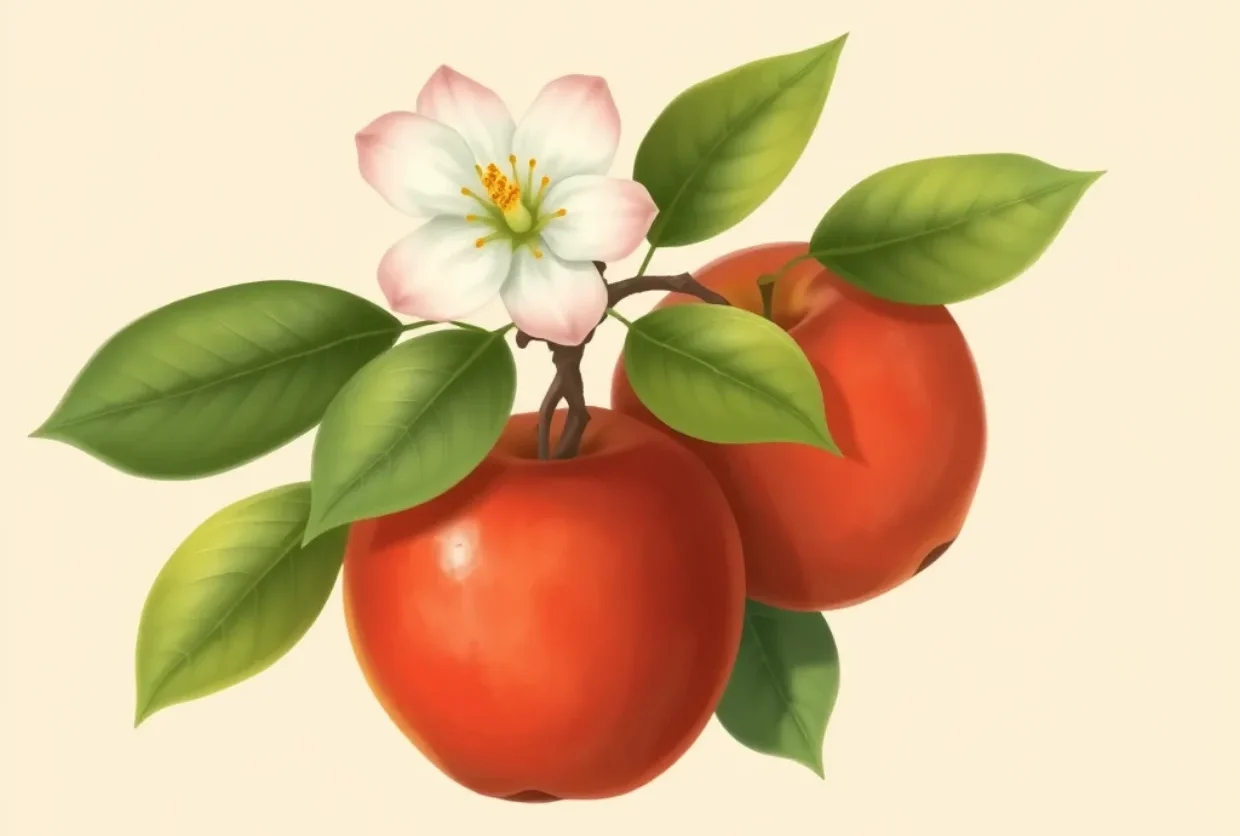
The variety decides the taste. The rootstock decides the size and the pollination partner decides whether you get fruit at all, and both are in smaller type.
The record
Every plant in the database answers the same questions in the same order, so two entries can be read line for line. 13 of 16 fields sourced.
- Light
- Full sun
- Light detail
- 6 hours or more; fruit quality follows sun directly
- Water
- Moderate
- Water detail
- Well drained; tolerates moist or occasionally dry
- Soil
- Clay, loam or sand, well drained
- Soil pH
- 6.0 to 8.0 or alkaline
- Mature size
- 15 to 30 ft tall and wide on standard roots; far smaller on dwarfing stock
- Toxicity
- not recorded
- Lifecycle
- Tree
- Difficulty
- Challenging
- Hardiness zones
- 4 to 9
- Growth rate
- Moderate
- Root spread
- not recorded
- Pruning window
- Late winter, every year
- Bloom time
- Spring, white with a pink tinge
- Deer resistant
- not recorded
Hardy in zones 4 to 9. Colder than zone 4, grow it in a container and overwinter it under cover.
Cultivars needed for fruit. Most apples need another variety flowering at the same time as a pollen donor. A crabapple works well, because it blooms over a long enough period to overlap with almost anything.
The year
Plant or divide and prune, and when it is actually in flower. Everything else is leaving it alone.
You are buying two decisions, and neither is the variety
The name on the label, Honeycrisp or Gala or Braeburn, decides what the fruit tastes like. Two other things decide whether you get any fruit at all and how big the tree becomes, and both are usually printed in smaller type.
The rootstock controls the size. NC State notes apples grow up to 30 feet tall and wide from seed, and that grafted dwarfing rootstocks keep them much smaller. A tree on B.9 or M.9 stays genuinely small and starts fruiting in the second season after planting; one on a semi-dwarf rootstock such as EMLA.7, M.7A or G.30 is still a large tree at up to 20 feet.
The pollination partner decides whether it fruits. Most cultivars need another co-blossoming variety planted nearby as a pollen donor. A single apple tree in a garden with no other apple or crabapple within range flowers beautifully every spring and sets almost nothing.
Get those two right and the variety is the enjoyable part of the decision. Get them wrong and no amount of care compensates.
Pollination, in practical terms
Two different cultivars are needed in most cases, and they have to flower at the same time, which is what co-blossoming means. Early, mid and late-season bloomers do not reliably pollinate each other.
A crabapple will do the job, and often better than a second apple, because crabapples flower over a long period and overlap with most cultivars. If space is tight, that is usually the answer.
A neighbor’s tree within a few hundred feet also counts, since bees range that far. Before assuming you need two trees, it is worth looking over the fence.
Types of apple trees, and choosing between the varieties
The rootstock section above covers the size and the pollination section covers the fruit set. This is the enjoyable part of the decision, and the useful axis is not flavor but when the fruit ripens, because that is what decides whether you get a few weeks of apples or a supply running from late summer to the first frost.
| Variety | Ripens | The fruit | Worth knowing |
|---|---|---|---|
| Gala | Early August | Excellent quality, good fresh and in salads | The earliest of the common varieties, so it extends the season at the front |
| Honeycrisp | Late season | Crisp and sweet, the reason it took over supermarket shelves | A 1991 introduction and now the most-planted garden variety in much of the country |
| Granny Smith | Late September into early October | Yellow-green, excellent quality, genuinely all-purpose | Susceptible to fire blight, which is the one thing to weigh against it. Spur and non-spur strains both exist |
| Fuji | Early October | Superb quality, good for cooking, eating and baking | Does not color well, so a dull-looking Fuji is normal rather than unripe |
| Mutsu, also sold as Crispin | Early October | Yellow, exceptional quality, crisp, juicy and slightly tart | Has sterile pollen. See the warning below |
| Rome Beauty | Early October | Red, and grown mainly for baking rather than eating fresh | Holds its shape when cooked, which is what a baking apple is for |
| Jonagold | Early September | Very large yellow apple with a red blush, sweet and juicy | Also has sterile pollen |
The pollen trap in that table
Three varieties, Mutsu, Jonagold and Stayman, produce sterile pollen. They need a pollinator themselves but cannot act as one for anything else. Planting a Jonagold and a Mutsu together gives two trees and no fruit on either.
If you want one of those three, plan for three trees rather than two: the sterile-pollen variety plus two other varieties that can pollinate each other and it. Or plant one of them alongside a crabapple, which sidesteps the problem entirely. This is the most expensive mistake available on this page, because it is only discovered two or three years after planting.
Spur and non-spur strains
Several varieties are sold in two forms, and the label will say which. A spur strain sets its fruit on short spurs held close to the branches, producing a naturally more compact tree that needs less pruning and crops earlier. A non-spur strain is the standard, more open form. Where the label offers both and space is limited, the spur strain is the better buy.
Trained forms, for gardens with no room for a tree
The rootstock section above sets the size. Training decides the shape, and between them they make an apple possible in spaces where a tree obviously is not.
- Espalier is the tree grown flat against a wall or a fence, with the branches trained horizontally along wires. It takes a strip about a foot deep, it crops well because every branch gets light, and a south or west-facing wall adds warmth that helps the fruit ripen. It needs a dwarfing rootstock and it needs pruning twice a year rather than once, in summer as well as winter, because summer pruning is what keeps it flat and productive.
- Cordon is a single stem planted at an angle and grown against wires, and it is the most space-efficient of all: several different cultivars can be grown in the length of a normal fence, which also solves the pollination problem in one stroke.
- Columnar apples, sold as colonnade or ballerina trees, are a different thing again. These are genetically compact cultivars that grow as a single upright stem with fruiting spurs held tight against it, reaching around eight feet with almost no spread. They need no training at all, they fit a large pot or a narrow bed, and they are the option that needs least skill.
All three still need a pollination partner, and all three still need the eight hours of sun. What they remove is the space problem, not the biology.
Site and soil
Full sun at six hours or more, or partial shade at two to six. Fruit quality follows sun directly.
Soil can be clay, loam or sand at neutral to alkaline pH, wanting good drainage and tolerating moist or occasionally dry conditions. Hardy in zones 4a to 9b, growing at a medium rate to 15 to 30 feet on standard roots, spaced 24 to 60 feet apart for full-size trees and much closer on dwarfing stock.
Chill hours are the constraint people in warm regions miss. Cultivars have different chilling hour requirements, so a variety bred for Michigan will not fruit properly in the lower South, and low-chill varieties exist specifically for that.
Two numbers make that concrete. Apples want at least eight hours of direct sun through the growing season, which is more than the six hours usually written as full sun, and it is the difference between fruit that colors and ripens properly and fruit that stays green and bland. And the soil pH wants to be between 5.8 and 6.5, which in much of the country means liming before planting rather than after. Test first, amend once, and recheck the pH every three years, because it drifts back.
Drainage cuts both ways on this tree and both are worth naming. Apples will not thrive in poorly drained ground: the roots die, growth stalls and the tree eventually follows. But they also perform badly on droughty soil, where shoot growth is stunted and both the size and the quality of the fruit drop. Steady moisture in ground that sheds surplus water is the target, and neither extreme is survivable long term.
The site detail nobody thinks about until it costs a crop is air. Cold air flows downhill and settles, so a low-lying spot or the bottom of a slope is a frost pocket, and an apple in full flower during a late frost loses that year entirely. A gentle slope, or anywhere the cold air can drain away past the tree, is worth more than a marginally sunnier position at the bottom of the garden.
The work, and there is real work
NC State rates apple maintenance as high, which is honest and worth reading before planting one.
- Head the young tree at planting
Cut to about 28 to 32 inches for a standard tree, or 30 to 35 for spur-type and semi-dwarf. This sets where the first branches form.
- Train branches outward instead of cutting them
Bending and tying shoots rather than removing them induces earlier fruiting. Wide-angled branches are also stronger than narrow ones.
- Prune in late winter, every year
An open center or a central leader, kept light enough that sun reaches the fruit. An unpruned apple becomes a dense, unproductive, disease-prone thicket within a few years.
- Thin the fruit in early summer
Thinning prevents limb breakage and improves fruit size and quality. It feels wasteful and it is what separates good apples from a mass of small ones.
- Expect to manage pests
This is not a plant-and-forget tree in most of the country. Decide in advance what level of blemish you will accept.
What goes wrong
NC State lists apple maggots, codling moths, aphids, white apple leafhopper and tufted apple bud moth among insects, and mildew, apple scab, fire blight, black spot, cedar apple rust and powdery mildew among diseases.
Codling moth is the grub in the apple. It is the reason unmanaged home apples are so often tunneled.
Apple scab is the most common disease in humid climates, showing as olive-brown blotches on leaves and corky scabs on fruit. Scab-resistant cultivars exist and are the single most effective thing an amateur can do about it.
Cedar apple rust needs both an apple and a juniper to complete its life cycle, which is why it appears in some gardens and never in others. Resistant varieties are again the practical answer.
Fire blight is the serious one: shoots that suddenly blacken and curl as though scorched. It is bacterial, spreads in warm wet weather, and infected wood has to be cut well below the damage with tools disinfected between cuts.
Choosing disease-resistant cultivars at the point of purchase removes more future work than any spray program.
Toxicity, in plain terms
NC State’s entry carries no toxicity listing for the fruit, and this page records toxicity as not recorded rather than a confident no, because an absent listing is not a positive statement of safety.
The one point worth stating: apple seeds contain amygdalin, which releases cyanide when the seeds are crushed and eaten in quantity. Swallowing a few pips whole is not a concern; this matters mainly for animals given large amounts of pomace or cores.
Frequently asked questions
- Do I need two apple trees?
- Usually yes. Most cultivars need another co-blossoming variety nearby as a pollen donor, and the two have to flower at the same time. A crabapple works well because it flowers over a long period, and a neighbor’s tree within a few hundred feet counts.
- What are the best types of apple trees to plant?
- Choose by ripening date rather than by flavor, so the season spreads. Gala ripens early August, Jonagold early September, Granny Smith late September, and Fuji, Mutsu and Rome Beauty early October. Granny Smith is susceptible to fire blight. Mutsu, Jonagold and Stayman have sterile pollen and cannot pollinate anything else.
- How much sun do apple trees need?
- At least eight hours of direct sun a day through the growing season, which is more than the six hours usually meant by full sun. Less than that and the fruit stays green, small and bland even on a healthy tree.
- Can I grow an apple tree against a fence?
- Yes, as an espalier or a cordon. Both are grown flat against wires on a wall or fence, take about a foot of depth, and crop well because every branch gets light. Both need a dwarfing rootstock and pruning twice a year, in summer as well as winter. Cordons let you fit several cultivars along one fence, which also solves the pollination problem.
- What is a columnar or colonnade apple tree?
- A genetically compact cultivar that grows as a single upright stem about eight feet tall with fruiting spurs held tight against it and almost no spread. It needs no training, fits a large pot or a narrow bed, and is the easiest option where space is the constraint. It still needs a pollinator and full sun.
- How big will my apple tree get?
- That is set by the rootstock, not the variety. From seed they reach 15 to 30 feet; dwarfing rootstocks such as B.9 and M.9 keep them genuinely small and fruiting from the second season, while semi-dwarf stocks like M.7A still make a 20-foot tree.
- Why does it flower but never fruit?
- Most often no pollination partner. After that: too few chill hours for the cultivar in a warm region, a late frost catching the blossom, or a young tree on standard rootstock that simply is not old enough yet.
- Do I have to thin the fruit?
- If you want good apples, yes. Thinning in early summer prevents limb breakage and improves size and quality. It also reduces the tendency to crop heavily one year and barely at all the next.
- Can I grow apples without spraying?
- It depends on your climate and your tolerance for blemishes. The most effective step is choosing cultivars resistant to scab, cedar apple rust and fire blight at the point of purchase, which removes more work than any later intervention.
Companion plants
How this entry is compiled
- Care values come from university extension publications and the USDA hardiness map, never from other gardening sites.
- Toxicity follows the ASPCA listing and is quoted rather than summarized.
- A value we cannot source is printed as not recorded, never estimated.
Compiled and checked by the Gardnicks editorial desk · last checked 2026-08-16
Sources for this entry
- NC State Extension Gardener Plant Toolbox, Malus domestica
- University of Minnesota Extension, Growing apples in the home garden
- Missouri Extension, Home Fruit Production: Apples
- Missouri Extension, Pollinating Fruit Crops
- Clemson HGIC, Pruning and Training Apple and Pear Trees
Where two sources disagree, the entry follows the one closest to the plant’s own growing region and says so in the text.
What kills it
Three failures cover almost everything readers write in about.
More in Trees & Shrubs
 Arborvitae
Full sun · zones 3 to 7
Arborvitae
Full sun · zones 3 to 7
 Peach tree
Full sun · zones 5 to 9
Peach tree
Full sun · zones 5 to 9
 Limelight hydrangea
Full sun · zones 3 to 8
Limelight hydrangea
Full sun · zones 3 to 8
 Sago palm
Part shade · zones 9 to 12
Sago palm
Part shade · zones 9 to 12
Plates are illustrations, not photographs of a specific plant, and are not evidence of a variety, place or season.