Calathea
Calathea spp.
Prayer plant
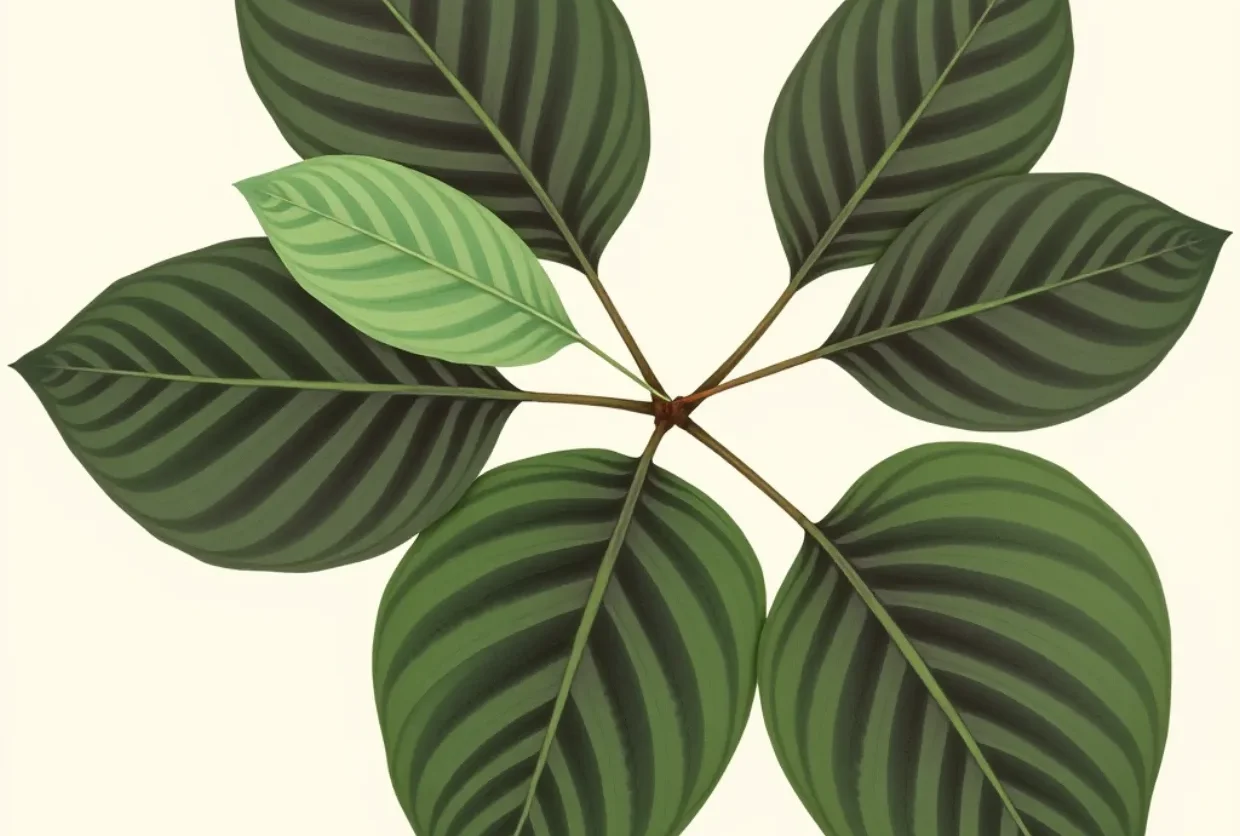
Brown crispy edges are the plant meeting a heated house, not a mistake. Low humidity, treated tap water and erratic watering all produce them, often at once.
The record
Every plant in the database answers the same questions in the same order, so two entries can be read line for line. 9 of 15 fields sourced.
- Light
- Part shade
- Light detail
- Bright indirect; direct sun bleaches the leaf markings
- Water
- Moderate
- Water detail
- Consistently moist, never soggy and never dry through; filtered or rainwater if tap is heavily treated
- Soil
- Peat or coir based mix that holds moisture and still drains
- Soil pH
- not recorded
- Mature size
- not recorded
- Toxicity
- not recorded
- Lifecycle
- Houseplant
- Difficulty
- Challenging
- Humidity
- High
- Potting mix
- Peat or coir based potting mix, pot with a drainage hole
- Repotting
- not recorded
- Temperature range
- not recorded
- Safe for pets
- not recorded
Separate causes of brown leaf edges. Low humidity, chlorine or fluoride in tap water, and letting the plant dry out between waterings. In an average heated house all three apply at once.
The brown edges are the plant, not you
Almost every calathea question is the same question: why are the leaf edges going brown and crispy. It happens on nearly every plant in nearly every ordinary house, and it is worth understanding rather than treating.
Iowa State names three separate causes and any of them will do it on this genus. Humidity, which is difficult to provide in most homes in winter, and the leaves dry out starting along the edges. Water quality, because chlorine and fluoride cause brown tips over time on sensitive species, and calathea and prayer plant are named among them. And inconsistent watering, particularly letting the plant dry out too long between waterings.
All three of those describe an average living room in February. This is a rainforest floor plant with thin, wide, decorative leaves, and a heated house in winter is drier than the desert plants on the same shelf are used to.
So the realistic goal is fewer brown edges rather than none. A calathea kept well still loses older leaves, and trimming a brown margin off with scissors, following the leaf shape, is normal maintenance rather than an admission of failure.
What it actually wants
Light: bright, indirect. Bright light gives the best color development, though these plants grow well in lower light too. What burns them is direct sun on the leaf, which bleaches the pattern that is the entire reason to own one.
Humidity: high, and this is the demanding part. Iowa State’s options are a humidifier, a pebble tray, a terrarium, or grouping plants together. A humidifier is the one that genuinely works; misting raises humidity for a few minutes and is mostly a ritual.
Water: consistently moist, never soggy and never dry through. This plant has less tolerance for the dry end than almost any common houseplant.
Water quality: worth taking seriously here specifically. If your tap water is heavily chlorinated or fluoridated, rainwater, distilled water or filtered water makes a visible difference over months. Leaving tap water to stand overnight helps with chlorine and does nothing about fluoride.
Mix: a peat or coir based potting mix that holds moisture while still draining, in a pot with a drainage hole.
The types, and the name that changed
One thing to get out of the way, because it causes confusion when buying: most plants sold as calathea have been reclassified into the genus Goeppertia. Calathea orbifolia is now Goeppertia orbifolia, Calathea makoyana is Goeppertia makoyana, and so on. Nurseries still label them calathea, and this page does too, but a plant tag reading Goeppertia is the same plant under a corrected name rather than something different.
The species differ almost entirely in the leaf, and since the leaf is the whole reason to grow one, that is the choice being made. Identification of calathea varieties is done on foliage rather than on flower, because most of them barely flower indoors at all.
| Variety | The leaf | Size and habit | How difficult |
|---|---|---|---|
| Orbifolia | Large round leaves to a foot across, dark green with broad silver-green stripes and a pale silvery underside | 2 to 3 ft tall, 1 to 2 ft wide | Manageable, but large enough that a mistake shows across a foot of leaf |
| Makoyana, the peacock plant | Fine dark feathering over a pale green ground, with the pattern showing through from the purple underside | Mid-sized | Moderate |
| Lancifolia, rattlesnake plant | Long wavy leaves with alternating large and small dark blotches, purple beneath | Upright, mid-sized | The easiest by a clear margin, and the one to start with |
| Roseopicta and the medallion types | Rounded leaf with a pink or cream halo running inside the margin, deep purple underneath | Compact | Moderate. The medallion flower is insignificant; nobody grows it for that |
| Zebrina | Soft velvety green leaves with broad light bands | Larger, spreading | Demanding of humidity |
| Ornata and White Fusion | Fine pinstripes, and in White Fusion irregular white and green variegation | Compact | The hardest. White Fusion is the one to avoid first time |
- Orbifolia is the one most people are looking for. Large round leaves up to a foot across, dark green with broad silver-green stripes and a pale silvery underside, on a plant reaching 2 to 3 feet tall and 1 to 2 feet wide. It is the boldest of the group and the least busy, because the pattern is simple.
- Makoyana, the peacock plant, carries fine dark feathering over a pale ground, with the pattern showing through from the purple underside.
- Lancifolia, rattlesnake plant, has long wavy leaves with alternating large and small dark blotches, and it is the most forgiving of the group by a clear margin.
- Roseopicta and the medallion types carry a rounded leaf with a pink or cream halo running inside the margin, and dark purple undersides.
- Zebrina has soft velvety leaves with broad light bands, and is more demanding of humidity than most.
- Ornata and White Fusion are the pinstriped and variegated ones, and both are noticeably harder to keep than the rest.
If this is a first calathea, lancifolia is the one to start with and White Fusion is the one to avoid. Orbifolia sits in between: not difficult, but large enough that a mistake shows across a foot of leaf.
Can it go outside?
Only as a summer holiday, and only in shade. Calathea is a rainforest floor plant from eastern Brazil, hardy nowhere in the continental United States, and direct sun scorches it within hours. A shaded porch through warm humid weather suits it well, and the outdoor humidity is often better than anything achievable indoors. It comes back in before night temperatures fall below the mid-60s.
Care through the year
- Check moisture twice a week
The top inch should stay slightly damp. This is the opposite regime from the succulents most people own, and the two cannot share a watering routine.
- Group it with other plants
Plants transpire, and a cluster holds noticeably more humidity around itself than a single pot on an open shelf.
- Keep it away from radiators and vents
A hot dry draft is the fastest way to brown a whole plant. So is a cold draft from a door in winter.
- Turn the pot regularly
The leaves fold up at night and open by day, and they orient to light. A pot never turned grows lopsided.
- Wipe the leaves
Dust dulls the markings and reduces the light reaching a plant that is already in indirect light.
The movement, which is real
Calatheas and marantas are called prayer plants because the leaves fold upward at night and open again in the morning. The movement is driven by a swollen joint at the base of each leaf stalk, and on a quiet evening it happens fast enough to notice.
A plant that stops moving is usually one that is not getting a clear day-night light cycle, or one that is stressed. It is a useful health signal that costs nothing to watch.
What goes wrong
Spider mites are the pest to watch for, and the connection to the rest of this page is direct: they thrive in dry air, which is exactly the condition that also browns the leaves. Fine webbing where the leaf meets the stalk and a stippled, dusty look to the upper surface are the signs.
Beyond that, most calathea problems read straight off the leaf. Brown crispy edges are dry air, water quality or erratic watering. Yellowing lower leaves with soft stems are overwatering. Faded, washed-out markings are too much direct light. Calathea leaves curling inward and not opening again are usually underwatering or very low humidity, and leaves curling and crispy together mean both at once: the plant is short of water and the air around it is too dry.
Leaves curling: four causes, told apart by what else is happening
Curling is the calathea symptom people ask about most, and it is not one problem. The plant curls its leaves as a water-conservation response, so the question is always what is making it conserve water.
- Curling with dry mix: simple underwatering. The leaves unfurl again within a day of a proper soak, and no damage is done.
- Curling with crispy brown edges: low humidity, and usually tap water on top of it. This is the combination behind the search for leaves curling and crispy, and the curl recovers while the brown edges do not.
- Curling in bright light, worst in the afternoon: too much direct sun. The plant is shading its own surface area. It uncurls in the evening, which is the tell.
- Curling with soft yellowing lower leaves and wet mix: root rot. Here the roots have failed, so the plant cannot take up water even though the water is there. This is the one that kills, and it is covered below.
The normal nightly folding described further down is a different thing entirely and involves the whole leaf hinging upward from the stem, not the edges rolling inward.
The other pests, and how to tell them apart
Spider mites get named first because they are the most likely, but three others turn up on calathea and each looks different enough to identify by eye.
- Mealybugs: white cottony masses tucked where the leaf stalk meets the stem, and in the folds of new growth. A cotton bud dipped in rubbing alcohol removes them one at a time, which is practical because they are usually few.
- Scale: greasy-looking brown bumps stuck to stems and the undersides of leaves, which do not move when touched. Often the first sign is stickiness on the leaf below rather than the insect itself.
- Aphids and thrips: clustered on new growth, with thrips producing silvery streaking and distorted young leaves rather than obvious insects.
All four respond to the same two treatments, insecticidal soap or horticultural oil, applied to the undersides of the leaves where they actually live. On a plant this size, wiping the leaves by hand is usually enough and is something the plant wants anyway.
Two problems that come from watering technique rather than amount
Root rot follows overwatering, and on a plant that genuinely likes consistent moisture the line between right and wrong is drainage rather than frequency. The signal is yellowing lower leaves with soft stems, and by the time it shows above ground the roots have already gone. A calathea in a pot without a drainage hole will get there eventually no matter how carefully it is watered.
Leaf spot comes from wetting the foliage when watering. This is worth knowing because the instinct with a humidity-loving plant is to spray it, and water sitting on the leaves overnight is how the spots start. Raise the humidity around the plant rather than wetting the plant itself.
How to save a dying calathea
A calathea that has lost most of its leaves is usually recoverable, because the growth points are at soil level rather than on the stems. The order that works:
- Take it out of the pot and look at the roots. Firm and pale means the problem is above ground; brown, soft and smelling sour means root rot, and the rotted roots have to be cut away and the plant repotted into fresh mix.
- Cut off leaves that are more than about half dead. They are not going to recover and they are drawing on a plant that has little to give.
- Move it out of direct sun and away from any vent or radiator entirely, and raise the humidity around it.
- Switch to distilled, filtered or rainwater from that point, and water only when the top of the mix has dried slightly.
- Then wait, and do nothing else. New growth comes from the base, and it takes weeks rather than days. The most common way a recovering calathea is finally lost is being repotted, fed and moved repeatedly while it is trying to rebuild.
Toxicity, in plain terms
Calathea is widely listed as non-toxic to cats and dogs, and it is one of the standard recommendations for a home with pets. No extension toxicity listing was found for the genus, so this page records toxicity as not recorded rather than repeating the claim as though it were sourced here.
Frequently asked questions
- Why are my calathea’s leaf edges brown?
- Three usual causes, and often all at once: low humidity, which Iowa State notes is hard to provide in most homes in winter; chlorine or fluoride in tap water, to which calathea is specifically sensitive; and letting the plant dry out too long between waterings.
- Should I use filtered water?
- On this plant, yes, if your tap water is heavily treated. Extension guidance names calathea and prayer plant among the species where chlorine and fluoride cause brown tips over time. Rainwater, distilled or filtered water all work; standing water overnight only helps with chlorine.
- Does misting help?
- Barely. It raises humidity for a few minutes. A humidifier, a pebble tray, a terrarium or grouping plants together are the options that actually change the air around the plant.
- Can I cut off the brown bits?
- Yes. Trim with scissors following the natural leaf shape, leaving a thin margin of brown rather than cutting into green tissue. It is routine maintenance on this plant, not a sign of failure.
- What is the difference between calathea and Goeppertia?
- None, botanically. Most plants sold as calathea were reclassified into the genus Goeppertia, so Calathea orbifolia and Goeppertia orbifolia are the same plant. Nurseries still use the old name.
- Which calathea is easiest to grow?
- Lancifolia, the rattlesnake plant, by a clear margin. Orbifolia is manageable but large enough that any mistake shows across a foot of leaf. Ornata and White Fusion are the hardest and are not the ones to start with.
- Can a calathea live outside?
- Only in warm weather and only in shade. It is a rainforest floor plant, hardy nowhere in the continental United States, and direct sun scorches it. A shaded porch in summer suits it, and outdoor humidity is often better than indoor, but it comes back in before nights drop below the mid-60s.
- Why have the leaves stopped folding at night?
- Usually no clear day-night light cycle, or stress from watering or dry air. The movement comes from a joint at the base of each leaf stalk, and it is a useful free health indicator.
Companion plants
How this entry is compiled
- Care values come from university extension publications and the USDA hardiness map, never from other gardening sites.
- Toxicity follows the ASPCA listing and is quoted rather than summarized.
- A value we cannot source is printed as not recorded, never estimated.
Compiled and checked by the Gardnicks editorial desk · last checked 2026-08-16
Sources for this entry
- Iowa State Extension, Why does my houseplant have brown leaf tips and edges?
- Iowa State Extension, Diagnosing Houseplant Problems from Improper Environmental Conditions
- Penn State Extension, Maranta Diseases
- Missouri Extension, Caring for Houseplants
Where two sources disagree, the entry follows the one closest to the plant’s own growing region and says so in the text.
What kills it
Three failures cover almost everything readers write in about.
More in Houseplants
Plates are illustrations, not photographs of a specific plant, and are not evidence of a variety, place or season.