Garlic
Allium sativum
Hardneck / softneck garlic
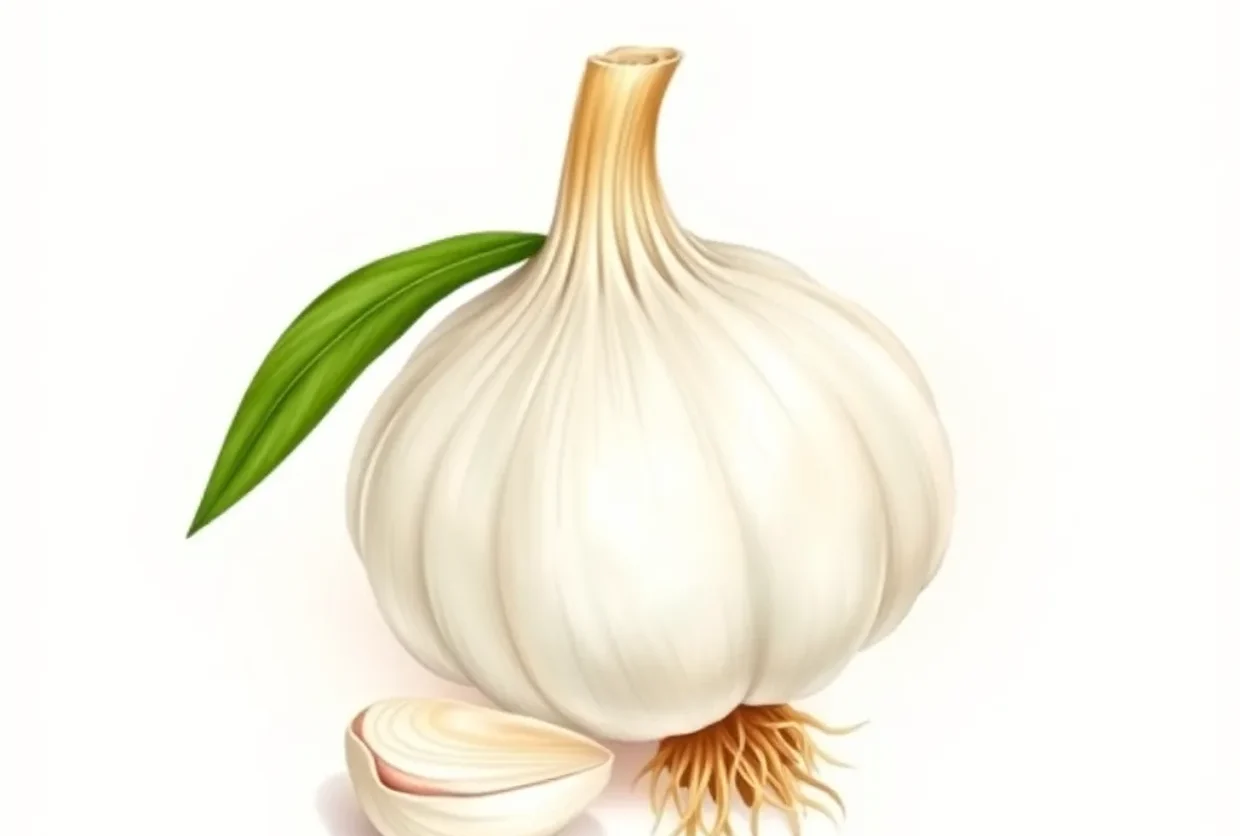
Planted in October, harvested in July. Nothing else in a vegetable garden runs on that schedule, which is why so many people miss it and get one undivided bulb.
The record
Every plant in the database answers the same questions in the same order, so two entries can be read line for line. 11 of 15 fields sourced.
- Light
- Full sun
- Light detail
- 6 hours or more; it competes badly with weeds because the leaves cast little shade
- Water
- Moderate
- Water detail
- Steady through spring growth, easing off as the leaves brown
- Soil
- Loose, fertile, well drained
- Soil pH
- not recorded
- Mature size
- not recorded
- Toxicity
- not recorded
- Lifecycle
- Perennial
- Difficulty
- Easy
- Sowing depth
- Base of the clove 2 to 3 in deep, pointed end up
- Sowing time
- Autumn, 1 to 2 weeks after the first killing frost or 4 to 6 weeks before the ground freezes
- Spacing
- 6 to 7 in apart, rows about 1 ft
- Days to harvest
- July, when a third to a half of the leaves have browned
- Hardiness zones
- not recorded
Equals one wrapper layer on the bulb. That is how you time the harvest: lift while a third to a half of the leaves have browned, because dead leaves mean the wrappers have already gone.
The year
Plant or divide and prune. Everything else is leaving it alone.
It goes in the ground in autumn, and that is the whole trick
Garlic is planted in October and harvested the following July. Nothing else in a vegetable garden runs on that schedule, which is why so many people miss it every year and then wonder why their spring-planted garlic produced one round bulb the size of an onion set.
Extension timing is consistent across the country: plant in autumn, one or two weeks after the first killing frost, or four to six weeks before the ground freezes. In central Illinois that means October into early November; in colder regions earlier, in warmer regions later.
The reason is that garlic needs a cold period to divide into cloves. A clove planted in autumn puts down roots, sits through winter, and comes away in spring with a root system already built. A clove planted in spring has to do everything at once, and it usually gives you a single undivided bulb.
Hardneck or softneck
The two types behave differently enough that the choice belongs before the planting date, not after.
Hardneck varieties produce a flowering stalk called a scape from the center of the leaves in mid to late May. Flowers on the scape usually abort and form bulbils, small aerial cloves. Hardnecks tend to be hardier in cold regions, produce fewer but larger cloves, and store for less time.
Softneck types, including the Artichoke and Silverskin groups, do not produce a flowering stalk. They typically produce more cloves per bulb, they store longer, and they are the ones that can be braided.
Supermarket garlic is usually softneck and often treated to prevent sprouting, which is why planting it works poorly. Buy seed garlic from a supplier, once, and then save your own biggest bulbs each year.
Garlic growth stages, and how long it takes
How long does garlic take to grow? Between eight and nine months for a fall planting, which is longer than any other common vegetable and the single fact that most surprises people the first time. It goes in after the first killing frost and comes out the following July. There is no way to shorten it, because the cold period in the middle is not waiting, it is a requirement.
| Stage | When | What is happening |
|---|---|---|
| Planting and rooting | Late summer to fall, usually within a week or two after the first killing frost | The clove puts out roots, and a shoot emerges from the clove but should not push above the soil before the first hard freeze |
| Winter | Through the cold | Root growth and the cold exposure that bulbing depends on. Mulch moderates the freezing and thawing that heaves cloves out of the ground |
| Spring leaf growth | As soil warms | Leaves come up and expand. Feed when the shoots are 4 to 6 inches tall. Every leaf becomes a wrapper layer on the finished bulb |
| Bulbing | End of May to mid July | The clove divides and the bulb forms. The most moisture-sensitive stage of the whole cycle, and drought here costs bulb size directly |
| Scapes | Early summer, hardneck only | The flower stalk emerges and curls. Cut it, as described below |
| Maturity and harvest | July | Foliage begins to wither from the bottom. Lift when a third to a half of the leaves have browned |
Two things follow from that table. Watering matters most in a six-week window in early summer, not evenly across nine months. And the plant is doing something useful all winter, so a bed that looks empty in January is not a failed planting.
Planting
- Split the bulb the day you plant
Break it into cloves and leave the papery skin on each one. Cloves separated weeks in advance dry out.
- Plant the biggest cloves and eat the small ones
Clove size predicts bulb size directly. This is the easiest gain available and most people plant the whole bulb regardless.
- Pointed end up, base 2 to 3 inches deep
Iowa State’s depth, measured to the base of the clove. Upside down cloves come up eventually and produce bent, smaller bulbs.
- Space 6 inches apart
Six to seven inches in rows about a foot apart, or in double rows six inches apart with the beds 30 inches on center.
- Mulch after the ground has cooled
Straw or leaves over the bed steady the soil temperature and reduce the freeze-thaw heaving that pushes cloves out over winter.
Scapes, and why you cut them
In mid to late May, hardneck garlic sends up a curling flower stalk. Removing it is standard practice, and the reason is straightforward: it makes the bulb bigger, because the plant puts energy into the bulb rather than into flowers and bulbils.
Cut them just after they start to curl. They are also one of the best things a vegetable garden produces, and treating them as a crop rather than as waste is what makes the job feel worth doing.
Softneck varieties produce no scape, so this step does not apply to them.
Harvesting garlic, and curing it
Garlic is ready in July, and the signal is the leaves. Each leaf corresponds to a wrapper layer around the bulb, so when roughly a third to a half of the leaves have browned but the rest are still green, it is time. Waiting until all the leaves are dead means the wrappers have rotted away and the bulb splits and will not store.
Lift with a fork rather than pulling, since the necks break easily.
Then cure, which is the step people skip and the reason home garlic goes soft in September. Put the whole plants somewhere warm, dry and airy for three to four weeks, which dries the sheaths around the bulb along with the shoots and roots. Out of direct sun, with air moving around them.
Once cured, trim the roots and cut the tops back, or braid softnecks by their leaves, and store somewhere cool and dry. Not in the refrigerator, which encourages sprouting.
How to store fresh garlic
Curing and storing are two separate steps and the conditions are almost opposite. Curing wants warmth and moving air. Storage wants cold and dryness.
Garlic is cured when the skin has gone papery, which takes roughly three weeks on racks with good airflow out of direct sun, or until the outer two leaves are completely dry. Only then does storage begin.
- Cold and dry. Cured bulbs keep best at 32 to 35°F and 65 to 75 percent relative humidity.
- Avoid the two failure zones. Prolonged storage around 40°F makes the cloves sprout, and humidity above 70 percent brings both sprouting and mold. That is why a domestic refrigerator, which sits near 40°F and is humid, is the wrong place: it does both things at once.
- Softneck keeps far longer than hardneck. In good conditions softneck stores up to nine months against six for hardneck, and at ordinary room temperature it is six to eight months against three to four. Storing hardneck at 32°F extends it to about seven months.
- Seed garlic is the exception. Cloves being held for replanting are kept at room temperature rather than cold, since cold storage starts the process the plant is supposed to go through in the ground.
If a household has no cold store, the practical answer is to plant softneck for keeping and hardneck for eating first, and to work through the hardneck by midwinter.
Garlic sprouts, in the pantry and in the garden
A green shoot coming out of a stored clove is a storage fault rather than spoilage. It means the bulb has been held too warm or too damp, most often in a refrigerator. The clove is still usable, though it softens and loses flavor as the shoot draws on it, and the shoot is easily removed by splitting the clove in half lengthwise.
The better use for a sprouted clove is to plant it. A clove that has already broken dormancy will grow, and if it is a variety suited to the climate it produces a normal plant. The one caution is that most sprouted supermarket garlic is a softneck grown for a different region, so it is worth treating as an experiment rather than a crop.
Garlic greens are a separate and deliberate use. Cloves planted close together in a pot or a spare corner and cut young give a mild garlic-flavored green in weeks rather than months, and it is the only way to get anything edible from garlic in a single season.
What goes wrong
Garlic is close to trouble-free in a home garden. The problems that do occur are mostly self-inflicted.
A single round undivided bulb means the cold period was too short, so either it was spring planted or autumn planting came too late. Small bulbs usually mean small cloves planted, crowding, or competition from weeds, which garlic is poor at outrunning because its leaves cast so little shade.
Bulbs that rot in the ground point at drainage. Bulbs that soften within weeks of harvest point at curing that was too short or in air that was not moving.
Where garlic does pick up disease, white rot and nematodes are the serious soil-borne ones, and both persist for years. Rotating alliums around the garden rather than growing them in the same bed every year is the sensible precaution.
Varieties worth knowing by name
Within the hardneck and softneck split described above there are subgroups, and they are more useful than individual variety names because they predict how the bulb behaves.
- Rocambole, hardneck. The most commonly grown hardnecks and the ones usually singled out for flavor, with 6 to 11 cloves to a bulb.
- Porcelain, hardneck. Taller plants with only 4 to 6 large cloves, storing 4 to 8 months, which is long for a hardneck.
- Purple stripe, hardneck. Very flavorful, mostly 8 to 12 cloves.
- Artichoke, softneck. Described as the most adaptable garlics, with two layers of cloves and skins that are difficult to peel.
- Silverskin, softneck. The most common softneck group and easy to grow, with 8 to 12 or 18 to 24 cloves depending on type, pale green leaves, rarely producing a flower stalk, and white or pink-blushed bulbs. Best in mild winter climates, and the flavor range across the group runs from very mild to very hot.
Nootka Rose is a Silverskin, alongside Silver White and S and H Silver, so everything in that line applies to it: a long-keeping softneck with many cloves, no scape to cut, and a preference for a mild winter. It is one to choose for storage rather than for the culinary reputation the rocamboles have.
Garlic chives are not garlic either
The second plant that gets confused with this one is Allium tuberosum, garlic chives, sometimes sold as Chinese chives. It is a true Allium, unlike society garlic, but it is grown as a leaf herb and forms no bulb worth lifting.
The quick way to tell it from ordinary chives is the leaf: garlic chives have flat, linear leaves up to a foot long in a basal rosette, where common chives are hollow and round. The taste and smell are garlic rather than onion, and leaves, bulbs and flowers are all edible. It is hardy across zones 3a to 9b, makes a low clump 4 to 6 inches tall and about a foot wide, and carries pale yellow to cream bell-shaped flowers in summer. Full sun, soil rich in organic matter at a neutral pH with good drainage, tolerant of drought and humidity but liable to bulb rot in wet ground. Deer, rabbits and most insects leave it alone.
The catch, and the reason to think before planting it in a bed: it self-seeds readily and is described as weedy and spreading. Growing it in a container is the standard way to keep it in bounds, and cutting the flowers before they set seed is the alternative. It is also mildly toxic in quantity, containing sulfides that cause nausea, vomiting and diarrhea if a lot is eaten, which is worth knowing in a garden with pets.
Society garlic is not garlic
Worth separating, because the names overlap and the plants do not. Society garlic is Tulbaghia violacea, an ornamental perennial from South Africa, grown for its flowers rather than for a bulb. There is no head of cloves to harvest and none of the planting calendar on this page applies to it.
It is hardy in zones 7a to 10b, makes a clump 1 to 2 feet tall and wide, and carries fragrant lilac-pink star-shaped flowers under an inch across in terminal clusters on 20-inch stalks from early summer into fall. It takes full sun or partial shade, tolerates clay, sand or rich soil as long as it drains, and has good drought and heat tolerance while doing best with steady moisture through the growing season. It is deer resistant and moderately salt tolerant, has no serious pests beyond slugs and snails, and in colder regions it overwinters indoors or outdoors under mulch.
The leaves and rootstock smell strongly of garlic when bruised, which is where the name comes from, and both the leaves and the flowers are edible with an oniony to peppery flavor, raw or cooked. White society garlic refers to the white-flowered form; the variegated selections, with a cream stripe down the leaf, are sold under the same name and grown for foliage. Care is the same across all of them.
Toxicity, in plain terms
Garlic is a food crop for people. It is also a genuine hazard to dogs and cats, in which alliums damage red blood cells, and it is more concentrated than onion by weight. This page records toxicity as not recorded because no extension listing was consulted for it, but the veterinary consensus on alliums and pets is not in doubt and is worth acting on.
Frequently asked questions
- When do I plant garlic?
- In autumn, one or two weeks after the first killing frost, or four to six weeks before the ground freezes. October into early November suits the middle of the country. Spring planting usually gives a single undivided bulb because the clove has had no cold period.
- Should I cut the scapes off?
- Yes, on hardneck varieties, just after they start curling. Removing them puts the plant’s energy into the bulb instead of into flowers and bulbils, so the bulbs come out larger. They are also good to eat.
- How do I know when to harvest?
- When about a third to a half of the leaves have browned and the rest are still green, usually in July. Each leaf is a wrapper layer on the bulb, so waiting until everything is dead means the wrappers have gone and the bulb will not store.
- Why did my garlic go soft in storage?
- Curing was too short or the air was not moving. Whole plants need three to four weeks somewhere warm, dry and airy after lifting. Store cured bulbs cool and dry, not in the refrigerator, which prompts sprouting.
- Can I plant supermarket garlic?
- Poorly. It is usually a softneck type suited to a different climate, and it is often treated to stop it sprouting. Buy seed garlic once, then replant your own largest bulbs each year and the strain adapts to your garden.
Companion plants
How this entry is compiled
- Care values come from university extension publications and the USDA hardiness map, never from other gardening sites.
- Toxicity follows the ASPCA listing and is quoted rather than summarized.
- A value we cannot source is printed as not recorded, never estimated.
Compiled and checked by the Gardnicks editorial desk · last checked 2026-08-16
Sources for this entry
- University of Minnesota Extension, Growing garlic in home gardens
- Iowa State Extension, Growing Garlic in the Home Garden
- Illinois Extension, How to grow garlic
- Penn State Extension, Growing and Using Garlic
Where two sources disagree, the entry follows the one closest to the plant’s own growing region and says so in the text.
What kills it
Three failures cover almost everything readers write in about.
More in Vegetables
 Cucumber
Full sun · zones not recorded
Cucumber
Full sun · zones not recorded
 Tomato
Full sun · zones not recorded
Tomato
Full sun · zones not recorded
 Beet
Full sun · zones not recorded
Beet
Full sun · zones not recorded
Plates are illustrations, not photographs of a specific plant, and are not evidence of a variety, place or season.