Beet
Beta vulgaris
Beetroot / garden beet
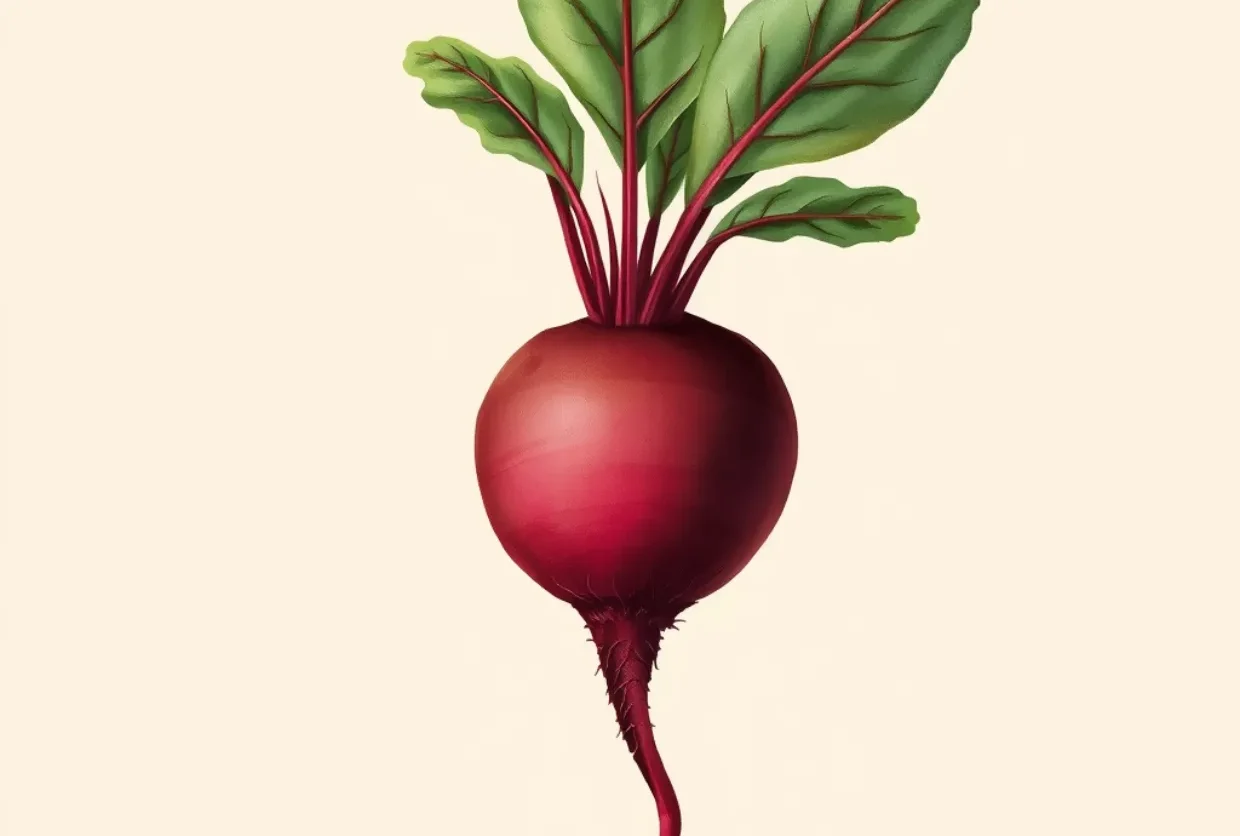
Every beet seed is a fruit holding several seeds, so seedlings come up in clumps. Thinning is not tidying here; it decides whether you get roots at all.
The record
Every plant in the database answers the same questions in the same order, so two entries can be read line for line. 13 of 15 fields sourced.
- Light
- Full sun
- Light detail
- 6 hours or more; tolerates light shade in summer heat
- Water
- Moderate
- Water detail
- Steady; stop-start watering splits the roots
- Soil
- Loose and well drained
- Soil pH
- 6.0 to 7.0
- Mature size
- Roots 1.5 to 3 in across at harvest
- Toxicity
- not recorded
- Lifecycle
- Biennial
- Difficulty
- Easy
- Sowing depth
- 1/2 in
- Sowing time
- Early to mid April, then every 2 to 3 weeks until mid July
- Spacing
- Thin to 3 to 4 in; rows 1 to 1.5 ft apart
- Days to harvest
- 50 to 70 days
- Hardiness zones
- not recorded
How much foliage you can take as greens. Up to a third of the leaves can be harvested without harming the root, so the same plant gives you two crops.
The year
Plant or divide. Everything else is leaving it alone.
Every beet seed you plant is not a seed
This one fact explains most of what goes wrong with beets, and almost nobody is told it. Iowa State puts it plainly: each seed that is sown is actually a fruit containing several seeds.
So a beet sown at one-inch intervals does not come up as a neat row of single plants. It comes up in clumps of three or four, all competing in the same inch of soil, and left alone they produce a row of leaves and no roots worth pulling.
Thinning is not tidying with beets. It is the step that decides whether you get a crop at all.
When to sow
Beets are a cool-season crop grown at both ends of the year, and skipping the middle is deliberate rather than lazy. High temperatures diminish the quality of the root, so mid-summer beets are woody and pale in the middle whatever you do to them.
Iowa State’s schedule for the upper Midwest is to begin sowing in early to mid-April, with successive sowings every two to three weeks for a continued harvest into autumn, and a last practical planting date of mid-July for the fall crop. Warmer regions shift both ends of that but keep the same shape: spring, a gap, then autumn.
Sowing every two or three weeks rather than all at once is what turns a glut into a supply. A whole packet sown in one afternoon gives you thirty beets ready in the same week.
Sowing and thinning
- Half an inch deep, rows 1 to 1½ feet apart
Iowa State’s figures. Beet seed is large enough to place individually, which is worth doing rather than scattering it.
- Space the seedballs about an inch apart
Each one will produce several seedlings, so this is already denser than it looks.
- Thin to 3 to 4 inches once they are up
The stated spacing for good root development. Take out the smaller, weaker seedlings and leave the strongest one from each clump.
- Eat the thinnings
They are beet greens at their best stage. Nothing is wasted by thinning properly, which removes the main reason people avoid it.
- Keep water steady
Loose, well-drained soil at pH 6.0 to 7.0. Dry spells followed by heavy watering produce split roots and tough rings.
Harvest, and taking greens without losing the root
Beets need roughly 50 to 70 days from sowing to harvest. They can be pulled once the roots reach an inch across, though the main crop is usually left until 1½ to 3 inches.
Beyond about three inches, the texture goes. A very large beet is not a bonus, it is a beet left in the ground too long, and this is the single most common harvesting mistake.
The greens are a second crop from the same plant, and there is a limit that keeps both. Up to one third of the foliage can be harvested for greens without harming the root. Take outer leaves and leave the center growing.
Stored properly they keep a long time: three to four months in a cool, humid place at 32 to 35 degrees Fahrenheit. Twist the tops off rather than cutting them close, since a cut into the crown bleeds and shortens storage.
Soil, and the one deficiency that ruins the root
Beets are a root crop, so the soil decides the shape of the thing you are growing. They want loose, stone-free ground worked eight to ten inches deep. A stone or a hard clod in the way produces a forked or twisted root, and no amount of watering or feeding straightens it afterwards.
Two soil details matter more for beets than for most vegetables. The first is pH: they prefer 6.0 to 7.0 and perform poorly in acid soil, which is one of the more common reasons for a disappointing crop in an otherwise well-run garden. The second is boron. Beets are unusually sensitive to boron deficiency, which shows as dark, corky patches inside the root, sometimes called black heart. It is diagnosed by a soil test rather than guessed at, and it is not fixed by adding more of a general fertilizer.
Skip the fresh manure. Beets grown in recently manured ground put their energy into leaf and produce hairy, forked roots, which is the same nitrogen problem that gives all leaf and no crop.
Which beet you are growing
Most people plant a red beet and never look further, but the type changes both the harvest and what you can do with it.
| Variety | What it is | Why grow it |
|---|---|---|
| Detroit Dark Red | The standard round red beet | Reliable, stores well, and the benchmark everything else is compared against |
| Chioggia | An Italian heirloom with concentric red and white rings inside | The rings are the point. They fade when cooked, so it is at its best raw and sliced thin |
| Golden, including Touchstone Gold | Orange skin, yellow flesh | It does not bleed, so it stays out of everything else on the plate. Milder and sweeter |
| Cylindra | Long and cylindrical rather than round | Slices into even discs, and produces more usable beet per foot of row |
| Bull’s Blood | Grown mainly for its deep red foliage | The leaves are the crop. Roots are secondary and best pulled small |
If you have seen a beet come out pale with white rings when you expected solid red, check the packet before blaming the growing: Chioggia is striped by design, and heat stress can also produce ringing in a red variety.
Frost, storage and how long a beet keeps
Beets tolerate light frost and the flavor improves after one, because cold prompts the plant to convert starch to sugar. That makes them one of the crops you can leave in the ground into autumn rather than lifting on a date. Mulch the row heavily and pull as needed until the ground begins to freeze hard.
For anything you are storing, twist or cut the tops off to about an inch, and do not wash the roots. Beets keep for four to six months just above freezing at high humidity, which in practice means a perforated bag in the bottom of a fridge, a bucket of damp sand in an unheated garage, or a root cellar if you have one. Left with their leaves attached, they go soft within a week, because the foliage keeps drawing water out of the root.
What goes wrong
Almost every beet failure traces back to one of three things, and none of them is a pest.
No thinning. Clumped seedlings from multigerm seedballs, producing foliage and marble-sized roots.
Heat. Sown too late in spring so the roots size up in July, producing pale rings and a woody texture. The fix is the calendar, not the care.
Erratic water. Growth that stops and restarts gives split, ringed, tough roots.
Beyond that, leaf miner tunnels inside the foliage are the visible complaint, which is a greens problem rather than a root problem, and picking off affected leaves handles it in a home row.
Frequently asked questions
- What is the short version of how to grow beets?
- Sow direct into loose, stone-free soil half an inch deep, thin the clumps to three or four inches apart once the seedlings are two inches tall, keep the water even, and pull at golf-ball size around fifty to seventy days. The thinning is the step that decides whether you get roots.
- When should I harvest beets?
- At golf-ball size, roughly fifty to seventy days from sowing. A beet much over three inches across turns woody and loses its sweetness, and there is no way back from that. In autumn you can leave them in the mulched ground and pull as needed until it freezes hard.
- What should I plant beets next to?
- Bush beans, onions, lettuce and brassicas all work, mainly because none of them compete for the same root space at the same depth. Keep them away from pole beans. As with all companion planting, the reliable gains are shade, spacing and timing rather than one plant repelling a pest from another.
- Can I grow beets in a container?
- Yes, and it is one of the better root crops for it. Use a pot at least eight to ten inches deep so the root has somewhere to go, thin exactly as you would in the ground, and expect to water more often because an evenly moist container is what prevents woody, cracked roots.
- Why did my beets grow leaves but no roots?
- Almost always no thinning. Each beet seed is a fruit containing several seeds, so seedlings come up in clumps and compete. Thin to 3 to 4 inches apart and each remaining plant has room to swell a root.
- When should I pull them?
- Fifty to seventy days after sowing, when the roots are 1½ to 3 inches across. They are edible from about an inch. Left much beyond three inches they turn woody, so bigger is not better here.
- Can I eat the leaves?
- Yes, and they are one of the better greens. Take up to a third of the foliage and the root keeps developing normally. The thinnings you remove early are the same thing at a younger stage.
- Why are mine pale with white rings inside?
- Heat during root development, usually from a spring sowing that matured in midsummer. Beets are a cool-season crop; sow early spring and again from midsummer for autumn, and skip the hottest stretch.
- How long do they keep?
- Three to four months at 32 to 35 degrees in a humid place. Twist the tops off instead of cutting them close to the crown, because a cut crown bleeds and stores badly.
How this entry is compiled
- Care values come from university extension publications and the USDA hardiness map, never from other gardening sites.
- Toxicity follows the ASPCA listing and is quoted rather than summarized.
- A value we cannot source is printed as not recorded, never estimated.
Compiled and checked by the Gardnicks editorial desk · last checked 2026-08-16
Sources for this entry
- Iowa State Extension, Growing Beets in the Home Garden
- Illinois Extension, Beet
- Oregon State Extension, Beets
Where two sources disagree, the entry follows the one closest to the plant’s own growing region and says so in the text.
What kills it
Three failures cover almost everything readers write in about.
More in Vegetables
 Cucumber
Full sun · zones not recorded
Cucumber
Full sun · zones not recorded
 Tomato
Full sun · zones not recorded
Tomato
Full sun · zones not recorded
 Garlic
Full sun · zones not recorded
Garlic
Full sun · zones not recorded
Plates are illustrations, not photographs of a specific plant, and are not evidence of a variety, place or season.