Tomato
Solanum lycopersicum
Garden tomato
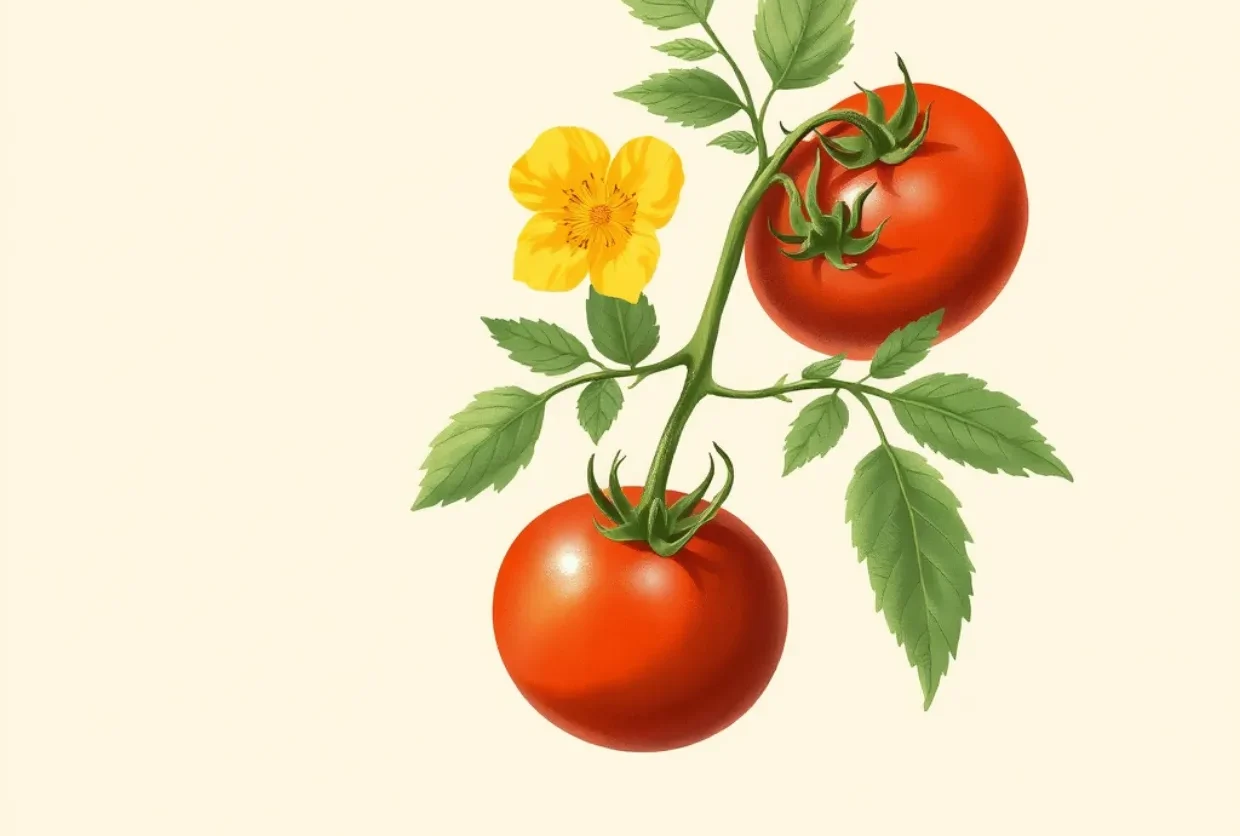
One word on the label decides the support, the pruning and the harvest. Determinate ripens everything at once; indeterminate keeps going until frost.
The record
Every plant in the database answers the same questions in the same order, so two entries can be read line for line. 14 of 15 fields sourced.
- Light
- Full sun
- Light detail
- 6 hours or more
- Water
- Moderate
- Water detail
- 1 to 1.5 in a week, evenly; unevenness causes end rot and splitting
- Soil
- Loamy, well drained, consistently moist
- Soil pH
- 5.8 to 6.8
- Mature size
- 1 to 10 ft tall, 1 to 4 ft wide
- Toxicity
- NC State rates tomato medium severity. Ripe fruit is edible, but leaves and stems eaten in large quantities cause headaches, abdominal pain, dilated pupils, vomiting and diarrhea.
- Lifecycle
- Annual
- Difficulty
- Moderate
- Sowing depth
- 1/4 in indoors; transplants set 2 to 3 in deeper than they grew
- Sowing time
- Indoors 5 to 6 weeks before the frost-free date
- Spacing
- 18 to 24 in apart
- Days to harvest
- 2 to 5 months from planting
- Hardiness zones
- not recorded
How long before nightshades return to a bed. Fusarium and verticillium wilts persist in soil and cannot be cured, so rotation is the only real defense.
The year
Plant or divide and prune. Everything else is leaving it alone.
Toxic to pets
NC State rates tomato medium severity. Ripe fruit is edible, but leaves and stems eaten in large quantities cause headaches, abdominal pain, dilated pupils, vomiting and diarrhea.
Determinate or indeterminate decides everything else
Two tomato plants can look identical in the tray and want completely different treatment for the rest of the season. The word on the label that tells you which is the one most people skip.
Iowa State’s definitions are worth memorizing. Determinate tomatoes are small compact plants; they grow to a set height, stop, then flower and set all their fruit within a short period. Indeterminate tomatoes keep growing, flowering and setting fruit until the first frost kills them, so the harvest stretches over two or three months.
That decides the support, the pruning and what you can do with the crop. A determinate variety ripens most of its fruit in a fortnight, which is what you want if you are making sauce and a problem if you are eating them in salads. An indeterminate one gives you a few every week from July to October and needs a stake tall enough for a plant that never stops.
Types of tomatoes, and which to grow for what
Determinate and indeterminate is the growth habit. The other axis is the fruit itself, and it decides what the crop is good for once it is in the kitchen. Choosing by fruit type first and by cultivar name second is how most people avoid growing thirty pounds of the wrong thing.
| Type | The fruit | Usual habit | What it is for |
|---|---|---|---|
| Cherry and grape | Bite-sized and very sweet. Grape types are smaller, less watery and more flavorful than most cherries | Anything from dwarf (Tiny Tim) to seven feet (Sweet 100) | Fresh eating and salads. One cherry tomato plant is usually enough for a family |
| Beefsteak and slicing | Large, often over a pound, a single slice covering a sandwich | Mostly indeterminate | Eating fresh. The largest fruit is the slowest to ripen and the most prone to cracking |
| Paste, Roma and plum | Oblong or pear-shaped, meaty, few seeds, no large central core, less juicy | Mostly determinate | Sauce, salsa and canning. The determinate habit ripens the crop together, which is exactly what canning wants |
| Heirloom | Older open-pollinated cultivars grown for eating quality, color and shape. Some carry potato-leaf foliage | Usually indeterminate | Flavor, and the only group worth saving seed from. Black Krim is a rich heirloom beefsteak at 80 days |
| F1 hybrids | Deliberate crosses, more uniform and usually carrying more disease resistance | Both | Reliability. Seed saved from them germinates but will not come true |
If the plan is salsa or sauce, the paste tomatoes are not a preference but a functional choice: fewer seeds and less water means less time on the stove and a thicker result from the same weight of fruit. If the plan is a sandwich, a paste tomato is a disappointment for the same reasons.
Days to maturity, which matters most in a short season
Every cultivar carries a number, counted from transplant rather than from sowing, and Iowa State groups them into three: early-season at 65 days or fewer, mid-season at 70 to 79, and late-season at more than 80. Most cultivars begin ripening in August, while early ones such as Early Girl and many cherry and grape types start from mid to late July.
That number is the single most useful thing on a seed packet in a northern garden. An 85 day beefsteak transplanted in late May in a cold state is being asked to ripen in the week the first frost arrives. Growing one early cultivar alongside a late one is the standard insurance, and it also spreads the harvest instead of concentrating it.
Site and soil
Full sun, six hours or more. Loamy soil, well drained with consistent moisture, at a slightly acidic pH of 5.8 to 6.8.
NC State adds a rotation instruction that matters more than it sounds: plant where nightshades have not been grown for three to four years. Fusarium and verticillium wilts persist in soil, and the same bed year after year is how a garden acquires them permanently.
Size runs from 1 to 10 feet tall and 1 to 4 feet wide across the varieties, spaced 18 to 24 inches apart. In a container, the minimum is five gallons and one to two feet deep, and a determinate variety is the sensible choice there.
Planting
- Start indoors 5 to 6 weeks before the frost-free date
Or buy transplants. Tomatoes are warm-season plants and nothing is gained by putting them out early into cold soil.
- Plant deeper than it was growing
Bury 2 to 3 inches of the lower stem. Roots form all along the buried portion, which gives a sturdier plant.
- Lay a leggy plant sideways
Missouri Extension’s fix: plant at about a 30 degree angle in a trench, leaving only the top 5 or 6 inches above ground. The whole buried stem becomes root.
- Put the cage or stake in at planting
Driving a stake beside an established plant cuts the roots holding it up, and an unsupported indeterminate variety ends up on the ground with its fruit.
- Mulch, then water weekly and deeply
About 1 to 1.5 inches of water a week. Mulch is what keeps that supply even, and evenness is the whole game with tomatoes.
When to plant, and why the answer is not your zone
The most common form of the timing question asks which zone you are in, and that is the wrong variable. Hardiness zones describe how cold a winter gets, which a tomato never experiences: it is an annual that is dead before winter arrives. What actually decides the date is your last spring frost, and after that, the soil.
- Transplant only after all danger of frost has passed and the soil has warmed. A soil temperature around 70°F is what the plant wants. Warm soil beats cool soil, and nothing is gained by going early: a tomato in cold ground sits still while a plant set out two weeks later catches and passes it.
- Harden off over about a week. Put the plants somewhere shaded and out of the wind first, then increase their time in full sun daily. This applies to nursery transplants as much as to home-raised ones.
- Set them out late in the afternoon, or on a cool, cloudy, still day. A transplant put into midday sun and wind spends its first days recovering rather than rooting.
- In a short season, warm the soil first. Black plastic mulch laid over the bed raises soil temperature, keeps moisture in and buys back a week or more at the front of the season.
Growing tomatoes in pots
You can grow tomatoes in pots as well as in a bed, and on a patio or a balcony it is often the only option. The requirements are more exacting than in open ground, because a container gives the plant no reserves of either water or nutrients to fall back on.
- Size. Iowa State puts the floor at about two gallons, roughly a 10 inch pot, for a cherry tomato, and about four gallons, roughly 12 to 14 inches, for a standard one. The figure recorded on this page for a full-size plant is five gallons and one to two feet deep. Bigger is better at every point on that scale.
- Use a soilless potting mix, not garden soil. Mixes drain properly and come free of the soil-borne disease organisms and weed seed that make garden soil a poor choice in a pot.
- Expect to water daily in heat. Water until it runs from the drainage holes, and never let the mix dry out completely, because uneven moisture in a container is the fastest route to blossom end rot and split fruit. Water at the base and keep the leaves dry, especially late in the day.
- Feed more often than you would in a bed. A container plant has less soil to draw on. A soluble fertilizer such as 15-30-15 or 20-20-20 applied with the water covers it, though many commercial mixes carry a slow-release feed, in which case there is often nothing to do until midsummer.
- Choose the plant for the pot. Dwarf and patio cultivars exist for this, and a determinate variety is the sensible default. A standard-size plant in a container needs a stake or cage and is best pruned to one or two stems.
- Cages need to be big enough to reach into. At least 24 inches across, made from mesh of at least four inches so the fruit can actually be picked through it.
How often to feed a tomato
Tomatoes are heavy feeders, and the timing is more useful than the product. Work compost in before planting, then start side-dressing once the first fruits are about an inch across, and continue every three to four weeks until frost. Pull the mulch back, scratch the fertilizer in around the drip line, water it in and replace the mulch.
The one thing to avoid is high nitrogen. It produces a large, dark, healthy-looking plant with very few flowers and almost no fruit, and by the time that is obvious the season is half gone. A soil test before the season is the only way to know what the ground actually needs; without one, err low.
Suckering, and how much is enough
Suckers are the shoots that form where a leaf branch meets the main stem. Removing them channels energy into larger, earlier fruit instead of foliage.
How far to go depends on the type, and Iowa State is specific. On determinate tomatoes, remove suckers only up to the first flower cluster; going further does not increase yield and costs you leaves. On indeterminate tomatoes, keep removing suckers along the main stem all season.
Over-pruning a determinate variety is a common and quiet mistake. The plant has a fixed amount of growth in it, and stripping its foliage exposes the fruit to sunscald without producing more of it.
Blossom end rot, and the myth attached to it
A sunken, leathery brown patch on the bottom of the fruit is blossom end rot. It is a calcium problem in the fruit, and the reflex is to buy a calcium spray.
Clemson lists that among gardening myths for a reason. There is usually plenty of calcium in the soil; what fails is the plant’s ability to move it into the fruit. Minnesota Extension names the causes: drought stress, alternating extremes of soil moisture, root damage, waterlogged or cold soil, and high concentrations of ammonium, potassium or magnesium.
So the fix is water, not calcium. Water weekly in dry weather, mulch to hold moisture even, avoid damaging roots by hoeing close to the plant, and go easy on fertilizer. Affected fruit will not recover, but the next trusses come through clean once the watering is steady.
Splitting fruit has the same root cause: a dry spell followed by heavy water, so the inside swells faster than the skin can stretch.
What goes wrong
NC State’s list is hornworms, aphids, whiteflies and spider mites among insects, and blights, fusarium wilt, verticillium wilt and viruses among diseases.
Hornworms are the dramatic one: a caterpillar the size of a finger that strips a plant overnight and is almost invisible against the foliage. They are hand-picked, and the ones covered in white rice-like cocoons should be left alone, because those are parasitic wasps that will deal with the next generation for you.
The wilts are the ones that end a season, and rotation is the only real defense. Early blight, the brown target-ringed spots that work up from the lowest leaves, is slowed by mulch, by spacing plants for airflow, and by watering the soil instead of the foliage.
Telling the leaf diseases apart
Three fungal problems start on the lower leaves and work upward, and they get confused constantly even though the treatment window differs.
- Early blight (Alternaria linariae): small brown lesions on the oldest foliage that enlarge into spots with concentric rings in a bull’s-eye pattern, with the surrounding tissue turning yellow. It also takes the fruit, producing large ringed lesions that make infected fruit drop. Where a stem lesion forms near the soil line it can girdle the plant outright, which is called collar rot. The fungus overwinters on debris in the soil, on seed, and on volunteer tomatoes and other nightshades including potato and eggplant.
- Septoria leaf spot (Septoria lycopersici): numerous small circular spots with dark borders and beige centers, appearing on the lower leaves once the plant starts setting fruit. The identifying detail is inside the spot, where tiny black specks are visible; those are the spore-producing bodies. It does not infect the fruit, but it strips the leaves, and a defoliated plant exposes its fruit to sunscald. Most active between 68 and 77°F with high humidity and wet foliage.
- Late blight (Phytophthora infestans): the serious one. Leaf spots start dark and water-soaked, enlarge fast, and carry a white mold at the margins on the underside of the leaf. Complete defoliation can happen within 14 days of the first symptom. Fruit develops shiny dark or olive lesions over large areas. It thrives in cool wet weather and spreads on rain and wind between gardens, so it is not just your problem when it appears.
The management for all three is the same and is entirely about keeping foliage dry: morning sun on the plants, extra spacing, no overhead watering and none at all late in the day, mulch to stop soil splash, staking, and clearing crop debris at the end of the season. Rotation matters because early blight and the wilts persist in soil, while septoria overwinters on residue rather than in the ground itself.
The wilts, and how to tell which one
Fusarium wilt (Fusarium oxysporum) is a warm-weather disease. It begins with the lower leaves drooping and losing color, and the giveaway is that leaves on only one side of the stem often turn golden yellow first. There is no soft rot in the stem, but a stem cut lengthwise near the base shows a dark brown discoloration in the water-conducting vessels. That cut is the field diagnosis, and it separates fusarium from drought and from root damage.
Both fusarium and verticillium are soil-borne and enter through wounds on roots growing through infested ground. Neither can be treated. Resistant cultivars exist and are marked on the label; rotation away from all nightshades for three to four years is the other half.
Disorders that are not diseases
Several common complaints have no organism behind them at all, which matters because no spray will touch any of them.
- Leaf roll: the upward curling of the lower leaves. Caused by high temperatures, prolonged wet soil, drought, severe pruning, or root damage from tilling too close. It looks alarming and does not reduce the crop.
- Catfacing: badly malformed and scarred fruit, usually at the blossom end, caused by cold temperatures during fruit set. Fruit that sets later in the season is unaffected, so this is a spring problem that resolves itself.
- Sunscald: pale, papery, sunken patches on fruit exposed to direct sun in hot weather, most common on green fruit, and often invaded by decay fungi afterwards. The fix is shade from the plant’s own foliage, which is why controlling the leaf diseases above prevents it indirectly.
- Cracking: covered under blossom end rot above, and the same cause, uneven water. Cultivars differ substantially in susceptibility.
Harvest, and why they are not turning red
A plant loaded with full-sized green fruit that simply will not color is the most common late-summer complaint about tomatoes, and in most cases nothing is wrong with the plant. It is the weather.
Ripening runs best between 70 and 75°F. Above about 85°F the plant slows or stops producing lycopene and carotene, the red and yellow pigments that color the fruit, so a tomato reaches full size and then sits in the mature green phase indefinitely. When the pigments are partly produced the result is the familiar yellowish-orange fruit, or a red tomato with hard yellow shoulders. Heat does not speed ripening up; past a point it shuts it down.
The same heat interferes a stage earlier. Days above 90°F combined with nights above 70°F reduce fruit set, and as little as three hours at 104°F can stop it altogether, which is why a plant can go through a heatwave and produce nothing that sets in that window.
- Do not feed it, spray it or prune it in response. None of those touch the cause, and stripping leaves in a heatwave exposes the fruit to sunscald on top of everything else.
- Keep the water even and the mulch deep. That is what the plant can actually use, and it prevents the split fruit that a heatwave followed by a storm otherwise guarantees.
- Pick at the breaker stage and finish them indoors. A tomato that is full size with a white or pink star at the blossom end will ripen off the plant perfectly well. One that is uniformly green all over is genuinely immature and will not be worth eating.
- Ripen at about 70°F, and not in the sun. Light plays no part in ripening a picked tomato. A sunny windowsill is the classic mistake: the fruit often rots before it colors.
- Never refrigerate an unripe tomato. Cold stops ripening and does not restart it. Ripe fruit is best on the counter too.
On timing, most cultivars start ripening in August, while early ones and most cherry and grape types begin from mid to late July. Cherry tomatoes are picked when fully colored and still firm, and they are worth checking daily once they start, because a ripe cherry tomato left on the plant through heavy rain splits within a day. Flavor peaks on fruit that ripened on the vine but is picked while still firm rather than soft.
Saving tomato seeds
Tomatoes are among the easiest vegetables to save seed from, with one condition attached: the plant has to be open-pollinated, which in practice means an heirloom. F1 hybrids such as Big Boy, Beefmaster or Early Girl produce perfectly viable seed, but the seedlings are a fresh reshuffle of the two parent varieties and there is no way to predict what they will do. Saving seed from a hybrid is an experiment, not a way of keeping the tomato you liked.
If you are saving deliberately, keep the plant at least 10 feet from other tomato varieties, since cross-pollination will otherwise do quietly what the hybrid did openly.
The method is a fermentation, and it is not optional: the gel around each seed contains germination inhibitors that have to be broken down.
- Let the fruit ripen fully on the plant, then scoop out the seeds together with the gel around them.
- Put seeds and gel into a glass jar with a little water, and stir or swirl it twice a day.
- Within about five days the mixture ferments and the good seeds sink to the bottom.
- Pour off the liquid and the floating debris, rinse the seeds, and spread them on paper towel to dry completely.
- Store them cool and dry. Between 32 and 41°F is ideal, so a refrigerator works, and a little silica gel in the container keeps the air dry.
One caution worth knowing: bacterial canker is carried on tomato seed as well as on transplants, so seed should be saved from healthy plants only. A surface bleach treatment removes pathogens from the seed coat but not from inside the seed, so it reduces the risk rather than eliminating it.
Toxicity, in plain terms
NC State rates tomato medium severity, and the distinction is between the parts. Ripe fruit is edible; leaves and stems, eaten in large quantities, cause headaches, abdominal pain, dilated pupils, vomiting and diarrhea.
This is a nightshade, and the foliage carries what the fruit does not. It matters for animals that browse, and for anyone tempted to use tomato leaves in cooking, which is not a thing that should be done.
Frequently asked questions
- What is the black patch on the bottom of my tomatoes?
- Blossom end rot. It is a calcium problem inside the fruit, but usually not a calcium shortage in the soil: erratic watering, drought stress, damaged roots or waterlogging stop the plant moving calcium into the fruit. Water weekly and mulch. Calcium sprays are on Clemson’s list of gardening myths.
- Should I remove the suckers?
- On indeterminate varieties, yes, all season along the main stem. On determinate ones, only up to the first flower cluster; beyond that it does not raise yield and it exposes fruit to sunscald.
- What is the difference between determinate and indeterminate?
- Determinate plants grow to a fixed size, then set and ripen their fruit within a short window, which suits containers and sauce making. Indeterminate plants keep growing and fruiting until frost, over two or three months, and need tall support.
- Why are my tomatoes not turning red?
- Almost always heat. Above about 85°F the plant stops producing lycopene and carotene, so full-sized fruit sits mature green or goes yellowish-orange with hard shoulders. Nothing you feed or spray changes it. Keep the water even and pick at the breaker stage, when there is a white or pink star at the blossom end, then ripen the fruit indoors at around 70°F.
- When should I pick cherry tomatoes?
- When they are fully colored and still firm, and check daily once they start. A ripe cherry tomato left through heavy rain splits within a day. Most cherry and grape types begin from mid to late July, ahead of the main crop in August.
- What size pot does a tomato need?
- About two gallons, roughly a 10 inch pot, for a cherry tomato, and at least four gallons for a standard one, with five gallons and one to two feet of depth the figure recorded on this page for a full-size plant. Use a soilless mix, expect to water daily in heat, and feed more often than you would in a bed.
- How often should I fertilize tomatoes?
- Start side-dressing once the first fruits are about an inch across, then every three to four weeks until frost. Avoid high-nitrogen feeds, which give a large leafy plant with very little fruit.
- Can I save seed from my tomatoes?
- From open-pollinated heirlooms, yes. Scoop the seeds with their gel into a jar of water, swirl twice daily, and after about five days the fermented seeds sink; rinse and dry them. Seed from F1 hybrids germinates but the plants will not come true.
- When should I plant tomatoes for my zone?
- Zones are the wrong measure here, since a tomato is an annual that never meets winter. Go by your last spring frost date: sow indoors five to six weeks before it, and transplant only once frost danger has passed and the soil has warmed to around 70°F.
- Can I plant tomatoes in the same bed each year?
- Better not to. NC State says to plant where nightshades have not grown for three to four years, because fusarium and verticillium wilts build up in the soil and there is no cure once a plant has them.
- Are tomato leaves poisonous?
- Yes, at medium severity. Ripe fruit is edible, but leaves and stems eaten in quantity cause headaches, abdominal pain, dilated pupils, vomiting and diarrhea. Tomato is a nightshade and the foliage carries what the fruit does not.
Companion plants
How this entry is compiled
- Care values come from university extension publications and the USDA hardiness map, never from other gardening sites.
- Toxicity follows the ASPCA listing and is quoted rather than summarized.
- A value we cannot source is printed as not recorded, never estimated.
Compiled and checked by the Gardnicks editorial desk · last checked 2026-08-16
Sources for this entry
- NC State Extension Gardener Plant Toolbox, Solanum lycopersicum
- Iowa State Extension, Pruning Tomatoes in the Home Garden
- University of Minnesota Extension, Blossom End Rot in Tomatoes
- Clemson HGIC, Gardening Myths: Fix Blossom End Rot with Calcium Sprays
- Missouri Extension, Growing Home Garden Tomatoes
Where two sources disagree, the entry follows the one closest to the plant’s own growing region and says so in the text.
What kills it
Three failures cover almost everything readers write in about.
More in Vegetables
 Cucumber
Full sun · zones not recorded
Cucumber
Full sun · zones not recorded
 Beet
Full sun · zones not recorded
Beet
Full sun · zones not recorded
 Garlic
Full sun · zones not recorded
Garlic
Full sun · zones not recorded
Plates are illustrations, not photographs of a specific plant, and are not evidence of a variety, place or season.