Cucumber
Cucumis sativus
Garden cucumber
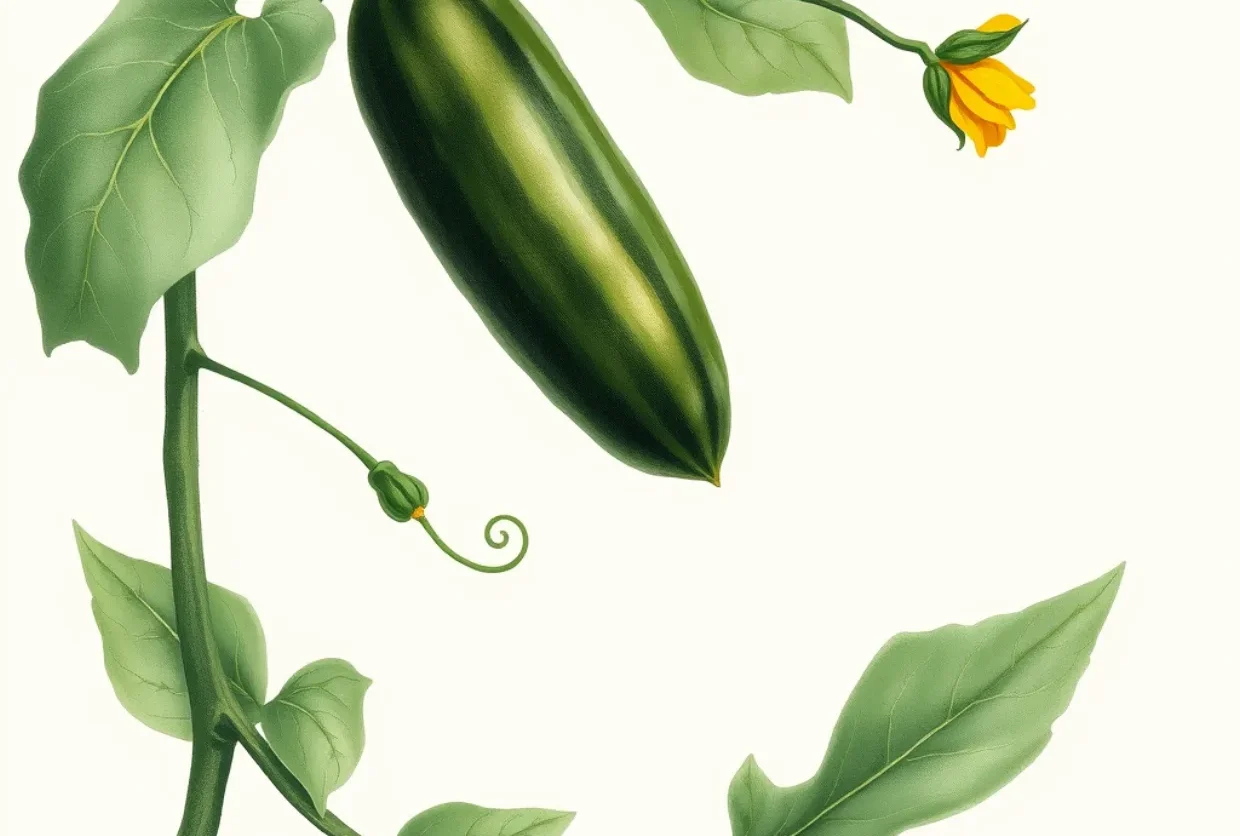
Eight to eighteen inches tall and three to eight feet wide. Read those together and the case for a trellis makes itself: air, fewer diseases, straighter fruit.
The record
Every plant in the database answers the same questions in the same order, so two entries can be read line for line. 12 of 15 fields sourced.
- Light
- Full sun
- Light detail
- 6 hours or more
- Water
- Moderate
- Water detail
- Consistent moisture, into the soil and not the leaves
- Soil
- High organic matter, rich, well drained
- Soil pH
- 6.0 to 8.0, slightly acidic preferred
- Mature size
- 8 to 18 in tall, 3 to 8 ft wide
- Toxicity
- NC State lists cucumber as non-toxic to cats, dogs and horses.
- Lifecycle
- Annual
- Difficulty
- Easy
- Sowing depth
- not recorded
- Sowing time
- Direct sow after the last frost into warm soil, or indoors 3 to 6 weeks before transplanting
- Spacing
- 12 in to 3 ft apart
- Days to harvest
- not recorded
- Hardiness zones
- not recorded
How wide one plant sprawls on the ground. On a trellis that becomes about eighteen inches, with better airflow, fewer fungal diseases and straighter fruit.
The year
Plant or divide. Everything else is leaving it alone.
Toxic to pets
NC State lists cucumber as non-toxic to cats, dogs and horses.
Grow it up, not along
A cucumber plant is 8 to 18 inches tall and 3 to 8 feet wide. Read those two numbers together and the whole problem is obvious: left on the ground it is a wide sprawling mat with fruit lying in the damp underneath it.
NC State’s recommendation is a trellis or a wire fence, and it gives three separate reasons: better air circulation, fewer diseases, and straighter fruit. All three matter, and the disease one matters most, because almost everything that goes wrong with cucumbers is a fungal problem that needs still, humid air and wet leaves.
Vertical growing also turns a plant that occupies eight feet of bed into one that occupies eighteen inches, which is why cucumbers are worth growing in a small garden at all.
Types of cucumber, and the bush or vining decision
Two independent choices sit behind every cucumber seed packet, and confusing them is why people end up with a plant that does not suit the space or a fruit that does not suit the kitchen. The first is the habit of the plant. The second is what the fruit is for.
| Choice | Options | What it decides |
|---|---|---|
| Habit | Vining: vigorous, needs a trellis, three to eight feet of growth | Yield per plant and the need for support. The section above is written for these |
| Habit | Bush: compact and upright, no trellis needed | The choice for containers, patio pots, window boxes and small beds. Lower total yield, far less space |
| Use | Slicing | Salad cucumbers, picked at 6 to 8 inches. The default supermarket shape |
| Use | Pickling | Shorter and blockier, picked at 2 to 3 inches for small pickles and up to 6 for larger. Boston Pickling is the classic vining heirloom |
| Use | Burpless, also sold as English or seedless | Long, thin-skinned and not prone to bitterness, so they can stay on the vine to 10 inches |
| Use | Lemon | Round, yellow and about the size of a lemon. Mild, and worth growing for the novelty and the thin skin rather than for yield |
The two choices combine freely, so a Burpless Bush Hybrid is exactly what the name says: a burpless cucumber on a bush plant, which is the combination for a pot on a patio.
Gynoecious and parthenocarpic, the two words on the packet
Seed catalogs use two terms that look like jargon and are actually purchase instructions.
- Gynoecious varieties produce almost entirely female flowers, and since every female flower is a potential fruit, they out-yield standard varieties substantially. The catch is that they need a pollen source. Seed packets normally include a few seeds of a standard monoecious variety for that purpose, often dyed a different color, and those seeds must be sown rather than discarded as contamination.
- Parthenocarpic varieties set fruit without pollination at all, which makes them the right choice under row cover, in a greenhouse or anywhere bees are unreliable. Diva is both gynoecious and parthenocarpic.
The pollination section further down explains why this matters in practice. If misshapen fruit is a recurring problem in your garden, a parthenocarpic variety removes the cause rather than managing it.
Site and soil
Full sun, six hours or more, in soil high in organic matter, moist, rich and well drained, at pH 6.0 to 8.0 with slightly acidic preferred.
Consistent moisture is the requirement people underestimate. A cucumber is mostly water and it is growing fast; a dry spell in the middle of fruiting gives you small, bitter, misshapen fruit that no amount of later watering corrects.
NC State adds the qualifier that decides how you water: keep the leaves dry. Water the soil, in the morning, not the foliage in the evening.
Consistent moisture has a number attached to it: one to two inches of water a week, and more than that in high heat or in a container, which dries far faster than open ground. The way it is delivered matters as much as the amount. A soaker hose or drip line at the base, run long enough to wet the soil deeply, does what an overhead sprinkler does not, which is to keep the leaves dry while the roots get a real soak. Mulch laid once the soil has warmed is what holds that moisture steady between waterings, and steadiness rather than volume is the whole objective.
Feeding is moderate rather than heavy, and the timing is specific. Work compost or aged manure into the bed before planting, then side-dress about a week after flowering begins and again roughly three weeks later if the plants look like they need it. A balanced or higher-potassium feed suits a fruiting crop; heavy nitrogen produces a large leafy vine carrying very little. A soil test before the season is the only way to know what the ground actually lacks, and without one the safer error is to underfeed.
One point that gets missed because it sits between the soil and the calendar: cucumbers will not do anything useful in cold ground. Germination stalls, seed rots rather than waiting, and transplants set out early sulk for weeks. Soil warmth is a requirement here in the same way sunlight is, not a preference.
Sowing
- Wait for warm soil
Direct sow after the last frost. Cucumbers need warm soil to germinate, and seed sown into cold ground rots rather than waits.
- Or start indoors 3 to 6 weeks ahead
Worth it in a short season. Sow into pots you can plant whole.
- Do not disturb the taproot
NC State flags this specifically. Cucumbers resent root disturbance, which is why transplants often sulk for a fortnight while direct-sown seed catches up.
- Space 12 inches to 3 feet
Closer on a trellis, wider on the ground. Crowding is what creates the still air the mildews want.
- Put the support in at sowing
Same rule as every climbing plant: adding it later means threading a tangled vine through a structure while breaking half of it.
Two details the step list above leaves out, because they are numbers rather than principles. Seed goes in about an inch deep, two seeds to a hole, and the weaker seedling is pinched off at soil level rather than pulled, so the survivor’s roots are not disturbed. The traditional alternative is a hill: two or three seeds sown together in a low mound, thinned to the strongest, with mounds spaced according to whether the plants will climb or sprawl.
Hold the mulch back until the soil has genuinely warmed, to around 75°F. Mulch applied early does the opposite of what is wanted here: it insulates cold soil and keeps it cold, on a crop whose first requirement is warmth.
Pollination, and misshapen fruit
Cucumbers carry male and female flowers separately on the same plant, and every fruit is the result of a bee moving between the two.
NC State’s note is that poor pollination may lead to misshapen fruit. A cucumber that is fat at one end and pinched at the other was incompletely pollinated: some ovules were fertilized and some were not.
That is worth knowing because the reflex is to blame water or feed. If the fruit is deformed rather than small, the cause is usually too few pollinators, which points at cool wet weather during flowering, or at insecticide use that removed the bees.
The first flush of flowers on a young plant is often all male and sets nothing. This alarms people every year and needs no action; the female flowers, recognizable by the tiny cucumber behind the petals, follow within a week or two.
Parthenocarpic and seedless varieties complicate this. Some need no pollination at all, and some, as NC State notes, still require conventionally-flowering plants nearby to set fruit. The variety description is the authority.
Pruning, and why bush types are exempt
Bush cucumbers do not need pruning at all. Vining ones benefit from it, and the job is smaller than the number of diagrams online suggests.
- Strip the leaves from the lowest six inches of vine once the plant is established and climbing. Those leaves sit closest to the soil, they are the first to be splashed and infected, and removing them opens the base of the plant to air. This is the single most useful cut on a cucumber and it is a disease measure rather than a yield one.
- Pinch out side shoots on the main stem as they appear, at least on the lower part of the plant, to keep a single strong leader running up the trellis rather than a tangle.
- Take off any leaf that is yellowing or mildewed as you see it, rather than waiting for a tidy-up. Cucumber foliage does not recover, and an infected leaf left in place is a source for the rest.
- Stop there. Cucumbers fruit on side shoots as well as the main stem, so heavy pruning of a vining plant costs yield. The goal is airflow at the base and a plant you can see into, not a bare stem.
Everything in that list works in the same direction as the trellis: dry leaves, moving air, nothing lying on soil. On a plant whose main enemies are downy mildew, powdery mildew and anthracnose, that is most of the disease program.
What to grow beside cucumbers
Cucumbers are climbers with shallow roots and a heavy demand for sun, and the useful companions are the ones that work around those facts rather than competing with them.
- Beans and peas fix nitrogen and climb the same structures, so they share a trellis without shading the cucumbers out if they are placed on the north side.
- Corn and sunflowers can act as living supports, an old practice that works provided the cucumbers go in after the corn has some height.
- Radishes and lettuce use the bed early and are out before the cucumbers spread, which is a timing partnership rather than a companion-planting claim.
- Flowering annuals such as nasturtium, alyssum, zinnia and marigold earn their place by bringing pollinators, and on a crop where every fruit depends on a bee visit that is a direct yield benefit rather than a vague one.
The one to keep apart is potato, which competes hard for water and shares disease pressure. As for the question of whether cucumbers and tomatoes can share a bed, they can. They are not related, they do not share the serious diseases, and the practical objections are about light and airflow rather than compatibility: both are tall, both want full sun, and planting them where one shades the other is the mistake. Give each its own support and put the taller on the north side.
Bitterness
Iowa State names the compounds: cucurbitacins B and C, which normally sit in the leaves, stems and roots and spread into the fruit when the plant is under stress. Hot dry conditions are usually responsible, along with wide temperature swings and poor nutrition.
They concentrate at the stem end and just under the skin, so a mildly bitter fruit can often be salvaged by cutting off the stem end and peeling the rest. The permanent fix is even moisture, which is the same instruction as everything else on this page: mulch, and water the soil regularly rather than heavily and occasionally.
Three other things push a plant toward bitterness and are worth ruling out before blaming the weather. Fruit left on the vine too long concentrates it, so a bitter cucumber is often simply an old one. Heavy nitrogen feeding, which produces fast soft growth, makes it worse rather than better. And some varieties are far more prone than others: the burpless and English types were bred specifically for low cucurbitacin content and stay mild even under stress, which is the reason to choose one if bitterness has been a recurring problem in your garden rather than a one-off in a hot summer.
Two things commonly blamed have nothing to do with it. Cucumbers do not turn bitter from being planted near melons or squash, because cross-pollination affects the seed rather than the flesh of this year’s fruit. And removing the blossom end makes no difference, since the cucurbitacins concentrate at the stem end.
What goes wrong
NC State lists cucumber beetles and other cucurbit pests, and downy mildew, powdery mildew, anthracnose and gummy stem blight among diseases, with white-tailed deer as the wildlife problem.
Cucumber beetles are the ones to take seriously, not because of the chewing but because they transmit bacterial wilt. A plant that wilts suddenly and completely in mid-season, without recovering overnight, is usually infected and cannot be saved.
The mildews are near-inevitable late in the season. Downy mildew shows as angular yellow patches bounded by leaf veins; powdery mildew as a white dusting on the upper surface. Both are slowed dramatically by a trellis, wide spacing and dry foliage, which is the argument for growing vertically restated once more.
Cucumber beetles, and the disease they carry
Two beetles share the name and they are not equally serious. The striped cucumber beetle is the one that matters, because it transmits bacterial wilt; the spotted cucumber beetle, also known as the southern corn rootworm, does the same chewing damage with far less consequence. Both rasp holes in leaves, flowers and fruit skin, but the chewing is rarely what kills a plant.
- Cover young plants with floating row cover from planting until the first flower buds appear. This is the single most effective measure, because young plants are both the most vulnerable and the most likely to be infected. The cover must come off once flowering starts, since every cucumber depends on a bee visit.
- Sow late. Plantings made after mid-June largely miss the beetle peak, and in a garden that has had wilt before, a later sowing is a more reliable fix than any spray.
- Handpick into soapy water where numbers are low. Beetles are sluggish early in the morning and this is genuinely practical on a few plants.
- Buy resistant varieties. Cucumber cultivars differ substantially in susceptibility, and choosing a resistant one costs nothing.
Bacterial wilt, which cannot be treated
Bacterial wilt is caused by Erwinia tracheiphila, which the beetles carry in their gut and introduce through feeding wounds. The bacteria multiply inside the vascular tissue and physically plug it, so the plant dies of thirst with wet soil around its roots.
The progression is recognizable once you have seen it. Leaves first turn a dull, flat green rather than yellowing, then individual lateral leaves wilt while the rest of the plant looks normal, then the wilt spreads down the vine and the whole plant collapses. A plant that wilts in afternoon heat and recovers overnight is short of water; a plant that wilts and stays wilted through a cool morning is almost certainly infected.
There is no treatment and no recovery. Pull the plant, take it out of the garden rather than composting it, and treat the loss as an argument for the beetle measures above next season, since preventing the insect is the only control there is for the disease.
Harvest
Pick young and pick often. A cucumber left to swell on the vine tells the plant its work is done, and production slows or stops. Every fruit removed pushes it to make another.
The size to pick at depends on the type, and this is where most of the disappointment comes from. Pickling cucumbers are at their best between 2 and 3 inches for small pickles and should not go past 6. Slicing types are picked at 6 to 8 inches. Burpless and English types can run to 10, because they are the group that does not turn bitter with size. Past those lengths the flesh coarsens, the seeds harden and the skin starts to yellow, and a yellowing cucumber is overripe rather than ripe.
Cut the stem with a knife or shears rather than pulling. A pulled fruit tears the vine, and cucumber stems are brittle enough that a hard tug takes a length of the plant with it.
On yield, a healthy vining plant in a good season produces roughly 8 to 10 pounds per 10 feet of row, which works out to a steady few fruit a week per plant across a six to eight week window rather than a single glut. Two plants is enough for most households eating them fresh; pickling in quantity is what justifies a row.
Cut rather than pull, because the stems are brittle and a tug takes the vine with the fruit. Fruit that has turned yellow or gone fat and seedy is past eating, and removing it is still worth doing to restart the plant.
Toxicity, in plain terms
NC State lists cucumber as non-toxic to cats, dogs and horses. It is one of the few entries in this database where a positive statement of safety exists rather than an absence of one.
Frequently asked questions
- Why are my cucumbers bitter?
- Cucurbitacins, produced under stress from heat, drought or uneven watering. The bitterness sits at the stem end and under the skin, so trimming and peeling rescues a mild case. Mulch and steady watering prevent it.
- Why are the fruit misshapen?
- Incomplete pollination. Male and female flowers are separate and a bee has to visit both; a fruit that is fat at one end and pinched at the other had only some of its ovules fertilized. Cool wet weather during flowering and insecticide use are the usual reasons.
- My plant has flowers but no fruit.
- Early flowers are typically all male and set nothing. Female flowers, which carry a tiny cucumber behind the petals, follow within a week or two. If female flowers form and then shrivel, the problem is pollination rather than the plant.
- How do I prune a cucumber plant?
- Bush types need no pruning. On vining types, strip the leaves from the lowest six inches of stem, pinch off low side shoots to keep one leader on the trellis, and remove yellowing or mildewed leaves as they appear. Do not go further, because cucumbers fruit on side shoots and hard pruning costs yield.
- When should I pick cucumbers?
- By type. Pickling at 2 to 3 inches, or up to 6 for larger pickles; slicing at 6 to 8 inches; burpless and English up to 10. Yellowing skin means overripe, not ripe. Cut the stem rather than pulling, and pick often, because a fruit left to swell shuts production down.
- How many cucumbers does one plant produce?
- Roughly 8 to 10 pounds per 10 feet of row for vining types in a good season, delivered as a few fruit a week over six to eight weeks rather than all at once. Two plants covers most households eating them fresh.
- Can I plant cucumbers and tomatoes together?
- Yes. They are unrelated and share no serious diseases. The real constraint is light: both are tall and both want full sun, so give each its own support and put the taller one on the north side so it does not shade the other.
- What is the difference between bush and vining cucumbers?
- Vining types run three to eight feet and need a trellis, and they yield more. Bush types are compact and upright, need no support, and suit containers and small beds at the cost of a smaller crop. The habit is independent of whether the fruit is a slicing, pickling or burpless type.
- Do cucumbers need a trellis?
- They do not need one, but NC State recommends it for better air circulation, fewer diseases and straighter fruit. Given that most cucumber failures are fungal, and that a ground-grown plant sprawls to eight feet, vertical growing is close to always the right choice.
- The whole plant wilted overnight. What happened?
- Most likely bacterial wilt, spread by cucumber beetles. A plant that wilts completely and does not recover overnight is usually infected and cannot be saved. Controlling the beetles early is the only real defense.
Companion plants
How this entry is compiled
- Care values come from university extension publications and the USDA hardiness map, never from other gardening sites.
- Toxicity follows the ASPCA listing and is quoted rather than summarized.
- A value we cannot source is printed as not recorded, never estimated.
Compiled and checked by the Gardnicks editorial desk · last checked 2026-08-16
Sources for this entry
- NC State Extension Gardener Plant Toolbox, Cucumis sativus
- Iowa State Extension, Growing Cucumbers in the Home Garden
- Iowa State Extension, Why are some of my cucumbers bitter?
Where two sources disagree, the entry follows the one closest to the plant’s own growing region and says so in the text.
What kills it
Three failures cover almost everything readers write in about.
More in Vegetables
 Beet
Full sun · zones not recorded
Beet
Full sun · zones not recorded
 Tomato
Full sun · zones not recorded
Tomato
Full sun · zones not recorded
 Garlic
Full sun · zones not recorded
Garlic
Full sun · zones not recorded
Plates are illustrations, not photographs of a specific plant, and are not evidence of a variety, place or season.