Hyacinth
Hyacinthus orientalis
Common hyacinth / Dutch hyacinth
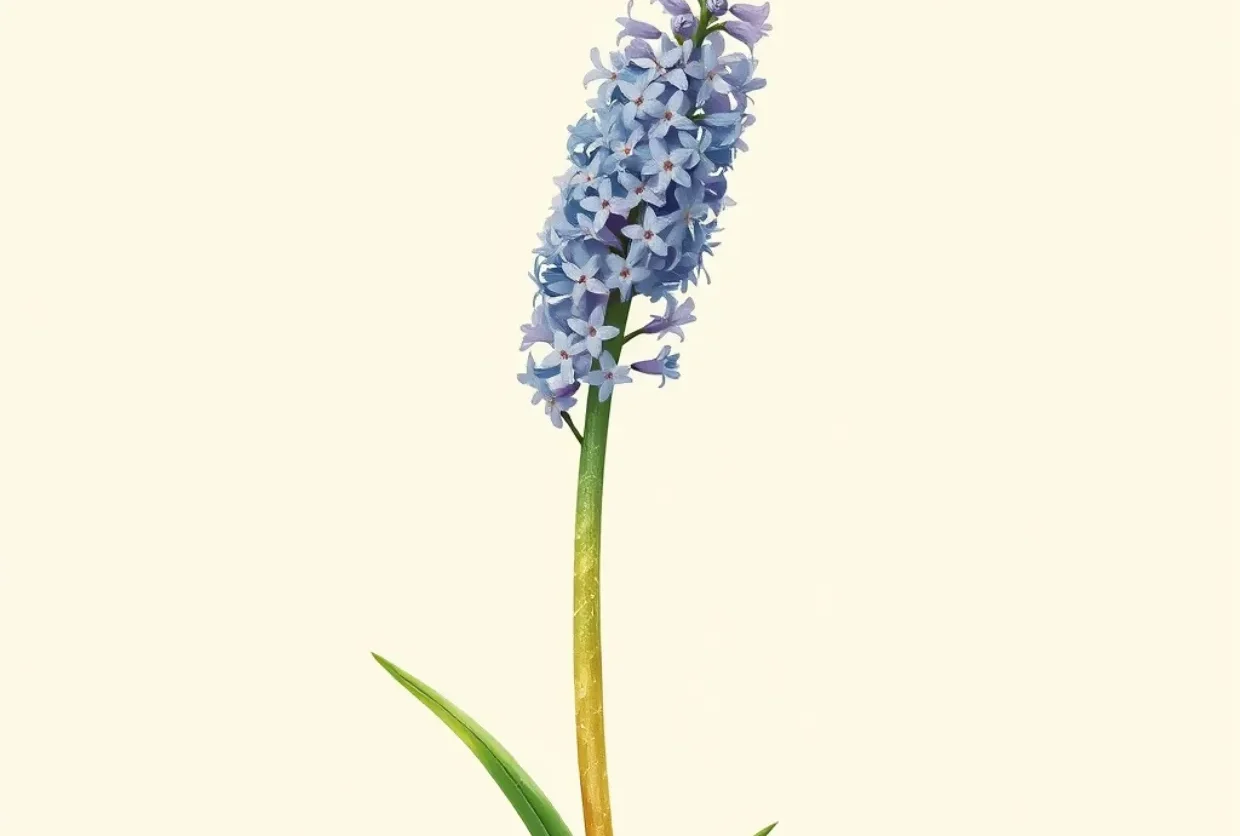
The first spring is the best one, and that is the plant rather than your soil. NC State records the flowers declining in size every year they are left outdoors.
The record
Every plant in the database answers the same questions in the same order, so two entries can be read line for line. 15 of 17 fields sourced.
- Light
- Full sun
- Light detail
- 6 hours or more; tolerates 2 to 6
- Water
- Moderate
- Water detail
- Medium moisture; rots in ground that stays wet
- Soil
- Organically rich loam or silt, well drained
- Soil pH
- Acid, neutral or alkaline
- Mature size
- 8 to 12 in tall, 3 to 6 in wide
- Toxicity
- NC State rates hyacinth medium severity: all parts are considered mildly toxic if ingested, with the highest concentration in the bulbs, causing stomach cramps, salivation, vomiting and diarrhea. Contact with the bulbs causes dermatitis, and repeated exposure can provoke asthma in sensitive people. The compounds are alkaloids such as lycorine.
- Lifecycle
- Perennial
- Difficulty
- Easy
- Hardiness zones
- 4 to 8
- Bloom time
- Mid spring, for 2 to 3 weeks
- Flower color
- Blue, purple, pink, white, yellow, orange or red
- Pollinators
- not recorded
- Deer resistant
- not recorded
- Spacing
- Under 12 in apart
- Native range
- Eurasia, the Mediterranean and southern Turkey
Hardy in zones 4 to 8. Colder than zone 4, grow it in a container and overwinter it under cover.
Planting depth, in autumn. Deep enough to anchor a flower spike heavy enough to fall over in the first spring shower.
The year
Plant or divide and prune, and when it is actually in flower. Everything else is leaving it alone.
Toxic to pets
NC State rates hyacinth medium severity: all parts are considered mildly toxic if ingested, with the highest concentration in the bulbs, causing stomach cramps, salivation, vomiting and diarrhea. Contact with the bulbs causes dermatitis, and repeated exposure can provoke asthma in sensitive people. The compounds are alkaloids such as lycorine.
The best year is the first one
A hyacinth’s first spring is a dense, heavy column of flowers on a short stem, so uniform it looks manufactured. The second spring is looser. The third is a few scattered bells on a thin stalk.
NC State states this outright: flowers decline in size and spacing yearly when hyacinths are grown outdoors as perennials. It is not a fault in your soil or your care. Those first-year spikes were produced in a Dutch field by growers who select and feed bulbs for exactly that effect, and no garden reproduces the conditions.
Knowing it in advance changes what you do. Either plant them where a loosening spike is welcome, which many people prefer to the stiff bedding look, or accept that a formal display is something you replant every few years. What does not work is trying to feed a declining hyacinth back to its first season.
So the plain answer to whether hyacinths are perennials is yes, botanically, and no, in the way most people mean it. The bulb is hardy from zone 4 through zone 8 and it will come back for years. What it will not do is come back the same, which is why they are so often treated as a two or three year planting rather than a permanent one.
Plants sold as hyacinth that are not hyacinths
Four completely unrelated plants carry the name, and only one of them is the bulb described on this page. It is worth knowing which is which before buying, because a bag labeled hyacinth bulbs and a bag labeled grape hyacinth bulbs sit side by side in the same fall display and grow into very different things.
| Sold as | Botanical name | What it actually is | How it is grown |
|---|---|---|---|
| Hyacinth | Hyacinthus orientalis | The heavy scented spring bulb this page is about | Planted in fall, flowers mid-spring, excellent in containers and for forcing |
| Grape hyacinth | Muscari armeniacum and relatives | A separate genus, not a true hyacinth. Small bulbs carrying tight cobalt-blue spikes that look like upside-down bunches of grapes | Planted in fall, hardy in zones 3 to 9, spreads on its own |
| Water hyacinth | Pontederia crassipes, formerly Eichhornia crassipes | A free-floating tropical pond plant with lavender flowers, unrelated to either of the above | Not a garden bulb at all. A federally listed noxious weed, illegal to possess in Florida and Texas among others |
| Hyacinth bean | Lablab purpureus | An annual climbing bean grown for purple flowers and glossy purple pods | Sown from seed in spring as an ornamental vine. The mature dried seeds are toxic raw |
Grape hyacinth is the one that actually competes for garden space with a true hyacinth, and it behaves almost oppositely. Where a hyacinth is a short-lived display bulb that gets weaker every year, grape hyacinth naturalizes: it multiplies by division and by seed, and in the right spot it will go on thickening into drifts for decades. Wisconsin Horticulture notes it can become invasive in some situations, which is the same trait read from the other side.
- Planting: fall, 3 to 4 inches deep and about 2 inches apart, in sun to part shade. Full sun gives the strongest plants, light shade makes the blooms last longer.
- Size: flower stalks of 4 to 8 inches, with 20 to 40 tightly packed florets each, so they only read properly when planted in masses rather than in a line.
- The autumn foliage surprise: unlike most spring bulbs, the leaves start growing again in mid-fall and persist through mild winters. Untidy grass-like foliage appearing in October is normal and is not a bulb that has been fooled by the weather.
- Where they work: rock gardens, the front of beds, along paths, in containers, and naturalized under trees and shrubs where the spreading habit is an asset rather than a nuisance.
Color, and what hyacinth blue actually means
The color is the other reason people reach for grape hyacinth. A true hyacinth sold as hyacinth blue is usually closer to violet or lavender; grape hyacinth is a genuinely saturated cobalt, with a thin white rim on each floret. Planting the two together is the standard trick for making a hyacinth read bluer than it is.
The species began as a pale blue or violet flower and now blooms across a wider range than almost any other spring bulb. Catalogs list lilac, pink, white, cream, primrose yellow, apricot, cobalt and a deep blood red, and some cultivars shift as they age: City of Haarlem, an heirloom in circulation since the late 1800s, opens soft yellow and matures to creamy white. If you want the flowering effect to hold together in a bed, buy one color in quantity rather than a mixed bag, because these are dense enough that a mixture reads as noise from any distance.
Where it goes
Zones 4a to 8b, 8 to 12 inches tall and 3 to 6 inches wide, in full sun or partial shade.
Soil wants to be organically rich loam or silt, well drained at medium moisture, and NC State records tolerance across acid, neutral and alkaline pH, which is unusually broad.
Drainage is the one point that matters, because bulb rot in poorly drained soil is the main disease listed. The other problems, bulb mites and narcissus bulb fly, are occasional.
Bloom is mid-spring, April into May, and lasts two to three weeks.
Planting
- Plant in autumn, once soil drops below 60°F
Bulbs go in while the ground is cooling but still workable. Too early and they can start into growth before winter.
- Four to six inches deep
Deep enough to anchor a heavy flower spike, which is the part of the plant most likely to keel over in a spring shower.
- Wear gloves
Hyacinth bulbs cause skin irritation in a lot of people. This is well documented and it is why growers handle them gloved.
- Space them under a foot apart
NC State gives less than 12 inches. Close planting is what makes the display read as a block rather than as scattered spikes.
- Leave the leaves after flowering
Cut the spent flower spike, leave the foliage until it yellows. That is next year’s flower being built, and it is already fighting the natural decline.
The scent, which is not a small detail
NC State describes the fragrance as pungently sweet, notes the flowers are marketed as natural deodorizers, and adds that the scent may be overwhelming.
That last clause is worth taking at face value. Three hyacinths in a pot in a small room is a lot, and some people find it genuinely unpleasant rather than charming. Outdoors it is close to perfect: strong enough to carry from a path, diffused enough not to dominate.
If you are forcing them indoors, one pot in a hall is usually the right dose, not a windowsill row in a bedroom.
Forcing them for winter flowers
Hyacinths are among the easiest bulbs to bring into flower indoors, and the process is entirely about giving them a fake winter first.
Spring bulbs need 12 to 16 weeks at 40 to 45°F to force properly, though hyacinths are more forgiving than most and can be cooled unplanted in a paper bag in the refrigerator for four to six weeks. Start in late summer or early autumn if you want flowers around midwinter.
One warning that catches people: do not store the bulbs in a fridge that also holds apples. Ripening fruit gives off ethylene, which kills the flower bud inside the bulb, and the result is a pot of leaves and no spike after four months of waiting.
Hyacinths also grow well in outdoor pots and containers, where the short heavy spike is at nose height and the scent is worth having by a door. The one thing container-grown bulbs need that garden ones do not is protection from winter wet: cover the pots or move them somewhere sheltered, because a bulb sitting in saturated potting mix through a cold January rots where the same bulb in open ground would not.
Forced bulbs are generally spent afterwards. They can be planted out in the garden, where they may recover over a season or two into a thinner but real garden hyacinth. They will not force a second time.
Toxicity, in plain terms
NC State rates hyacinth as medium severity, higher than most garden bulbs, and the wording is specific: all parts of the plant are considered mildly toxic if ingested, with the highest concentration in the bulbs. The compounds are alkaloids including lycorine.
Eaten, it causes stomach cramps, salivation, vomiting and diarrhea. Handled, it causes contact dermatitis, and in sensitive people repeated exposure can provoke asthma.
The practical risks are a dog digging up and chewing bulbs, which is worth a call to a vet, and bare hands planting a hundred of them, which is worth a pair of gloves.
Frequently asked questions
- Are hyacinths perennials?
- Yes, they are hardy perennial bulbs in zones 4 through 8 and they do return. But the flower spike gets smaller and looser every spring, so a planting that has to look formal is usually replaced every two or three years. Grape hyacinth, by contrast, is a true naturalizer and gets denser with age.
- Is grape hyacinth the same as a hyacinth?
- No. Grape hyacinth is Muscari, a different genus, and only the shape of the flower cluster connects them. It is smaller, hardier, deeper blue, spreads on its own, and its leaves reappear in autumn rather than staying underground until spring.
- How deep do grape hyacinth bulbs go?
- 3 to 4 inches deep and about 2 inches apart, planted in fall. That is shallower and much closer together than a true hyacinth, which wants 4 to 6 inches deep and up to a foot of space.
- Why were mine so much better the first year?
- Because that is how hyacinths behave. NC State notes the flowers decline in size and spacing every year when grown outdoors. The first-year spike was produced under commercial growing conditions; a garden cannot repeat it. Replant every few years if you want the formal look.
- Why do my hands itch after planting them?
- Hyacinth bulbs cause contact dermatitis, and it is common enough that extension guidance recommends gloves as standard. Repeated exposure can also trigger asthma in sensitive people.
- Can I replant the pot I bought at the supermarket?
- Yes. Let the leaves die back naturally, then plant the bulb out in autumn. It will be thinner than it was, but it usually settles into a real garden plant. It will not force again indoors.
- How long do they need in the fridge to force?
- Four to six weeks unplanted in a paper bag is enough for hyacinths, against the 12 to 16 weeks at 40 to 45°F that spring bulbs generally want. Keep them away from apples: ethylene from ripening fruit kills the flower bud inside the bulb.
- Are hyacinths poisonous to dogs?
- Yes, mildly, and more so than most spring bulbs. NC State rates them medium severity, with the toxin concentrated in the bulb, causing cramps, salivation, vomiting and diarrhea. A dog that has dug up and eaten bulbs is worth a vet call.
Companion plants
How this entry is compiled
- Care values come from university extension publications and the USDA hardiness map, never from other gardening sites.
- Toxicity follows the ASPCA listing and is quoted rather than summarized.
- A value we cannot source is printed as not recorded, never estimated.
Compiled and checked by the Gardnicks editorial desk · last checked 2026-08-16
Sources for this entry
- NC State Extension Gardener Plant Toolbox, Hyacinthus orientalis
- Wisconsin Horticulture, Forcing Bulbs
- Clemson HGIC, Spring-Flowering Bulbs
- Iowa State Extension, How to Force Spring-Flowering Bulbs Indoors
Where two sources disagree, the entry follows the one closest to the plant’s own growing region and says so in the text.
What kills it
Three failures cover almost everything readers write in about.
More in Flowers
 Lavender
Full sun · zones 5 to 9
Lavender
Full sun · zones 5 to 9
 Mums
Full sun · zones 5 to 9
Mums
Full sun · zones 5 to 9
 Dahlia
Full sun · zones 7 to 10
Alstroemeria
Full sun · zones 7 to 10
Dahlia
Full sun · zones 7 to 10
Alstroemeria
Full sun · zones 7 to 10
Plates are illustrations, not photographs of a specific plant, and are not evidence of a variety, place or season.