Tulip
Tulipa spp.
Garden tulip
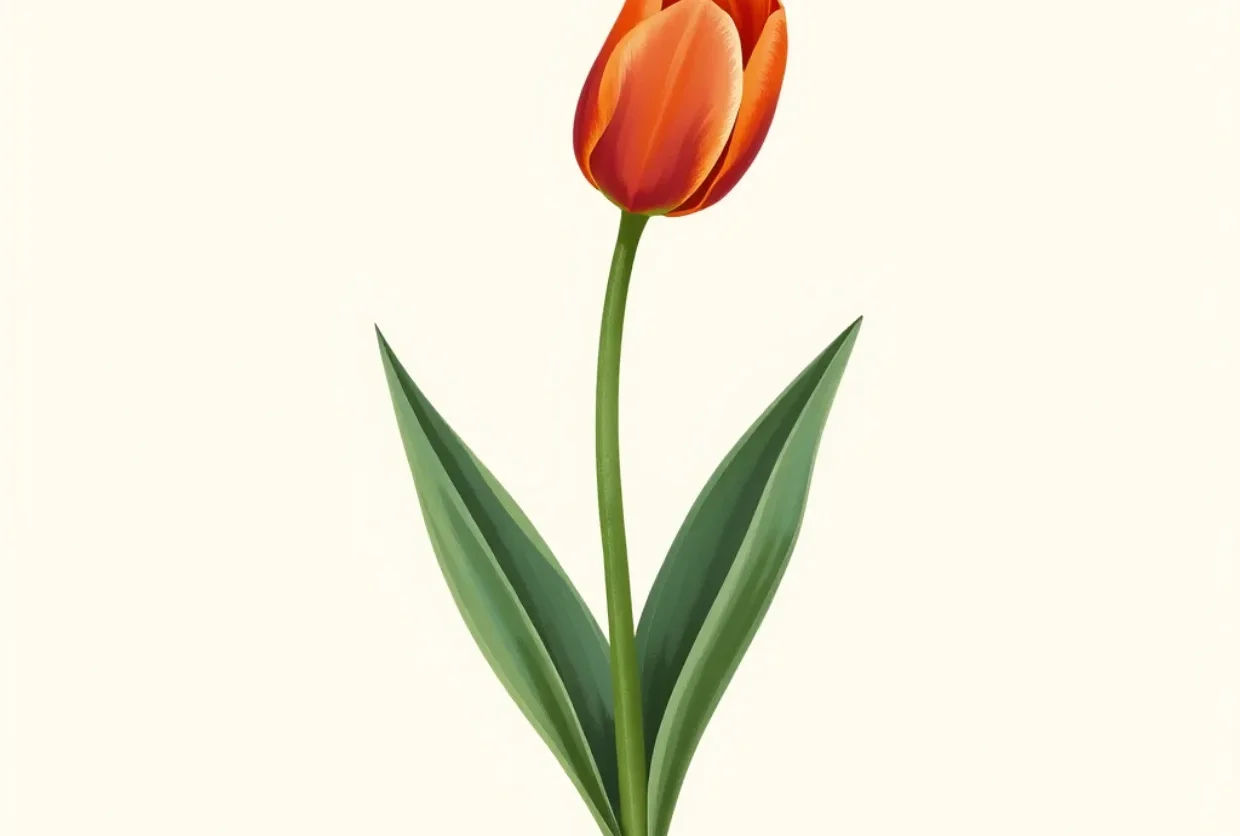
Most hybrid tulips are annuals sold as perennials: NC State records performance declining substantially from the second year. Species tulips are the ones that return.
The record
Every plant in the database answers the same questions in the same order, so two entries can be read line for line. 14 of 17 fields sourced.
- Light
- Full sun
- Light detail
- 6 hours or more
- Water
- Moderate
- Water detail
- Medium moisture; bulbs rot in ground that stays wet
- Soil
- High in organic matter, well drained
- Soil pH
- not recorded
- Mature size
- 4 in to 2 ft 4 in tall, 6 to 9 in wide
- Toxicity
- NC State rates tulip low severity, with the highest concentration of toxin in the bulbs. Ingestion can cause stomach pain, salivation, depression, diarrhea, sweating, nausea and vomiting, and handling can cause contact dermatitis.
- Lifecycle
- Perennial
- Difficulty
- Easy
- Hardiness zones
- 3 to 8
- Bloom time
- Mid to late spring
- Flower color
- Every color except true blue, including black and variegated
- Pollinators
- not recorded
- Deer resistant
- not recorded
- Spacing
- Under 12 in apart
- Native range
- Southern Europe to central Asia
Hardy in zones 3 to 8. Colder than zone 3, grow it in a container and overwinter it under cover.
Planting depth, as a multiple of the bulb. Three times the depth of the bulb you are holding, so a two-inch bulb goes six inches down. Shallow planting shortens the stems and the life.
The year
Plant or divide and prune, and when it is actually in flower. Everything else is leaving it alone.
Toxic to pets
NC State rates tulip low severity, with the highest concentration of toxin in the bulbs. Ingestion can cause stomach pain, salivation, depression, diarrhea, sweating, nausea and vomiting, and handling can cause contact dermatitis.
Most tulips are annuals that are sold as perennials
NC State says it without hedging: tulip performance declines substantially starting with the second year.
That single sentence explains the most common complaint about this plant. The first spring is a block of identical flowers on identical stems. The second is shorter, thinner and patchier. By the third there are leaves and almost nothing else.
Nothing has gone wrong. Modern hybrid tulips were bred for one perfect season in a Dutch production field, and no garden reproduces the feeding and lifting regime that produced it. NC State notes that many gardeners treat hybrids as annuals, which is a description of practice rather than a counsel of despair: buy them, enjoy the season, replant.
There is a real alternative and it is the part most people never hear. Species tulips, the small wild types, perform far better as perennials than the hybrids. They are shorter and less uniform, and they come back and multiply for years.
Among the hybrids the decline is not uniform either, and the division on the label predicts it. Darwin hybrids, Kaufmanniana, Fosteriana (long sold as Emperor tulips) and Greigii reflower with noticeably more certainty than the rest, which is why they are the ones worth leaving in the ground rather than lifting. Everything else is a display bought for one spring. So when the question is whether tulips multiply: species tulips do, by offsets and by seed, and the four groups above hold their own for several years. The Triumphs, Parrots and Double Lates that make up most of a garden center rack do not.
Types of tulips, and how the divisions set the bloom time
Tulips are sorted into fifteen official divisions, and the division is the most useful thing on a bulb label. It predicts three things at once: the shape of the flower, the week it opens, and whether the stem will hold that flower up in April weather. A bed planted from a single division flowers for about two weeks. A bed planted across the early, mid and late divisions flowers from late March into late May.
| Division | The flower | Bloom time | Worth knowing |
|---|---|---|---|
| Species, the botanical tulips | Small and short, closest to the wild plant | Early spring | The group that genuinely naturalizes and multiplies. Least uniform, longest lived |
| Kaufmanniana | Opens almost flat, faintly like a water lily; some have mottled leaves | Late March to early April | Among the most reliably perennial of all the hybrids |
| Single Early | Simple cup-shaped flowers on strong short stems | Late March to early April | Apricot Beauty is the standard. Good where wind is a problem |
| Double Early | Long-lasting double flowers on short stems | Early to mid April | Peony-like but low enough to escape the worst weather. A container favorite |
| Fosteriana, once sold as Emperor | Slim when closed, opening very wide in full sun, sometimes with dark markings | Early to mid spring | Reflowers more reliably than most hybrids |
| Greigii | Large bright flowers on low plants with marbled or striped leaves | Mid spring | Reliably perennial, and the foliage is a second feature. Red Riding Hood is the common one |
| Triumph | The classic tulip outline on tough, strong stems | April | The largest division and the best group for an exposed site |
| Darwin Hybrid | Tall, large goblet flowers on very strong wind-resistant stems | Mid to late spring | Reliably perennial. Apeldoorn is the reference cultivar |
| Single Late | Oval flowers on tall, strong stems | Late spring | Includes Queen of Night, the near-black purple. Not the same division as Darwin Hybrid despite the similar old names |
| Lily-flowered | Pointed petals that curve outward at the tips | Late spring | The most elegant outline in the genus. Ballerina is orange and scented |
| Fringed | Cup-shaped, with a crystalline frill along the petal edges | Late spring | Bought for texture rather than color |
| Viridiflora | Green streaks running up the outside of the petals | Late spring | Spring Green is the common one, and the division lasts longer in flower than most |
| Parrot | Twisted, fringed and feathered petals, often two-toned | Late spring | The heaviest heads in the genus. Needs shelter |
| Double Late, sold as peony tulips | Large many-petaled flowers with no visible center | Latest of all | Angelique is the peach-pink standard. Rain flattens them |
Buying across the table is the single change that makes the most difference to a tulip season, and it costs nothing extra. Three divisions bought in equal quantity, one early, one mid and one late, turn a two-week event into two months, and the fact that they never overlap means the bed is never crowded.
Peony tulips and parrot tulips
These are the two divisions people search for by name rather than by the official label, and both are worth understanding before buying because they share one weakness.
- Peony tulips are Double Late tulips. The flower carries so many petals that the center disappears entirely and the head reads as a peony rather than a tulip. They are the last division to open and among the longest lasting in flower.
- Parrot tulips are their own division. The petals are twisted, slashed and feathered, usually in two colors, and they open far wider than a normal tulip so a single flower can be five inches across.
The weakness is weight. Both carry a large head on a stem no stronger than any other tulip, and both flower in the part of spring when heavy rain is most likely. A soaked Double Late is on the ground by the following morning and does not stand up again. Plant them where a wall, hedge or house takes the weather off, or grow them in pots that can be moved, and keep the open ends of the garden for Triumphs and Darwin hybrids, which are bred for exactly that.
Where they go
Zones 3a to 8b, which is nearly the whole country, and 4 inches to a little over 2 feet tall depending on type, 6 to 9 inches wide, spaced under a foot apart.
Full sun, six hours or more, in soil high in organic matter, well drained and of medium moisture.
Wet ground is the one thing that kills them outright rather than disappointing them. A tulip bulb sitting in soil that stays saturated over winter rots, and no amount of feeding compensates. Where drainage is poor, the answer is a raised bed or a pot rather than a different variety.
Choosing and handling the bulbs
Tulip bulbs appear in shops from late summer but belong in the ground in fall, once the soil has cooled, which means almost everyone buys them several weeks before they can plant them. Keep them somewhere cool, dry and dark in the meantime. A bag left in a warm kitchen or a sealed plastic sack is the usual reason a bulb that looked fine in September is soft in November.
- Firm and heavy for its size. Softness anywhere on the bulb, and any sign of gray mold, means it goes in the bin rather than the ground.
- Torn skin does not matter. The papery brown coat often comes loose in the bag, and it has no effect on flowering. It is a cosmetic fault that gets confused with a real one.
- Bigger bulbs give bigger first-year flowers. Bulbs are graded by circumference, and growers sell the largest grades at a premium for a reason. Some tulip varieties naturally produce larger bulbs than others, so compare grades within a variety rather than across two different ones.
- Buy in quantity or do not bother. Tulips read as a block or as an accident. Twenty-five bulbs of one variety looks deliberate; five of five varieties does not.
The technique is the same wherever they go: pointed end up, at a depth of two to three times the height of the bulb, spaced at least twice the width of the bulb apart. Firm the soil down over them and water once.
Growing tulips in pots
A pot solves the two problems that spoil tulips in the ground. Drainage is under your control, which matters more here than anywhere else, since a container that cannot drain through a wet winter rots the bulbs outright. And the whole display can be moved into position the week it opens and moved out of sight when it goes over.
- Plant at the same depth and spacing as in open ground, then top the pot off with a layer of grit. The grit stops soil splashing up onto the flowers in rain and keeps weeds from growing in the surface.
- Greigii and Double Early tulips suit containers best, being short enough not to need staking, and Kaufmanniana is the other short division worth trying.
- Squirrels dig pots more readily than beds. Chicken wire pinned over the surface with tent pegs or landscape staples stops them, and it comes off as soon as the leaves push through.
- Pots are the one place where replanting is not a choice. Bulbs that have flowered in a container have nothing left for a second season, so plant fresh ones each fall.
Planting
- Plant in autumn, three times the depth of the bulb
NC State’s rule, and it scales with what you are holding: a two-inch bulb goes six inches down. Shallow planting produces short stems and worse repeat performance.
- Wait until the ground has cooled
Bulbs planted into warm soil can start into growth too early. Late autumn is safer than early autumn nearly everywhere.
- Plan for rodents
Squirrels and voles damage tulip bulbs, and this is a listed problem rather than local bad luck. Wire mesh over the planting, or pots, is what actually works.
- Group them close
Under twelve inches apart. Tulips read as a block or they read as an accident; there is no middle setting.
- Leave the foliage after flowering
Deadhead the flower so no energy goes into seed, then let the leaves yellow before removing them. It will not stop the decline in hybrids, but cutting green leaves accelerates it.
What to do after they flower
The six weeks after the last petal drops decide whether there is anything worth having next spring, and almost all of the work is leaving things alone. The leaves are still working at that point even though the display is over, and pulling them off early is the one mistake that turns an ordinary decline into a total one.
- Deadhead as soon as the flower goes over. Cut the stalk off just above the leaves so the plant does not spend the rest of the season building a seedhead. The exception is species tulips, which should be left to set seed, since seeding is exactly how they spread and naturalize.
- Leave the foliage for about six weeks. That is roughly how long the leaves need to move the season’s energy back down into the bulb. When they yellow and collapse of their own accord, they can be cut away.
- Feed while the leaves are still green. A potassium-rich liquid feed through that window supports the bulb that is being built underground. Stop feeding once the leaves start to yellow, because nothing is being taken up after that.
- Do not knot or fold the leaves. Tidying them into bundles is an old habit that cuts the light reaching them, which defeats the entire point of leaving them.
Lifting and storing, and whether it is worth it
Growers lift tulips every year, and it is the practice behind those perfect first-season flowers. For a garden the calculation is different, but it is worth knowing what the options actually are.
If you are going to lift, wait until the foliage has died back completely, then dig the bulbs, clean the soil off, discard anything soft, and store them somewhere dry and airy over summer until fall planting. Offsets, the small bulbs that form around the main one, come away at the same time. They can be stored and replanted in autumn about 8 inches deep, though a small offset takes three or four years to reach flowering size, so this is patience rather than a shortcut.
For most gardens the honest answer is that lifting hybrid tulips is more work than buying fresh bulbs and produces a worse result, which is why so many gardeners grow them as annuals and start again each fall. Lifting is worth the effort for two cases only: bulbs in a bed that has to be cleared for summer planting anyway, and species tulips, which are worth increasing because they actually improve with age.
Tulips as cut flowers
Tulips are among the few garden flowers that keep growing after they are cut, sometimes by an inch or more, which is why an arrangement that was right on Monday looks wrong on Wednesday. Cut them shorter than you think you need.
- Cut when the bud is showing color but has not opened. A fully open tulip cut from the garden has already spent most of its vase life.
- Leave some foliage on the plant. The flower is what you are taking; the leaves are what pays for next year, and stripping the stem bare costs the bulb its season.
- Recut the stems at an angle and change the water daily. A week is a realistic vase life.
- They are phototropic and lean hard toward the nearest window. Rotating the vase each day keeps the stems upright instead of curved.
Double Late and Parrot tulips are the two divisions most often grown for cutting, and doing so quietly solves their weight problem: a heavy head cut in bud opens indoors over several days, out of the rain that would otherwise have flattened it in the bed.
Color, and the one that does not exist
NC State’s list runs to black, cream, gold, orange, pink, purple, red, white and variegated, and states the exception directly: all colors except true blue.
That is worth knowing because blue tulips are advertised. What is being sold is a deep purple, and the photograph has usually been helped along. No breeder has produced a true blue tulip.
The variegated and flamed types have a stranger history. The famous broken tulips of the seventeenth century, the ones that drove the Dutch bulb mania, were streaked by tulip break virus. Modern flamed varieties are bred rather than infected, but the virus is still on NC State’s disease list along with mosaic virus and gray mold, and an unexpectedly streaked flower in a plain bed usually means an infected plant that should come out.
What goes wrong
Beyond the built-in decline, the problems are short: aphids, slugs, snails, bulb mites and narcissus bulb fly, plus rodents and squirrels on the bulbs, and gray mold in wet springs.
The complaint that is not a disease is a bed of leaves with no flowers in year two or three. That is the decline NC State describes, sometimes accelerated by planting too shallow or cutting foliage down while green.
Blind bulbs in the first year, on the other hand, usually mean the bulbs were small or dried out before they went in. Tulip bulbs should be firm and heavy; a light, papery one has already lost its season.
Toxicity, in plain terms
NC State rates tulip low severity, with the toxin concentrated in the bulbs. Ingestion can cause stomach pain, salivation, depression, diarrhea, sweating, nausea and vomiting, and handling can cause contact dermatitis.
The realistic risk is a dog that digs up and chews bulbs, which is worth a call to a vet, and sore hands after planting several hundred, which is worth gloves. Tulip fingers is a recognized complaint among people who handle them in quantity.
Frequently asked questions
- What are the main types of tulips?
- Fifteen official divisions. The ones on most garden racks are Single and Double Early, Triumph, Darwin Hybrid, Single Late, Lily-flowered, Fringed, Viridiflora, Parrot, Double Late (the peony tulips), the three species-derived groups Kaufmanniana, Fosteriana and Greigii, and the botanical species themselves. The division tells you the bloom week and the stem strength, which the variety name does not.
- What are peony tulips?
- Double Late tulips. So many petals that the center is hidden and the flower reads as a peony. They are the last division to open, they last well, and the heavy heads go flat in heavy rain unless they are sheltered or grown in pots.
- What is the difference between parrot tulips and normal tulips?
- Parrots are a division of their own, with twisted, fringed and feathered petals, usually two-toned, opening much wider than a standard tulip. They flower late and carry a lot of weight on an ordinary stem, so they want a sheltered spot.
- Do tulips multiply?
- Species tulips do, spreading by offsets and seed. Darwin hybrids, Kaufmanniana, Fosteriana and Greigii hold their own for several years. Most other hybrids decline from the second spring instead of increasing, which is why so many gardeners replant every autumn.
- Why do my tulips not come back?
- Because most modern hybrids are not built to. NC State states performance declines substantially from the second year, which is why many gardeners treat them as annuals and replant. Species tulips are the ones that genuinely perennialize.
- How deep do I plant them?
- Three times the depth of the bulb, in autumn once the ground has cooled. A two-inch bulb goes about six inches down. Too shallow gives shorter stems and a worse second year.
- Something dug up my bulbs. What was it?
- Squirrels or voles, both listed problems for tulips specifically. Wire mesh laid over the planting area, or planting in pots, is the reliable fix; repellents are not.
- Are there blue tulips?
- No. NC State lists every color except true blue. What is sold as blue is a deep purple, usually photographed generously.
- Are tulips poisonous to dogs?
- Mildly, with the toxin concentrated in the bulb. NC State lists stomach pain, salivation, diarrhea, nausea and vomiting on ingestion, and contact dermatitis from handling. A dog that has dug up and eaten bulbs is worth a vet call.
Companion plants
How this entry is compiled
- Care values come from university extension publications and the USDA hardiness map, never from other gardening sites.
- Toxicity follows the ASPCA listing and is quoted rather than summarized.
- A value we cannot source is printed as not recorded, never estimated.
Compiled and checked by the Gardnicks editorial desk · last checked 2026-08-16
Sources for this entry
- NC State Extension Gardener Plant Toolbox, Tulipa
- Clemson HGIC, Spring-Flowering Bulbs
- Iowa State Extension, Selecting and Planting Spring-Blooming Bulbs
Where two sources disagree, the entry follows the one closest to the plant’s own growing region and says so in the text.
What kills it
Three failures cover almost everything readers write in about.
More in Flowers
 Begonia
Part shade · zones 10 to 11
Begonia
Part shade · zones 10 to 11
 Vinca
Part shade · zones 4 to 9
Vinca
Part shade · zones 4 to 9
 Sunflower
Full sun · zones not recorded
Sunflower
Full sun · zones not recorded
Plates are illustrations, not photographs of a specific plant, and are not evidence of a variety, place or season.