Pomegranate
Punica granatum
Pomegranate tree
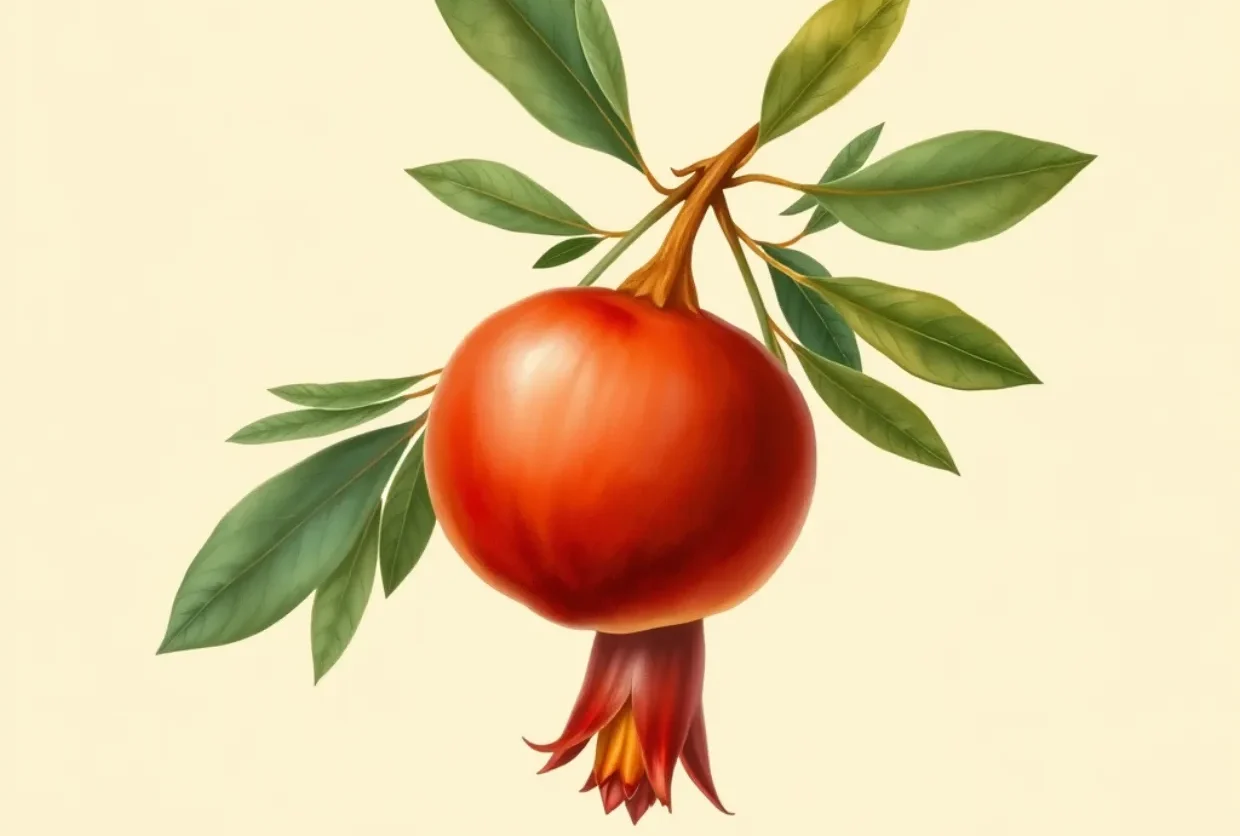
An easy ornamental shrub and an unreliable fruit tree, depending entirely on climate. NC State says it does not fruit dependably in humid regions.
The record
Every plant in the database answers the same questions in the same order, so two entries can be read line for line. 12 of 15 fields sourced.
- Light
- Full sun
- Light detail
- 6 hours or more; sun is what decides the fruit
- Water
- Low
- Water detail
- Drought tolerant once established; even water during ripening stops split fruit
- Soil
- Clay, loam or sand, well drained
- Soil pH
- Acidic, neutral or alkaline
- Mature size
- 10 to 12 ft tall, 8 to 10 ft wide
- Toxicity
- not recorded
- Lifecycle
- Shrub
- Difficulty
- Easy
- Hardiness zones
- 8 to 10
- Pollination partner
- not recorded
- Chill hours
- not recorded
- Harvest window
- Autumn; fruit 2 to 3.5 in across
- Growth rate
- Moderate
Hardy in zones 8 to 10. Colder than zone 8, grow it in a container and overwinter it under cover.
The coldest zone it takes in the ground. Colder than that it is a container plant: full sun outdoors all summer, then a cool bright room before hard frost.
The year
Plant or divide and prune. Everything else is leaving it alone.
It will grow almost anywhere warm. Fruiting is a separate question
Pomegranate is an easy, handsome, drought-tolerant shrub and a frequently disappointing fruit tree, and those two facts are not in conflict.
NC State is direct about the reason, and it is worth reading before buying: pomegranates do not fruit reliably in the Southeast, because of poor pollination and humidity. The plant is from northeast Turkey through to Afghanistan, and it evolved for a hot dry climate with a dry ripening season.
Put it somewhere with a humid summer and it grows well, flowers freely and sets little. Put it somewhere hot and dry and it fruits. That is a climate question rather than a care question, and no pruning or feeding schedule changes it.
So decide which plant you are buying. As a large ornamental shrub with brilliant orange-red flowers from early spring through autumn, it is excellent almost anywhere in zones 8 to 10. As a fruit crop, it depends entirely on where you live.
Where it grows
Hardy in zones 8a to 10b, reaching 10 to 12 feet tall and 8 to 10 feet wide at a medium growth rate, spaced 6 to 12 feet apart.
Full sun at six hours or more, or partial shade at two to six, though sun is what produces fruit. Soil is undemanding: clay, loam or sand, at acidic, neutral or alkaline pH, wanting good drainage and moisture.
That tolerance is unusual and real. The plant’s requirements are heat and drainage; almost everything else is negotiable.
Growing it in a pot
NC State recommends container growing in North Carolina, with plants brought indoors for the winter, and that approach extends the range considerably.
- Use a large container with real drainage
A plant that will reach ten feet in the ground stays much smaller in a pot, but it still needs root room and it will not tolerate standing water.
- Keep it in full sun through summer
Outdoors, in the hottest position available. This is where the fruit is decided.
- Bring it in before the first hard frost
A cool bright room rather than a warm one. It is deciduous and does not need much light while leafless.
- Water sparingly over winter
A dormant plant in a cool room needs very little, and this is where most container pomegranates are lost.
- Prune while dormant
Take out crossing and inward growth to keep the center open, and control the size. It flowers on new growth, so light annual pruning does not cost you the display.
Flowers and fruit
Flowering runs from early spring through to autumn, which is a remarkably long season, in orange-red trumpet-shaped flowers with crumpled petals.
The fruit ripens in autumn, 2 to 3.5 inches across with a thick rind, roughly the size of a large orange. Note that this is smaller than the fruit in a supermarket, which comes from commercial varieties grown in ideal dry-summer conditions.
One thing worth knowing before you plant one for its flowers: several of the most spectacular flowering cultivars are ornamental doubles that set little or no fruit. If fruit is the point, buy a fruiting variety by name rather than the one with the best flowers on the label.
When to harvest a pomegranate
One fact governs the whole question and it is the opposite of how most fruit works. A pomegranate does not ripen after it is picked. There is no way to bring one on indoors, so a fruit taken early stays exactly as sour as it was on the day it came off. The corollary is the practical instruction: leave it on the plant as long as you dare, because time on the tree is the only thing that improves it.
Fruit ripens six to seven months after flowering, depending on cultivar, which in California puts the harvest anywhere from August through November. Judge it on the fruit rather than the calendar.
- Color. Deep red or orange depending on the cultivar, and a fruit roughly the size of a softball on a commercial variety. On a garden plant in a humid region expect smaller, 2 to 3.5 inches across.
- The sound. The traditional test, and the one growers actually use: tap the fruit and listen for a metallic ting. A dull thud means it is not there yet. It takes a season or two of tapping to calibrate, which is why it is worth starting on fruit you are willing to open.
- Splitting is the deadline. A split fruit is past ripe and will spoil, so a plant that has begun splitting is telling you to pick the rest.
Clip, do not pull. Cut the fruit off close to the base so no stem is left sticking out, because a projecting stub punctures the next fruit in the basket. Once off the plant it stores and travels well, which is the compensation for not ripening further.
Splitting before harvest is the common frustration and it has a cause worth acting on: drought followed by rain or heavy irrigation. The rind cannot stretch to take a sudden uptake of water. Even moisture through the ripening period is the whole of the prevention, and excessive fall irrigation makes it worse rather than better.
What it looks like the rest of the year
Since this page recommends buying it as an ornamental in much of the country, the ornamental case deserves stating rather than assuming.
Punica granatum is a woody deciduous shrub or small tree, 10 to 12 feet tall and 8 to 10 feet wide, multi-stemmed, oval to rounded, at a medium growth rate. The leaves are lustrous dark green, 1 to 4 inches long, lanceolate to oblong, and unusually variable in arrangement: alternate, opposite or whorled on the same plant. They turn yellow-green in fall before dropping. The bark is smooth, light brown to light gray.
The flowers are the reason to grow it. Trumpet-shaped with fused, crumpled petals about an inch and a quarter across, clustered at the ends of the branches, and running from early summer through to fall in orange, red, pink, yellow or white depending on cultivar. Very few shrubs flower for that long.
The landscape uses NC State lists follow from all that: containers, patios, poolside and recreational spaces, and as a specimen, accent, hedge or border. It is named for children’s gardens, edible gardens, pollinator gardens, drought-tolerant plantings and Mediterranean schemes. On a hot dry site with poor soil, there are not many shrubs that do more.
What to expect, by climate
Everything on this page splits along one line, and setting the two cases side by side is the quickest way to know which set of expectations applies to you.
| Hot, dry summer | Humid summer | |
|---|---|---|
| Growth | Vigorous | Vigorous. The plant itself is not the problem |
| Flowering | Heavy, early spring into fall | Heavy, early spring into fall |
| Fruit set | Reliable | Poor. NC State attributes it to pollination and humidity |
| Fruit size | Softball size on commercial cultivars | 2 to 3.5 inches, smaller than supermarket fruit |
| Main diseases | Alternaria | Cercospora punicae and Botryosphaeria |
| Splitting | Follows drought then irrigation | Follows fall rain after a dry spell |
| What to buy it as | A fruit crop | An ornamental shrub that sometimes fruits |
The last row is the honest recommendation rather than a hedge. In a humid climate this is a first-rate flowering shrub, and treating an occasional crop as a bonus is the difference between a plant that pleases and one that disappoints every autumn.
The pomegranate plant: shrub, tree, or both
The plant is naturally a dense, deciduous, bushy, multi-stemmed shrub rather than a tree, and everything awkward about growing it follows from that. It is sold as a tree, trained as a tree, and spends its life trying to be a shrub again.
Two training approaches are used, and the choice affects the work for the plant’s whole life.
- Multiple trunks. Select three to six strong shoots coming directly from the ground and remove the rest. This is what UGA recommends for the Southeast, and it is the more forgiving system: if one trunk is lost to cold or damage the plant carries on. A triple-trunk system is the usual compromise.
- A single trunk. Tidier and easier to work under, but it fights the plant’s habit permanently and there is nothing in reserve if that trunk fails.
Either way, suckers from the base are constant and removing them is the recurring job. On a multi-trunk plant they are also the replacement stock: keep one when a trunk needs renewing, and take the rest off.
On timing, expect patience. A first small crop of late-maturing fruit comes in the third year, and the plant does not reach full production until the fifth or sixth. A young plant that flowers and sets nothing is usually just young.
Cold hardiness, in numbers
The zone rating of 8a to 10b understates what the plant survives, and the figures are worth having if you are on the margin. Most cultivars are hardy to about 12°F, and the hardier types come through 7°F without damage. Hard-seeded varieties are generally more cold-hardy than the soft-seeded ones.
The refinement matters more than the number: the plant is most vulnerable in fall and spring rather than in midwinter. A hard freeze on a dormant plant is far less damaging than an early frost on wood that has not hardened, or a late one on new growth. That is the argument against feeding late in the season, and for siting a marginal plant where it warms slowly in spring rather than in the first sun.
Varieties, and the Wonderful problem
Wonderful is the major California cultivar and the one nearly always sold, and it is worth knowing that UGA reports it performing very poorly in Georgia. That is the cultivar version of the regional point this page opens with: a variety selected in a dry-summer climate is not a neutral default elsewhere, and buying the familiar name is part of why so many humid-climate pomegranates disappoint.
The pathogens differ by region too. Georgia trials found Cercospora punicae and Botryosphaeria, and notably did not find the Alternaria that is a major California problem, which the drier conditions there make worse. Choosing on local trial results rather than on catalog reputation is the single most useful thing a buyer can do with this plant.
What goes wrong
NC State lists caterpillars, whiteflies, mealybugs and scale among insects, and leaf spot, fruit blotch and root rot among diseases.
Root rot is the one that kills, and it is a drainage problem rather than a watering-frequency problem. This is a plant that came from dry ground.
The most common complaint is not on that list: a healthy plant that flowers heavily and sets nothing, or sets fruit that drops early. In a humid climate that is the regional pollination problem NC State describes. In a young plant it is often just age, since pomegranates commonly take a few years to begin fruiting properly.
Split fruit after autumn rain is a separate and common frustration: the rind cannot stretch to accommodate a sudden uptake of water after a dry spell. Even watering through the ripening period reduces it.
Toxicity, in plain terms
NC State’s entry carries no toxicity listing for Punica granatum, and this page records that as not recorded rather than a confident no, because an absent listing is not a positive statement of safety.
The fruit is a food crop eaten by people worldwide. The rind, bark and root have a long history of medicinal use, and those are not parts anyone should be experimenting with.
Frequently asked questions
- Why does my pomegranate flower but never fruit?
- In humid regions that is expected. NC State states pomegranates do not fruit reliably in the Southeast because of poor pollination and humidity. Young plants also take a few years to begin, and several ornamental cultivars are bred for flowers and set almost nothing.
- How cold can it take?
- Zones 8a to 10b in the ground. Colder than that it can be grown in a large container, kept outdoors in full sun through summer and brought into a cool bright room before hard frost.
- Why did the fruit split?
- A sudden uptake of water after a dry spell, usually autumn rain during ripening. The rind cannot stretch fast enough. Watering evenly through the ripening period reduces it.
- What soil does it need?
- Almost any. NC State lists clay, loam and sand at acidic, neutral or alkaline pH. The requirements are good drainage and heat; root rot in wet ground is the main thing that kills it.
- How big does it get?
- 10 to 12 feet tall and 8 to 10 feet wide in the ground, at a medium growth rate, spaced 6 to 12 feet apart. Container plants stay considerably smaller.
How this entry is compiled
- Care values come from university extension publications and the USDA hardiness map, never from other gardening sites.
- Toxicity follows the ASPCA listing and is quoted rather than summarized.
- A value we cannot source is printed as not recorded, never estimated.
Compiled and checked by the Gardnicks editorial desk · last checked 2026-08-16
Sources for this entry
Where two sources disagree, the entry follows the one closest to the plant’s own growing region and says so in the text.
What kills it
Three failures cover almost everything readers write in about.